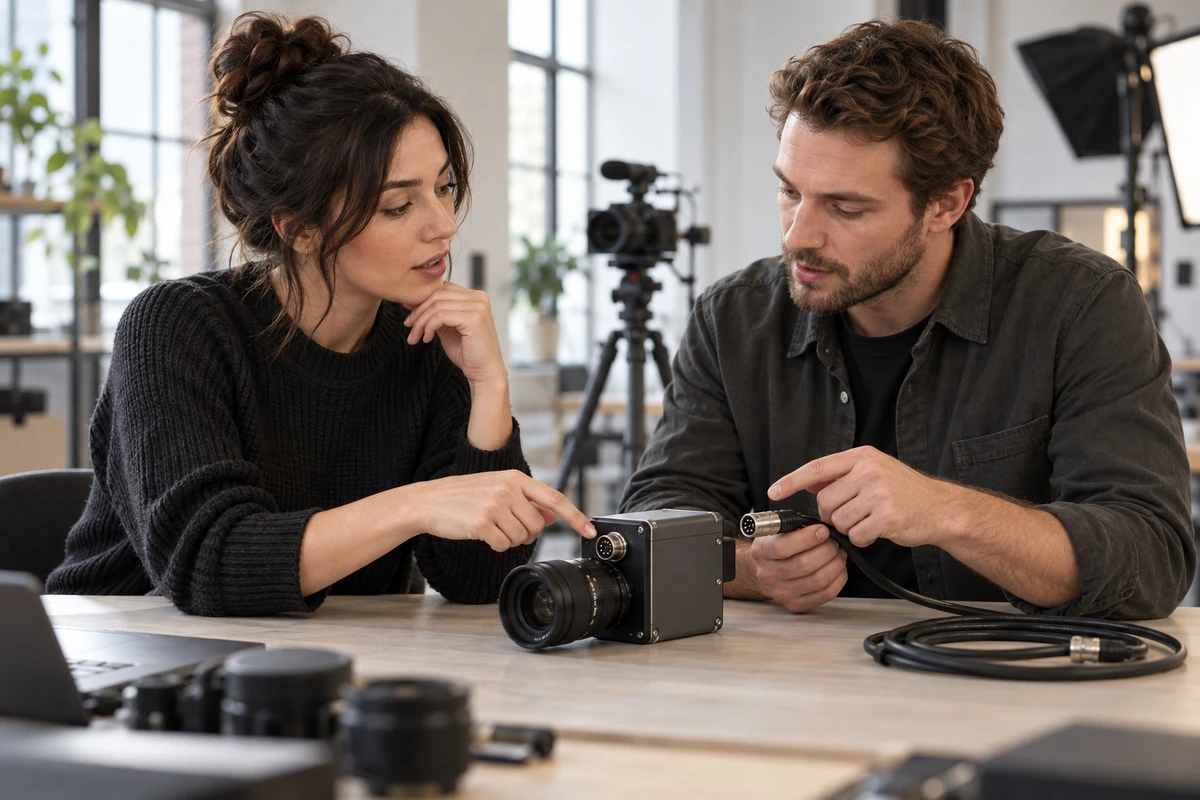
Imagine a marketing team selling industrial cameras sourced from China. It hires a polished English-speaking creator, receives an accurate feature video, and then hears from sales that prospects actually want to know what replacing an existing camera would involve. This hypothetical assignment has produced a usable presentation—but perhaps not the conversation buyers needed.
The commissioning question is not simply whether to use a creator. It is whether you need presentation, professional interpretation, access to an audience, or better product information first. For products whose suitability depends on installation or integration, ONCE proposes a small paid question-development assignment before committing to a recurring video series.
A current signal, with a limited conclusion
On October 14, 2026, BDB Group announced its acquisition of Creator Authority, combining specialist B2B expertise with the group's creative capabilities and Companion's creator intelligence. This is evidence of one company's expansion, not proof that every B2B brand should redirect its budget to influencers.
LinkedIn's partner directory entry describes Creator Authority as serving professional and B2B audiences. Its stated vetting factors include audience quality, industry alignment, content tone and brand safety. The listing does not establish the technical competence or likely sales impact of any particular creator.
The agency's own service description covers strategy, creator identification, creative production and measurement. For a buyer, the unresolved question is more specific: what will industry alignment contribute to this product's content? The method below is ONCE's proposed way to investigate that—not a method attributed to either company.
Separate a knowledge problem from a casting problem
A presenter supported by an application engineer may be entirely appropriate when the facts, operating sequence and buying rationale are already settled. You do not necessarily need to purchase a creator's distribution network to communicate approved information well.
A specialist creator becomes more relevant when the team needs help identifying how prospective users would challenge or compare the product. That requires more than a relevant job title. A technically experienced person may struggle to explain the issue to your intended audience; a compelling business commentator may not be equipped to discuss integration. Examine expertise, communication and audience access separately.
Then check the brand's readiness. If a creator asks about the conditions behind a performance statement and the manufacturer has only supplied a headline, the missing input is not necessarily better talent. Hiring someone willing to repeat the headline would remove friction from production without resolving the question.
The ONCE Buyer-Question Pilot
Commission a limited paid assignment, with agreed preparation, discussion time, written output and revision scope. It is not an unpaid pitch. Public posting, paid-media usage and rights to develop the entire concept further should not be assumed to come with it. Share only approved product material; do not send confidential customer lists, specifications or unreleased projects as routine briefing attachments.
Give the creator one target role, one buying situation and a current product information pack. Ask them to propose the questions most worth discussing, then hold a working session with the product owner. Agree a sensible scope for the product rather than demanding an arbitrary number of questions.
For each question, retain three short entries:
| Entry | What it records | What makes it useful |
|---|---|---|
| The buyer's decision | Who needs the answer, in which situation, and what choice it informs | The answer could change product selection, a trial plan or the next sales conversation |
| The missing input | A specific operating condition, demonstration, specification or technical confirmation | The team can identify the missing item and who should supply it |
| The publishable answer | What can be shown now, what remains uncertain and what qualification belongs with the explanation | Confirmed facts are kept distinct from interpretation and unfinished verification |
This is not product certification or an expert accreditation scheme. Accept the assignment on the quality of its questions and the clarity of the resulting content tasks. A well-explained reason to withhold a conclusion can be a useful deliverable.
How the pilot changes the production decision
Return to the hypothetical industrial camera. A creator asks whether the intended buyer is building a new line or replacing a camera already in use. If replacement is the priority, the film may need to address connections, mounting and system compatibility conditions—not simply repeat specifications. The manufacturer must substantiate model-specific answers; a creator's general experience cannot do that for it.
Three outcomes call for different purchases. If the creator turns the issue into a useful explanation and a feasible demonstration, commission a first co-created piece around that question. If the brand supplies the questions but the creator presents the answers exceptionally well, buy presentation or demonstration production, without dressing it up as an independent recommendation. If the product team cannot supply essential information, resolve that gap before public production.
That third outcome is not automatically a failed pilot. It may have identified why a persuasive film cannot yet be made. Keep the assignment limited, though: discovering a gap should not silently convert a small commission into open-ended consulting.
Price the contribution before measuring the campaign
Request separate scope lines for specialist preparation and discussion, filming and editing, publication and audience access, and agreed reuse. One partner can deliver all of them, but none should be treated as a free consequence of another. Include the brand's own product-team preparation and response time when comparing options. There is no defensible universal saving percentage to attach to this approach.
During the pilot, assess whether questions map to buying choices, missing inputs can be addressed, and the next piece has a clear brief. After publication, examine whether the intended audience raises more specific questions, enters relevant product discussions or progresses to the sales stage you defined. Views alone do not answer those questions; a change in sales does not by itself prove the pilot caused it.
For teams coordinating with a Chinese manufacturer, make the technical respondent and the language of the approved answer explicit before filming. A translated summary should preserve limitations, not turn a conditional answer into an unconditional claim. The question record can then become a practical input to ONCE's video production planning: what the creator contributes, what the manufacturer confirms and what the production crew must actually show.
For a production partner, the potential long-term asset is a permissioned, maintained understanding of category questions and ways to explain them—not merely a list of people who can appear on camera. Whether clients will pay for that ongoing service remains a commercial hypothesis, not a valuation conclusion established by the acquisition.
The feature video in the opening may not need a new presenter. It may need the replacement question answered first. Commissioning more finished videos will not automatically supply that missing question.
Source and scope notes
Sources above were checked on October 15, 2026: BDB Group's October 14 acquisition announcement, LinkedIn's Creator Authority partner entry, and Creator Authority's public service description. No claims about campaign returns, acquisition price or industry-wide adoption are inferred from them. The industrial-camera example is hypothetical. The cover is an AI-generated concept image, not a client production photograph.