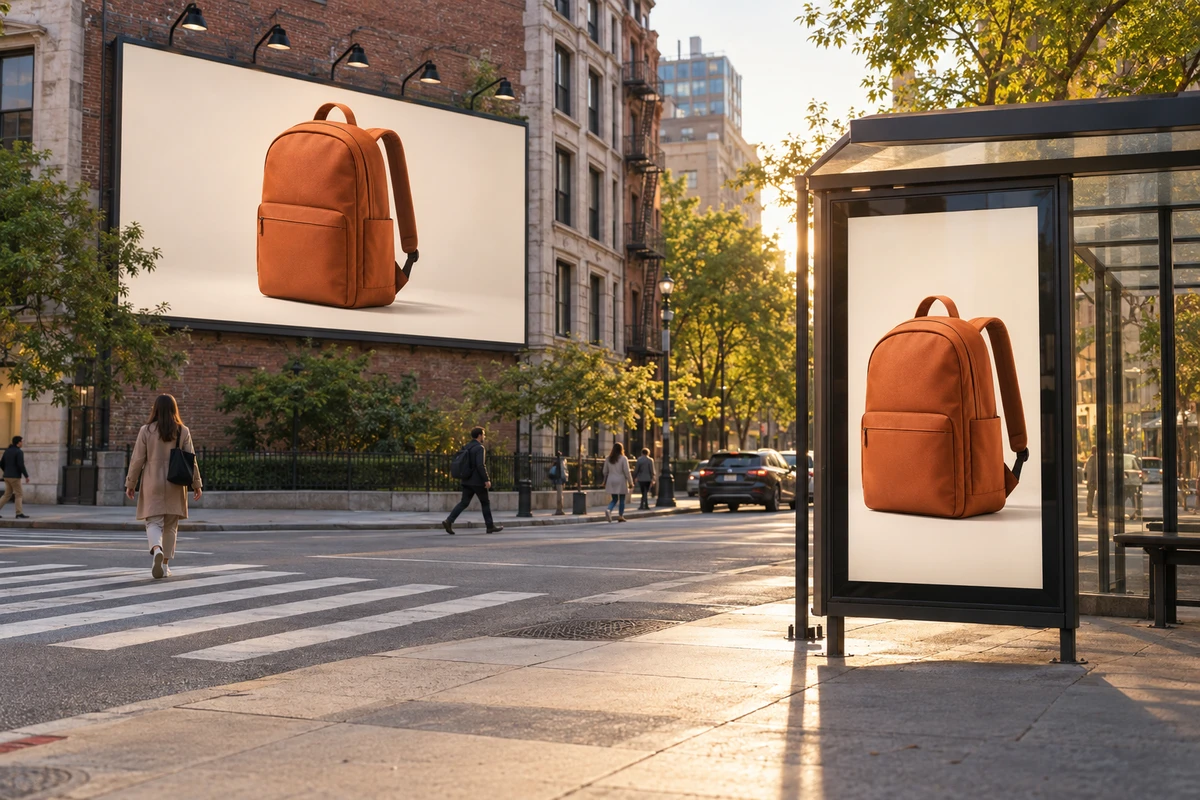
Imagine commissioning a commuter-backpack campaign for two cities. Your production quote offers two local concepts, eight sizes and two animated versions. The quantities are clear. The reason for each version is not.
For an international brand producing product assets with a team in China, that distinction matters. A different canvas may need a layout adaptation. A different buying situation may need new copy or a demonstration. A distant billboard and a close pedestrian placement can need different compositions even when they share a postcode.
ONCE proposes a more useful unit for the brief: one buying situation combined with one viewing condition. Group placements where those conditions genuinely match. Commission new work where they do not. The objective is neither a separate shoot for every city nor a universal master forced into every location.
What the UGG campaign makes concrete
In its October 7, 2026 project announcement, Jellyfish describes localized copy, design, retouching and location-specific treatments derived from UGG’s global fall campaign. The account discusses neighborhood and subway contexts in New York, and Sunset Strip and street-poster executions in Los Angeles.
The UGG announcement on Deckers’ investor site gives an outdoor campaign window of September 21–October 25, 2026, spanning formats including subway placements, murals, posters, digital shelters and a traditional billboard. This is an announced campaign schedule, not independently checked proof of delivery at every location.
These sources document a project’s approach. They do not establish a sales uplift from localization, disclose production costs suitable for benchmarking, or prove an industry-wide transition. The practical distinction is between adapting the local idea and adapting its physical presentation. Those are separate production tasks, even within one language and country.
A media specification is not yet a creative brief
Before the production team agrees the version count, request the unit’s location, orientation, approximate viewing distance, approach path and likely opportunity to stop. Obtain the actual static or digital delivery requirements from the media owner. For screens, confirm duration, motion, sound and file restrictions instead of assuming one rule applies to all outdoor inventory.
A photograph and a walk-through can reveal issues that a dimensions spreadsheet cannot: the panel faces sideways to the main flow; a clear sightline is brief; nearby objects obstruct part of the view. Waiting near a screen does not guarantee watching an entire ad. Until the real placement information is available, label work as a concept rather than as a location-ready execution.
OAAA’s public OOH Mockup Generator introduction describes environmental previews at different distances. Using the tool requires an active account; we did not use it for this article. The useful principle is to review creative in context rather than only as a full-screen design. A mockup remains a simulation, not a visibility guarantee, an attention study or a substitute for checking the delivered placement.
The ONCE City–Placement Adaptation Brief
For each proposed group of reusable assets, record three things: the brand promise that stays fixed, the locally relevant reason to care, and the expression the placement can support. Then identify what is actually changing.
| Confirmed difference | Work to commission first | Work not automatically justified |
|---|---|---|
| Same buying reason and viewing conditions; different canvas | Recomposition, crop, copy and identity placement, format checks | A new shoot for every city |
| Same buying reason; different distance, entry point or stopping opportunity | Revised hierarchy, motion timing and static key image | A mechanically shortened commercial |
| A genuinely different use action or buying reason | New copy and scene design; additional capture where needed | Decorative landmarks without a product role |
This is ONCE’s proposed method, not a published internal process at UGG or Jellyfish. More than one row can apply. A new local scene may also need a simpler distant-view composition. Name both changes so that substantive creative work is not buried inside a “resize” fee.
Applying it to the fictional backpack
Do not start with an unsupported statement about what an entire city likes. Ask which audience this particular buy intends to reach: people walking between transit connections, or people moving from a parking space to an office, for example. These are hypothetical situations to validate with the local team, not claims about the populations of New York or Los Angeles.
If both audiences need to understand everyday storage, a clean product view, material detail and packing demonstration may be shared. But footage of a bag in a car trunk cannot necessarily explain access while moving through a transit entrance. Confirm the real product operation before commissioning a new action or designing a different scene. A replacement background cannot repair an inappropriate action.
Within one city, a distant billboard might use a recognizable product silhouette and a single buying reason. A placement where pedestrians can approach and stop may support an additional detail or next step. These are choices for the hypothetical buy, not universal word-count rules or a claim that waiting audiences read everything.
For a moving execution, preview entry at several moments in the sequence. Can someone arriving halfway through still identify the product and proposition? If the answer appears only on the final frame, redistribute the information. Do not make the audience responsible for watching a complete narrative from its beginning.
Price the shared work and the new decisions separately
A comparable quote can distinguish five components: core brand and product assets, local concept adaptation, placement execution, additional capture or reconstruction, and final delivery checks. Each should specify inputs, outputs and approval responsibility.
Shared product photography should not silently become a fresh shoot charge for each city. Equally, reusing a layout should not eliminate the checks required for each placement. Where the media buy is unresolved, commission concepts and a defined adaptation allowance first, with a clear method for pricing later changes.
This is a scope model, not a claim about market prices or guaranteed savings. It lets a buyer see whether they are paying for image capture, creative judgment or file production. The number of files alone does not measure the amount of work.
When production takes place in Shenzhen, the overseas brand team should provide the local-context decisions and approved media brief early enough to influence the shot list. The China-based team can then plan clean product assets, useful framing options and the necessary actions within the production. Explore ONCE’s production solutions when scoping that shared capture; assign media buying, local creative approval and production delivery to named owners rather than assuming one supplier covers all three.
AI-generated environments can help a team discuss visual direction. They are not a substitute for actual placement photographs or evidence that a depicted routine is locally credible. Their usefulness depends on the decision being made, not merely on how convincing the image looks.
Give the next campaign something better than “final overseas version”
Attach a short usage record to each approved execution: product version, audience or city assumption, suitable placements, media specifications used, approval date and conditions that would trigger a fresh check. That makes reuse a decision rather than a filename search.
Review in two stages. The local team first checks whether the idea makes sense. Production and media teams then check its presentation against the intended environment and delivery requirements. If audience research is needed, design it separately; agreement among colleagues is not market validation.
For ONCE, maintaining these records alongside reusable assets is a proposed route from isolated deliveries toward ongoing content support. It is not a claim that a global production network already exists or that a particular margin improvement has been demonstrated.
Return to the backpack quote. Instead of asking only what two cities cost, ask which decisions are shared, which viewing conditions differ and which new actions actually need to be filmed. Those answers give the version count a purpose.
Source scope: Jellyfish’s dated project account, Deckers/UGG’s September 2026 campaign announcement and OAAA’s undated public tool introduction were checked on October 15, 2026. No UGG placement was inspected in person and no campaign outcome was verified. The backpack is a fictional planning example. The original AI-generated cover depicts a concept street scene, not the UGG campaign or an ONCE client project.