Imagine a home beauty device that needs twelve short videos every month for TikTok, Reels, product pages and seasonal promotions. A common mistake is to treat “twelve” as twelve scripts built from scratch. The talent repeatedly picks up the same device, the camera repeats the same demonstration, and this month’s price and offer are spoken into footage that was supposed to last. When the offer changes, accurate product shots expire with it.
A more durable system separates three layers: product facts that must be captured from the real sample, creative expression that changes through direction and performance, and commercial information that belongs in post-production or a platform data layer. One shoot can still produce genuinely different ideas without locking a short-lived offer into long-lived product footage.
The beauty device, communication task and twelve-video matrix below are hypothetical. They are not an ONCE client project and do not imply unapproved beauty-performance claims.
Why a price change should not force a product reshoot
A promotional short normally has three jobs: earn attention, make the product understandable, and explain why someone might act now. Those jobs have different shelf lives.
- Product-fact layer: appearance, accessories, grip, power-on sequence, mode selection, approved use, cleaning and storage. These should be captured with the real sample and usually remain useful the longest.
- Creative-expression layer: whether the performer opens with a problem or an action, looks into camera or concentrates on the device, appears at a vanity or packs for a trip, and performs with polished or natural timing. This layer needs filming, but it can vary around the same product facts.
- Commercial layer: price, code, gift, campaign dates, eligible market, availability and the next action. These change quickly and usually work better as captions, graphics, a replaceable voice line, an end card or catalogue data.
TikTok’s current Dynamic Video documentation describes a Price Sticker that can retrieve a product’s Price or Sale Price from a catalogue. It is not the right tool for every campaign, but it illustrates a sound production principle: frequently changing commercial information should connect to an editable layout or data source instead of being burnt into a reusable product master. TikTok Dynamic Video Packages
The US Federal Trade Commission also requires price, discount and “free” claims to be truthful, considering words, pictures and the overall context of an ad. An editable offer layer is not an ungoverned layer. Every market, currency, eligibility condition and date still needs an owner and approval. FTC Advertising FAQs
What must be captured from the real beauty device
The product master does not need to make every shot long. It needs to preserve facts that captions cannot manufacture. Assume the brand has approved the body and contact surface, charging and power-on sequence, three mode indicators, the correct movement along the face, and cleaning after use. Four groups of clean footage should be retained.
1. Product identity and structure
Show the front, side, contact surface, controls, indicators, accessories and package contents. If colour, structure or labels do not match the production model, post-production should not “finish” the sample. A cosmetic sample may be suitable for non-functional shots, but its limitation belongs in the file record.
2. One complete operation chain
Keep at least one continuous action from picking up the device through powering on, choosing a mode, making approved contact, moving and powering down. The ad may cut quickly; the master should not consist only of close-ups whose order cannot be checked.
3. Observable feedback
Capture only feedback the brand can approve: a mode indicator, a display state, real vibration or an actual device sound. Lighting effects, skin retouching or a performer’s reaction should not imply an unsupported immediate beauty outcome.
4. Clean endings that remain editable
Film the device at rest, the talent putting it down, a look to camera, and frames with deliberate negative space. Keep price, codes, dates and platform UI out of these shots, with one or two seconds of handles around the action for captions and end cards.
Twelve outputs are not one edit cropped twelve ways
The matrix below creates six creative cores with meaningful differences, then gives each an evergreen and a promotional ending. This makes it possible to compare opening and buyer question without treating a new price as a new creative insight.
| Buyer question | Opening A: problem first | Opening B: action first | Ending 0: evergreen | Ending 1: promotional |
|---|---|---|---|---|
| How should it be used? | Talent addresses one common handling mistake, then demonstrates the approved movement | Begin on the complete movement path, then explain the sequence | Continue to the full usage guide | Current offer, dates and eligibility |
| How is it different from a simple massage tool? | Lead with the contact surface, controls and grip | Complete power-on, mode selection and operation before returning to structure | Explore modes and accessories | Current bundle or gift information |
| Where does it fit in a routine? | Enter through one evening-vanity task | Take the device from a travel pouch and complete a short approved action | View the product details | Market- and currency-specific action |
Three questions multiplied by two openings creates six creative cores. Each then receives an evergreen and a promotional ending, creating twelve deliverables. Price, discount, gift or market changes do not automatically create a new idea. Reporting should separate the performance of six creative cores from the performance of two commercial endings.
The matrix is not appropriate when the correct handling, core benefit or public claim is still undecided. In that situation, two or three prototypes are more valuable than batch production that repeats an unresolved problem twelve times.
Shoot by production state, not final-video number
Filming finished video 01, then 02, then 03 forces the team to repeat product cleaning, lighting, talent positions and props. A more efficient order finishes the shots with the most shared conditions first.
- Clean product masters: identity, construction, accessories, power-on, mode feedback and clean endings, with no promotion attached.
- Complete operation chain: keep product state and lighting fixed while the performer completes the approved movement; record real buttons, indicators and contact sound separately.
- Six opening pickups: change dialogue, eye line and pauses for problem-first openings; change hand distance, entry point and sound emphasis for action-first openings.
- Two use contexts: the vanity and travel setup should add real information rather than duplicate every product close-up.
- Safe frames and endings: preserve space for vertical captions, interface controls and calls to action of different lengths.
TikTok’s official guidance notes that the safe zone depends on dimensions, caption length and additional formats, and recommends previewing the result before publication. On a 9:16 shoot, the product may look good in the centre of the monitor while a hand, contact surface, mode indicator or key caption is later covered by the interface. TikTok Video Ad Specifications
Every action should include a visible before and after. When a mode indicator changes from level one to level two, retain the state before the press, the press itself and the settled state afterwards. A glowing close-up on its own cannot confirm that it belongs to the same operation.
Deliver clean masters as well as promotional exports
A system designed for monthly updates contains more than twelve final files. At minimum, retain five asset classes:
- SRC: camera originals, never overwritten by a renamed export;
- SEL: director and brand-approved takes;
- CLN: clean masters without price, offer, platform UI or time-sensitive spoken copy;
- OVR: market-, currency- and campaign-specific overlay or voice layers;
- EXP: publication exports; expired versions become RET and remain in the record without remaining in circulation.
A practical filename might be:
BD01_USE_H1_O1_TT_916_EN_r03_20261011
The fields identify product, buyer question, hook, offer layer, platform, aspect ratio, language, revision and date. A team may choose different codes, but field order should not change every month. Each export should point back to the CLN master, offer copy and publication approval used to create it.
An offer register should record market, currency, list price, promotional price, eligibility, gift, start and end time, landing page, copy owner and approval time. Do not overwrite an old export with a new file. When a campaign ends, mark the asset RETIRED and stop it in both the library and the release schedule.
Structured metadata is what makes this practical at scale. Adobe’s current Experience Manager documentation describes metadata schemas as a way to organise, manage and retrieve assets consistently; the production team still needs to choose fields that match its actual release decisions. Adobe Experience Manager metadata
When post-production is enough, and when filming must return
| What changed | Post-production may be enough | Reshoot or renewed approval is usually needed |
|---|---|---|
| Price, code or dates | Replace OVR and EXP, then reapprove | Re-record any spoken price or physical offer card |
| Currency, language or market CTA | Replace caption, voice or end card | Reshoot when local handling, packaging or required wording differs |
| Packaging | No change when it never appeared and product identity is unaffected | Reshoot when package, accessory count or labels appear as product facts |
| Feature sequence or interface | Captions cannot correct the underlying action | Reshoot when steps, indicators, UI or visible result changed |
| Beauty-performance claim | Replace only approved wording that does not conflict with the image | Re-evaluate evidence and footage when a new claim changes what the image implies |
| Aspect ratio | Reframe when the clean master has sufficient resolution and safe space | Film again when a key action is cropped or a platform-native opening needs a new performance |
The decision is simple: if the change affects how the product is sold today, update the commercial layer first. If it changes what the product is, how it is used, or what the footage can support, return to the product-fact layer. Generative AI may help with non-functional background exploration, layouts or concept testing, but it should not invent device feedback, skin changes or use outcomes in place of live-action evidence.
A one-page layered brief to complete before the shoot
| Field | Project entry |
|---|---|
| Product model, production status and approved markets | |
| Structures, steps and observable feedback that must be filmed | |
| Outcomes or claims the film must not imply | |
| Three buyer questions | |
| Differences in dialogue, eye line, action and sound for two openings | |
| Next step in the evergreen ending | |
| Market, currency, terms and validity of the offer layer | |
| Safe zones and preview owner for 9:16, 1:1 and 16:9 | |
| CLN, OVR, EXP and RET naming rules | |
| Approvers for product facts, offer information and publication |
Durable batch production does not try to make twelve videos look unrelated. It gives every difference a job: product facts remain reusable, openings can be compared, commercial information can change promptly, and an expired price stops travelling through the asset library.
If you are planning monthly promotional shorts for a beauty device, personal-care appliance or consumer-tech product, use the ONCE ecommerce product video service to share the product link, target markets, channels, approved claims, sample status, update rhythm, launch timing and budget range. ONCE can first place product facts, creative openings, offer layers and naming rules into one executable scope, then decide whether to batch the production or validate a smaller prototype first.
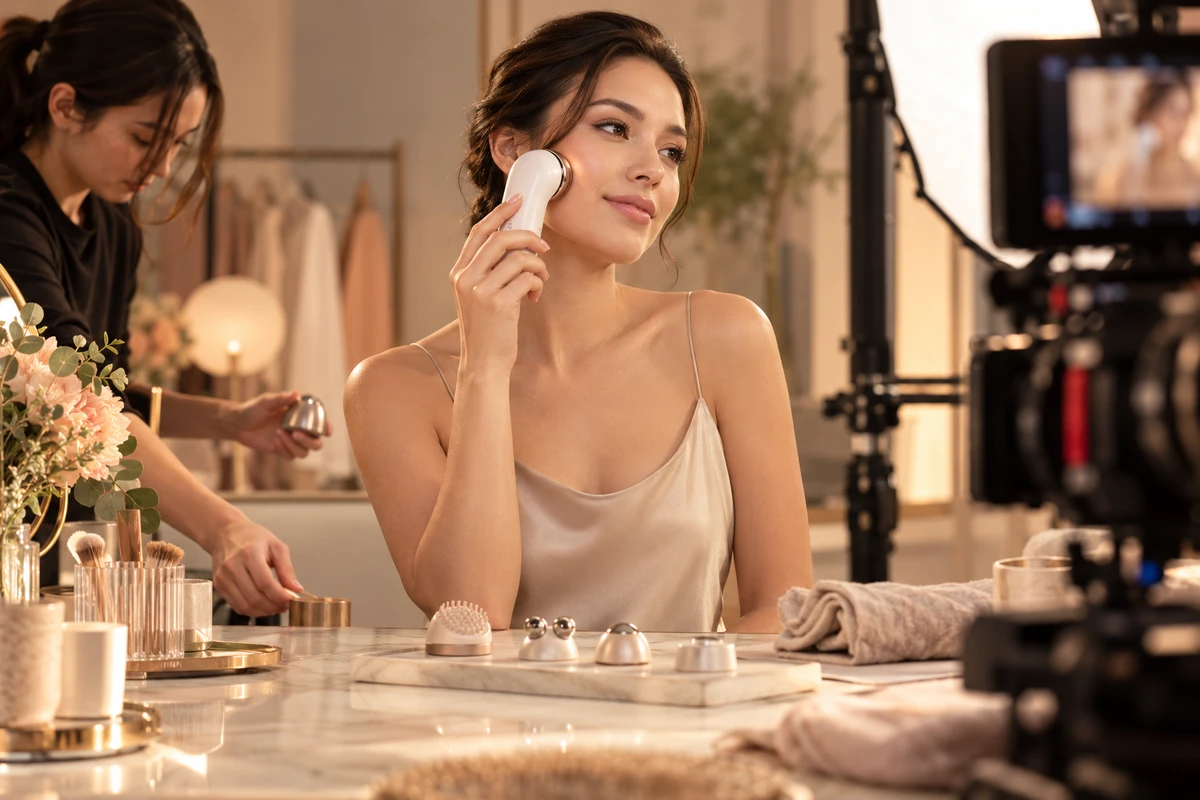
Research note: this article was checked on 11 October 2026 against current TikTok for Business dynamic-video and safe-zone guidance, the US FTC advertising FAQ, Amazon product-video categories, Adobe Experience Manager metadata guidance, and the current ONCE ecommerce product-video page. The cover is an original generated concept image, not a client-project photograph.