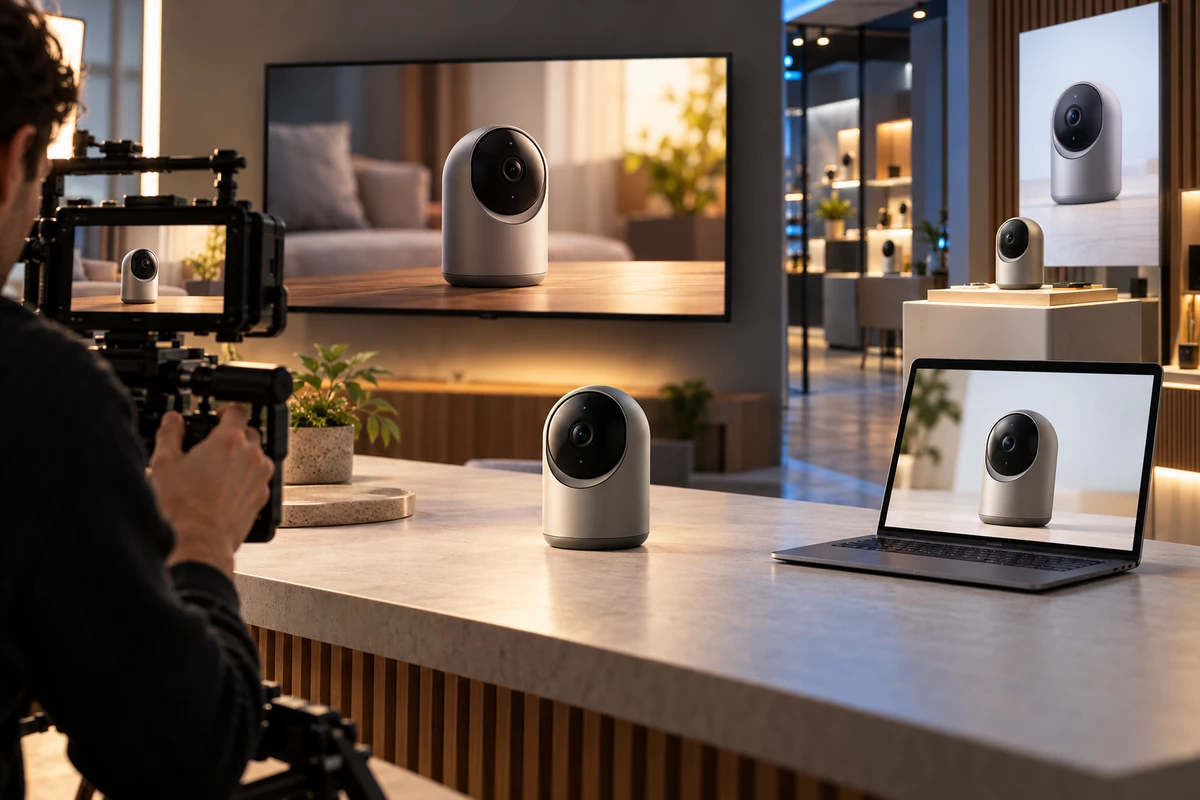
A brand preparing a US retail launch may be asked for a 30-second CTV spot, creator videos, PDP demonstrations, paid-social cutdowns and silent store-screen loops. Ordering those as five separate jobs produces files. It does not necessarily produce a reusable system.
The better production buy is a product-guidance asset pack: verified product truth, filmed use-task proof, room for an independent creator voice, a deployment map and an identifier that follows each module into measurement.
This matters because some large retailers are connecting more of the journey themselves. It does not mean every retailer has completed the same transformation. It means brands should own the portable layer that still works when the retailer, creator or media surface changes.
Our earlier analysis of Amazon’s full-funnel campaign argued for filming evidence modules that can move between streaming and commerce formats. Retailer creator systems add a harder requirement: another person may interpret the product, and their content may then be distributed as media.
The confirmed signal is company-specific, but commercially important
On September 28, 2026, Best Buy announced a connected set of capabilities in “Inside The Drop”. They included a Best Buy CTV ecosystem, multi-touch attribution across onsite and offsite media, paid search, CTV, social, influencers, affiliates and stores, and expanded incrementality testing. Best Buy also said it was expanding Best Buy Studios and Best Buy Creators for advertisers, combining established creators, product reviewers and its own Blue Shirts to develop content for social, streaming and commerce.
On September 22, Best Buy separately said its forthcoming TikTok Shop launch would feature nearly 10,000 products. Creator content could become shoppable content, be extended through paid advertising and connect back to Best Buy’s first-party measurement.
Amazon shows a different version of the same procurement pressure. Its Creator Connections documentation says brands choose products, commission rates, campaign dates and maximum budgets; eligible creators opt in; and reporting aggregates clicks, orders and sales. Eligible US ad accounts may be based in the United States, China or Hong Kong, subject to Amazon’s other requirements. Sales attribution uses a 24-hour click window.
These examples do not establish one universal retail-media operating model. They do establish a practical risk: a brand that commissions only finished edits leaves product logic, creator boundaries and version identity scattered across vendors and retailer systems.
Use GUIDE to define the master asset before formats
ONCE’s GUIDE product-guidance framework turns that risk into five production deliverables.
G — Grounded product truth
Create a versioned truth sheet for every SKU: functions, materials, compatibility, limitations, warnings and the evidence approved for public use. Every performance statement in the shot plan should point back to this record. When firmware, packaging or a component changes, the team can update the affected module instead of re-reviewing an entire film.
U — Use-task proof
Build each module around one shopper question: Will the earbuds stay secure with glasses? How often must this cleaner’s tank be emptied? Can a visitor’s face be seen at a backlit doorway? Film the condition, action and result. If a result depends on a specific setting, that setting belongs in the demonstration.
I — Independent voice
Separate non-negotiable product facts from opinions a creator or reviewer must be free to form. A brand can prohibit false claims and unsafe demonstrations without scripting an “independent review” word for word. The US Federal Trade Commission’s endorsement and influencer guidance emphasizes disclosure of material connections and truthful opinions. The brief therefore needs a disclosure requirement and a creator-freedom section, not just approved talking points.
D — Deployment map
Map each use task to the intended surface before editing. A CTV placement, PDP video, vertical shoppable post and silent store screen require different hooks, durations, framing, sound assumptions and calls to action. Deliver clean masters, safe crops and replaceable information layers alongside exported files.
E — Evaluation key
Assign an asset ID to every shopper-question × SKU-version × surface × creator-version combination. Record publication date, rights window and edit lineage. Retailer reporting can then be connected to a known content module instead of anonymous “video A” and “video B.”
Buy one of three systems, depending on retail coverage
| Operating condition | Minimum useful production buy | Avoid |
|---|---|---|
| One retailer, one PDP or promotion, stable SKU | One approved demonstration, retailer-compliant export, truth sheet and expiry record | Building a complex taxonomy before reuse exists |
| Creator content plus PDP and paid amplification | All five GUIDE records, source demonstration footage, creator-expression boundaries, disclosure instructions, paid-media rights and asset IDs | Turning a review into a scripted testimonial |
| CTV, stores and social commerce across retailers or markets | Versioned product-truth master, multiple use-task modules, sound-on and silent structures, aspect masters, language layers, rights matrix, test-cell IDs and a named refresh owner | Treating one campaign report as a permanent asset library |
A simple acceptance test is to pick one shopper question and ask the production partner to locate, within minutes, its factual source, proof shot, creator-edit boundary, surface versions and asset ID. If one element cannot be found, the delivery is still a folder of outputs rather than an operable asset system.
Attribution and incrementality answer different questions
Amazon’s 24-hour Creator Connections window can answer which sales its rules attribute to creator-link clicks. It cannot by itself tell a brand whether those sales would have happened without the activity.
The IAB and IAB Europe Guidelines for Incremental Measurement in Commerce Media distinguish experiments, model-based counterfactuals, econometric models and hybrid proxies. The guidelines emphasize credible counterfactuals, bias control and separating signal from noise. Best Buy’s announcement of expanded incrementality testing is therefore a relevant capability, not evidence that every campaign already has a causal answer.
Production should preserve two sets of identifiers:
- attribution identifiers for creator, link, SKU, surface, version and launch time;
- causal-test identifiers for exposed and control cells, eligibility, simultaneous creative differences and exclusions.
If the exposed group also receives a different offer, inventory position or audience rule, a reported lift can no longer be assigned cleanly to the guidance module.
Change the denominator in the cost review
Line-item bids can still show strategy, production, post, creator, rights and media costs. Portfolio decisions need a more useful denominator:
Cost per qualified retail decision module = (product verification + master capture + creator adaptation + rights + retail formatting + QA + measurement tagging + refresh) ÷ approved shopper-question × surface × SKU-version deployments
“Approved” is the constraint. A clip without factual approval, paid-media rights or version traceability does not become six qualified modules merely because it was exported in six sizes.
If retailer creator networks and closed-loop measurement continue to expand, production companies will not create the most value by exporting more files. The durable role is translating product truth from a supply chain into guidance that different people can explain, different screens can carry and different measurement systems can still identify. The best brief therefore asks two questions: what must work for this launch, and what should not need to be filmed again when the next retail surface appears?