Video Production Budget Decisions 06/10. A complete crowdfunding film may involve a founder, functional demonstrations, lifestyle scenes, animation, and multiple versions. That does not mean a team should commission all of them because it hopes to raise money later. For a hardware startup with an unstable prototype and limited cash, the more defensible sequence is to protect engineering, production, and fulfilment cash first, then decide whether the immediate purchase should be an evidence film, a controlled full campaign story, or a more elaborate brand production.
This article models a smart pet feeder with a camera and app. Every CNY rate and amount below is a hypothetical planning assumption, not a market quote, supplier quote, or ONCE quote. The numbers exist so a buyer can replace them with real proposals, contribution economics, and cash constraints.
Define the purchase before pricing the film
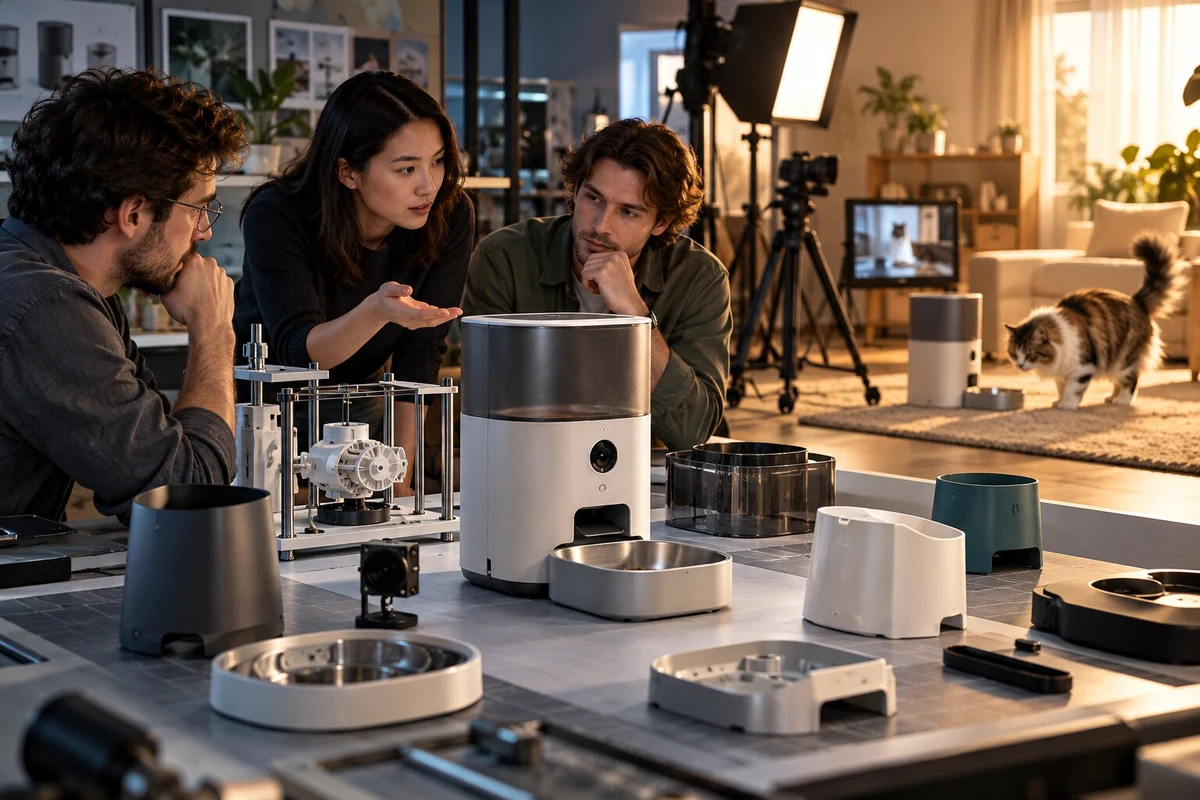
Assume the team is preparing a single-product reward crowdfunding campaign. The target market and eligible creator entity still need to be checked against the platform's current country and account rules. There is one engineering prototype: the feeder mechanism operates, and the camera can connect to the app, but repeatability, enclosure details, and error recovery are still changing. The planned uses are the campaign page, a pre-launch landing page, and a small set of social cutdowns over roughly six months.
The project team owns the approved product claims, demonstrable prototype, founder and engineer access, production and delivery plan, platform account, and final sign-off. The production team turns those approved facts into a script, shoot, edit, and versions. Safety, certification, tax, platform eligibility, shipping, and fulfilment promises remain with the appropriate specialists; a film cannot substitute for those decisions.
The completion criteria should be equally narrow. A viewer can identify the problem, follow a core action from starting state to visible result, distinguish current capability from controlled illustration or future intent, connect the founder's account with the campaign page, and use the agreed master and cutdowns on confirmed channels. “Guaranteed funding” and “guaranteed conversion” are not acceptance criteria.
Kickstarter's official rules, read on 9 October 2026, require honest and clear presentation. For Design and Technology projects, a prototype demonstration must reflect the product's current state; CGI or special effects cannot demonstrate functionality that does not exist, and software-hardware dependencies must be shown or disclosed. The rules also require transparency about AI use. For this type of project, complex visuals are first an explanatory tool, not a way to make the prototype appear to complete an action it cannot perform.
Calculate the production floor and the cash ceiling separately
The startup has CNY 360,000 of unrestricted pre-launch cash, but most of it has a more binding job than the film. The following is still a hypothetical scenario.
| Protected use | Assumed amount | Why it is not video money yet |
|---|---|---|
| Engineering, safety, and reliability validation | CNY 80,000 | An unstable demonstration creates waiting, resets, and rework |
| Tooling and manufacturing deposit | CNY 120,000 | A film cannot replace production readiness |
| Fulfilment, freight, and replacement reserve | CNY 50,000 | Pledged funds are not profit; delivery still needs cash protection |
| Pre-launch media and small-scale testing | CNY 40,000 | Without distribution and an observation window, the film's role cannot be evaluated |
| Maximum cash currently available for video | CNY 70,000 | 360,000 - 290,000 |
CNY 70,000 is a ceiling, not a target. If the minimum useful evidence film costs CNY 18,000, the floor and ceiling overlap and the team can act. If the necessary production scope exceeds CNY 70,000, the correct response may be to reduce scope, defer lifestyle work, reuse current material, or wait for a more stable prototype. Borrowing from fulfilment preparation is not a production strategy.
Compare three ways to achieve the same campaign task
All three options explain the same product. They are not price tiers created by changing the running time. Their differences are the risks they resolve and the assets they can support.
| Option | Hypothetical total | Cost build-up | Necessary problem solved | Current decision |
|---|---|---|---|---|
| Lean: engineering evidence | CNY 18,000 | Evidence outline 3,000; prototype test and prep 3,000; one founder-engineer shoot day 5,000; edit, graphics, captions 5,000; music and rights admin 1,000; contingency 1,000 | Establish what works now and create credible campaign-page and small pre-launch material | Buy first; it is not yet a full lifestyle story |
| Standard: controlled full narrative | CNY 58,000 | Story and pre-production 8,000; prototype verification 6,000; two product and people shoot days 16,000; controlled home set, props, and pet coordination 8,000; master and cutdown post 12,000; music and rights 3,000; contingency 5,000 | Join the problem, people, functional evidence, team, and next step into a launchable master with pre-launch versions | Inside the CNY 70,000 ceiling, but only after the upgrade gate |
| Enhanced: multiple scenes and complex visuals | CNY 118,000 | Creative and pre-production 12,000; technical prep 8,000; three shoot days 30,000; talent, locations, and pet logistics 22,000; complex 3D or motion work 24,000; post and versions 12,000; rights 4,000; contingency 6,000 | Handle richer character relationships, multiple real-use environments, or an invisible mechanism that genuinely needs explanation | CNY 48,000 above the cash ceiling; not viable now |
The disclosed line items reveal the real variables. Pet handling, prototype resets, app reconnection, engineer attendance, location moves, and graphics approval can all change labour. A real request for proposal should separate shoot days, crew, locations, prototype preparation, licence scope, versions, revision rounds, overtime, and pickup triggers.
Worked example: spend CNY 18,000 first, then decide on CNY 40,000
Assume the startup commissions the CNY 18,000 engineering-evidence stage. It considers the additional CNY 40,000 required to reach the standard scope only after the prototype completes three consecutive formal demonstrations, software-hardware dependencies can be disclosed accurately, manufacturing and fulfilment estimates are current, pre-launch evidence is meaningful, and one decision-maker can approve the work.
To test the marginal investment, calculate contribution per additional funded order. Assume a CNY 699 reward value, CNY 240 direct manufacturing cost, CNY 95 packaging and fulfilment cost, CNY 25 expected return and replacement provision, an 8% platform and payment-fee assumption of about CNY 56, and CNY 80 of necessary incremental acquisition cost. Then:
Incremental contribution per order = 699 - 240 - 95 - 25 - 56 - 80 = CNY 203.
Lean-to-standard hurdle = 40,000 / 203, rounded up = 198 additional funded orders.
That is a break-even hurdle for the additional production spend, not a sales forecast. It does not say the film will create 198 orders. If the team cannot isolate the role of the upgraded material through a staged release or credible test, it cannot attribute every campaign order to the film. Moving from standard to enhanced adds CNY 60,000 and requires 296 additional orders on the same assumptions, without proving that the extra scenes or visual effects will produce them.
| Contribution per additional order | Orders required for a CNY 40,000 upgrade | Orders required for a CNY 60,000 upgrade |
|---|---|---|
| CNY 100 | 400 | 600 |
| CNY 203 | 198 | 296 |
| CNY 300 | 134 | 200 |
If contribution is zero or negative, additional volume cannot make the film pay back on this basis; pricing, variable cost, or fulfilment needs attention first. Brand trust, organisational alignment, and technical explanation can also be judged through claim verifiability, resolved campaign-page questions, and usable versions rather than being forced into a short-term sales number.
The film also changes the minimum funding goal
Kickstarter's funding-goal guidance, published on 19 May 2024 and read on 9 October 2026, says the goal should cover the amount needed to complete the project, including production, materials, shipping, and platform fees; after launch, the goal and deadline cannot be changed. Kickstarter's US fee page, read on the same date, lists a 5% fee for successfully funded projects and payment processing of 3% to 5%; unsuccessful projects incur no Kickstarter fee. Actual fees depend on country and pledge structure.
The CNY 58,000 standard film is therefore both a pre-launch cash requirement and part of the minimum-delivery model. Assume CNY 300,000 for fixed product, tooling, certification, and production preparation; CNY 58,000 for the standard film; CNY 40,000 for campaign operations; CNY 60,000 contingency; and CNY 180,000 of direct variable cost for the first 500 units. The requirement before platform and payment fees is CNY 638,000. Using 8% solely as a planning assumption:
Internal funding-goal equivalent = 638,000 / (1 - 8%) = CNY 693,478.
The live project must set its goal in a platform-supported currency and recalculate using the creator country, actual payment mix, taxes, shipping, and reward structure. No currency conversion is made here. If the team moves from standard to enhanced, the additional CNY 60,000 increases this internal goal equivalent by approximately CNY 65,217 under the same fee assumption. The higher goal is defensible only when the enhanced production solves a necessary communication problem that the standard work cannot solve.
Three stop conditions matter more than “make it more premium”
First, stop when the prototype is still changing. If the feeder path, app flow, or camera response changes after filming, a polished master becomes obsolete. Capture lower-rework founder and engineering evidence first; add lifestyle work when the version is stable.
Second, stop when the audience and distribution conditions are missing. A small pre-launch list and no comparable landing page or observation window leave the effect of complex talent and sets unknowable. In a zero-lift scenario, the extra CNY 40,000 or CNY 60,000 is a cash loss. In an adverse scenario, polished imagery may make a concept look production-ready and create support and trust costs.
Third, stop when an enhancement has no independent task. Animation should explain a mechanism that live action cannot reveal. Talent should demonstrate a real friction, not merely make the frame busier. A location should be required by product use or the target market, not by the belief that crowdfunding films ought to look large. Generated visuals may explain a non-evidentiary mood or future direction, but they cannot stand in for a functional test.
A procurement template for replacing the assumptions
Start with three formulas:
- Cash ceiling = unrestricted cash - engineering and safety validation - manufacturing deposits - fulfilment and replacement reserves - committed pre-launch operations.
- Contribution per additional order = reward revenue - manufacturing - packaging and fulfilment - expected returns - platform and payment fees - necessary incremental acquisition cost. Do not deduct the same cost twice.
- Upgrade hurdle = additional production cost / contribution per additional order, rounded up. Separately record avoidable confirmed cash costs or required non-financial completion criteria.
Then ask the production partner and internal owners: Can each prototype function be repeated three times? Which unit is the appearance, functional, and backup prototype? What job belongs to the founder, engineer, talent, or animal? Is a lifestyle set genuinely necessary? What will animation explain, and what will it explicitly not prove? How many masters, cutdowns, page loops, and clean assets are required? Which countries, channels, and periods are covered by music, talent, location, and generated-content rights? What product change, weather event, prototype failure, or client revision triggers a pickup or additional charge?
For more production context, see ONCE's crowdfunding video production solution, Kickstarter shoot-day planning guide, and smart-hardware product video guide. These pages describe production scope and workflow; they do not validate the hypothetical amounts in this article or promise campaign results.
Conditional conclusion: CNY 118,000 is not optimal yet
Under these assumptions, CNY 18,000 is a rational first stage for obtaining verifiable material. The CNY 58,000 standard plan enters the affordable range only after the prototype, dependency, fulfilment, and pre-launch evidence clear the upgrade gate. The CNY 118,000 enhanced plan exceeds the CNY 70,000 cash ceiling and needs 296 additional CNY 203-contribution orders merely to cover its incremental production cost over the standard plan. The current decision is to stop, not to use hoped-for pledges to fill today's cash gap.
If you are preparing a hardware crowdfunding campaign, send ONCE the product, target market, intended uses, current assets, prototype state, timeline, acceptable budget, and only the operating assumptions needed for the model. You do not need to disclose unrelated private contracts or customer information. Start a project conversation to turn those inputs into a staged production scope.