Video Production Budget Decisions 05/10
When a product launch needs both defensible function proof and a credible US-home context, the first question should not be whether a shoot day costs less in Shenzhen or the United States. Assign each shot to the place that can prove it. Keep repeatable technical demonstrations close to the sample, engineers, and supply chain. Put market-specific human interaction in the target market. Share the script, post-production, and version plan wherever possible.
This article works through one smart air fryer launching in the United States. The conclusion is conditional. Under the assumptions below, hybrid production totals CNY 190,000, versus CNY 237,000 for a US-only shoot and CNY 138,000 for a Shenzhen-only shoot. Hybrid is the better fit only when authentic US-home interaction is a real requirement and the unbudgeted cross-border costs stay below CNY 47,000.
Every CNY amount is a bottom-up hypothetical assumption used to demonstrate the calculation. It is not a market average, a published supplier price, or an ONCE quotation. Buyers should replace every line with like-for-like written quotes.
Fix the buyer stage, task, and cash constraint first
The scenario is an overseas brand with manufacturing capacity and a new US launch. Its Shenzhen supply chain is preparing the first inventory, but the product has no stable US-market visual library. The job is not a corporate film. It must prove several cooking functions and show use in a kitchen with the scale, power, food habits, props, and human interaction expected in the target market.
All three routes use the same scope:
- one 60-second master and six 15-second paid-social cutdowns;
- an English-super version and a clean master;
- talent and music cost placeholders for 12 months of US website and paid-social use, with actual territory, media, term, exclusivity, edits, and renewals to be confirmed;
- a five-week delivery window and one client decision-maker for script, talent, location, and rough-cut approval;
- one engineering-tested unit in Shenzhen and two tested, shippable units for any US work;
- acceptance based on repeatable product action, credible market context, complete versions, usable rights, and the launch date—not a vague instruction to make the film look premium.
Cash capacity is a separate constraint. The brand cannot treat unearned launch revenue as available cash. Production, media, sample readiness, and fulfilment reserves must coexist. Any route that crowds out mandatory compliance, inventory, or distribution spend is unaffordable even if its film line looks efficient.
Assign shots to places, not the whole film to a country
What belongs close to Shenzhen engineering support
Basket assembly, control logic, display states, before-and-after food results, resets, and repeated operating cycles depend on stable samples, spare parts, technical interpretation, and repeatable testing. ONCE's kitchen appliance production page similarly treats model version, accessories, power, food preparation, kitchen workflow, reset conditions, and final product state as production inputs. The value of shooting these shots near the supply chain is not merely a lower location line. It reduces the risk of stopping with a malfunction that nobody on set can diagnose.
What must be verified in the target market
If the brief requires an actual US residential kitchen and local user interaction, cabinet scale, counter height, outlets, the view outside, food packaging, tableware, and performance all affect credibility. ONCE's U-STUDIO can support controlled white-cyc, practical-set, and lifestyle work in Shenzhen. A set that resembles a US kitchen, however, is not the same fact as filming in a US home. The production record and final communications must describe location truthfully.
What can be shared across both places
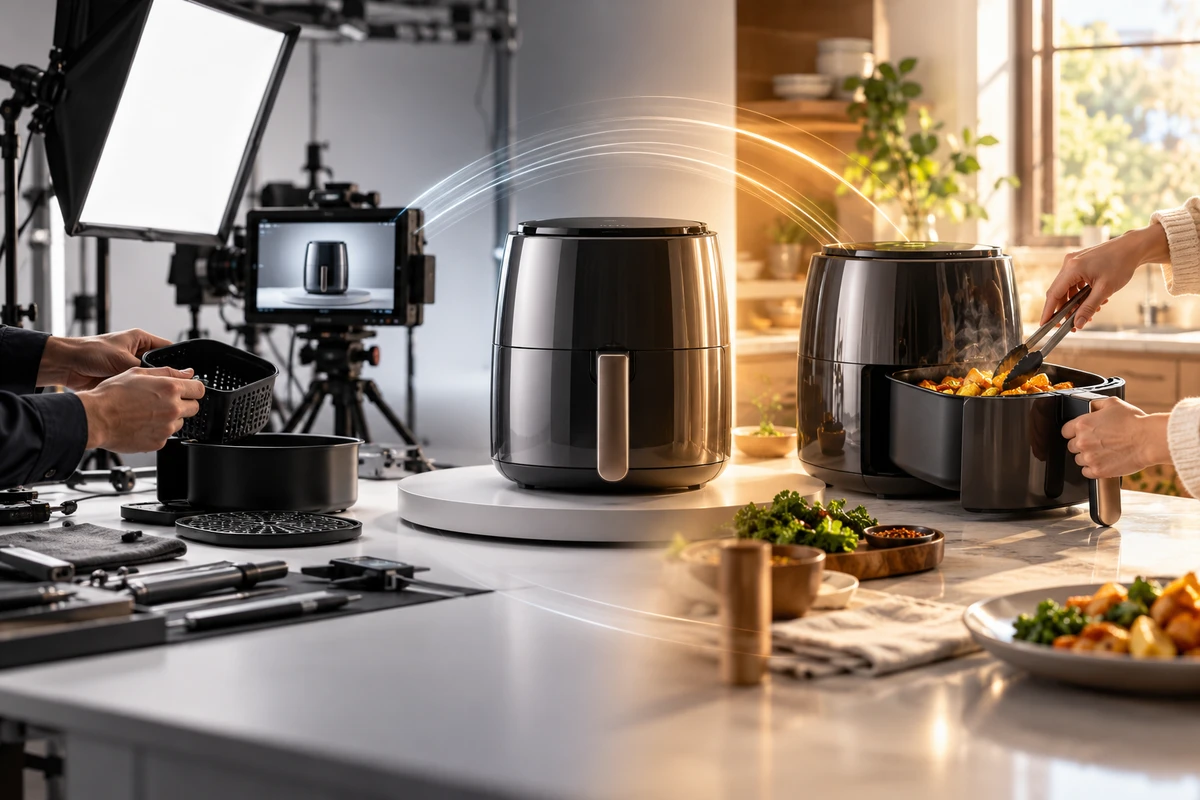
The story logic, shot IDs, colour reference, camera conventions, file naming, music direction, super lengths, and final post workflow can be shared. A hybrid plan should not commission two separate films. Shenzhen supplies the function evidence; the US unit supplies the market-specific human context; one post team makes them a coherent story.
Three like-for-like models: CNY 138,000, 190,000, and 237,000
The table is a model, not a rate card. Suppliers, agents, locations, logistics teams, and legal advisers must replace every assumption.
| Cost line | Shenzhen only | Hybrid | US only |
|---|---|---|---|
| Shared planning and script | 10,000 | 12,000 | 12,000 |
| Sample testing, engineering prep, or remote engineering support | 6,000 | 8,000 | 12,000 |
| Shenzhen product and function shoot | 42,000 | 32,000 | 0 |
| US or US-representative lifestyle shoot | 0 | 38,000 | 75,000 |
| Set, talent, food, and props | 18,000 | 24,000 | 42,000 |
| Sample freight and customs placeholder | 0 | 6,000 | 8,000 |
| Post, master, and six cutdowns | 28,000 | 28,000 | 35,000 |
| Talent, music, and other rights placeholder | 12,000 | 18,000 | 25,000 |
| Remote approval, translation, and cross-location coordination | 8,000 | 8,000 | 8,000 |
| Contingency | 14,000 | 16,000 | 20,000 |
| Model total | 138,000 | 190,000 | 237,000 |
The assumed differences follow workload rather than country labels. Hybrid production creates two set interfaces, sample logistics, and footage-matching work. US-only adds three local production days, a complete kitchen, and local talent, while removing the two-location conform. Shenzhen-only uses a representative lifestyle set, but it cannot satisfy an acceptance condition that requires an actual US residence.
Lean route: Shenzhen only, CNY 138,000
This route retains function demonstrations, product styling, one representative lifestyle environment, the master, and cutdowns. If the job is to explain the product clearly and the brand does not need to state or imply that filming took place in the United States, it may be the most cash-efficient viable route.
The counterexample is a procurement brief that makes an actual US residence and local-user interaction mandatory, then chooses a Shenzhen set because the reference photographs look right. That does not save money; it buys a deliverable that fails acceptance. Reduce the creative scope or move to hybrid production instead of obscuring the location fact in post.
Standard route: Shenzhen-US hybrid, CNY 190,000
Shenzhen captures disassembly, the control panel, the cooking process, and outcome evidence. The US unit captures the local kitchen, user behaviour, dining interaction, and environmental sound. Both units follow one shot-ID list, product-state log, and colour reference. Expensive target-market days are reserved for shots that genuinely require the target market.
Hybrid does not save money automatically. Mismatched colour temperature, different firmware, discontinuous hand actions, or incompatible framing can force repairs or reshoots. The CNY 8,000 coordination line and CNY 16,000 contingency are model placeholders; they are not promises that every risk is covered.
Enhanced route: US only, CNY 237,000
This route keeps function and lifestyle work with one US crew, one location system, and one approval chain. It reduces cross-location matching, but engineering samples are farther from Shenzhen support. If firmware, accessories, or repeated food results are unstable on arrival, waiting, replacement freight, and pickups can be expensive.
US-only becomes worthwhile not because the brand is large, but when most shots depend on local people, residential space, food, retail packaging, or continuous on-set interaction—and the buyer accepts a modeled CNY 47,000 premium for single-location execution and less conform work.
CNY 47,000 is the hybrid hidden-cost break-even point
The visible hybrid saving against US-only is:
CNY 237,000 − CNY 190,000 = CNY 47,000.
Add the actual cost of a second shipment and taxes, duplicated product prep, time-zone overtime, two production managers, extra translation, footage repair, emergency pickups, forfeited location bookings, and approval changes caused by delay. If those unbudgeted cross-border additions reach CNY 47,000, the cash advantage disappears. US-only may then be simpler and cheaper.
This is why buyers cannot compare shoot-day lines alone. The bid sheet needs a separate cross-border increment and a named owner for sample failure, customs delay, missed approval, and footage that does not match.
What evidence justifies the extra CNY 52,000 for market authenticity?
Hybrid costs more than Shenzhen-only by:
CNY 190,000 − CNY 138,000 = CNY 52,000.
For a project measured on incremental sales, the minimum order hurdle can be calculated as additional cost divided by incremental contribution per order. Contribution here means selling price less costs caused by that order, including product cost, platform charges, fulfilment, expected returns, and any necessary incremental acquisition cost. Buyers should avoid subtracting the same cost twice.
| Incremental contribution assumption | Incremental orders needed to cover CNY 52,000 | Interpretation |
|---|---|---|
| CNY 130 | 400 orders | Incremental contribution must reach at least 400 orders |
| CNY 260 | 200 orders | The hurdle is 200 incremental orders |
| CNY 520 | 100 orders | The hurdle is 100 incremental orders |
| CNY 0 or negative | No break-even | Repair product, fulfilment, or acquisition economics before adding production spend |
These are hurdles, not a sales forecast, and they do not prove that the video causes orders. The zero-uplift case must remain visible: if the US lifestyle footage produces no attributable incremental contribution, the CNY 52,000 has no sales payback. When the objective is brand expression or channel acceptance, do not invent a sales conversion. Use task constraints instead: an actual US location must be verifiable, user behaviour must fit the market, and every channel version and right must be complete.
Write the upgrade trigger before production. Move to hybrid only if the existing function demonstration passes an internal comprehension check, US context is a genuine channel or creative requirement, distribution will be sufficient to use the asset, and samples and rights can be confirmed inside five weeks. If any condition fails, produce function evidence in Shenzhen first, reduce the US shoot, or defer the lifestyle work.
Samples, customs, and performer rights cannot hide inside production
The current US International Trade Administration ATA Carnet guidance explains that eligible commercial samples and professional equipment may use ATA Carnet, Temporary Importation under Bond, or related temporary-import processes, depending on the route and jurisdiction. It does not automatically remove licensing or regulatory obligations. FedEx's current international shipping guide asks shippers to define shipment purpose, value, origin, HS code, importer or consignee, payer, and commercial or pro forma invoice information. These official pages were accessed on October 9, 2026. A customs, tax, or logistics specialist must confirm the actual project; CNY 6,000 and CNY 8,000 in this model are not estimates of tax liability.
Performer rights should not be reduced to a talent day rate either. The SAG-AFTRA 2025 Commercials Contracts cover a three-year agreement and include digital, social, consent, compensation, and AI-related provisions. Applicability depends on the contracting parties and intended use. A local producer, agent, or counsel should confirm territory, media, term, edits, renewal, exclusivity, and AI provisions. The rights lines above are calculation placeholders, not quotes for any performer.
Ownership determines who pays for a pickup
| Owner | Required before the shoot | Approval responsibility | Failure boundary |
|---|---|---|---|
| Brand buyer | Product version, market, use, rights scope, launch date, one decision-maker | Script, location, talent, hero frames, rough cut | Late approval or changed use is priced before work continues |
| Shenzhen production | Sample test, function shot IDs, product-state log, media specification, truthful location record | Function action and technical state | A new function outside the approved sample is not an automatic free pickup |
| US local unit | Verified location, talent and location rights, local production conditions | Context authenticity, talent action, set safety | Rights or location changes trigger a new quote and schedule |
| Unified post team | Cross-location shot IDs, colour and sound conform, version list, clean master | Rough cut, fine cut, supers, delivery package | Non-conforming source media and new versions are separate costs |
ScreenSkills describes the production coordinator role as connecting schedules, resources, paperwork, rights, and expenditure control. In a cross-border project, this is production work, not an administrative afterthought. Remote review must also define live viewing versus proxy uploads, the person who can give final direction, and the response window. ONCE's remote product shoots in China guide can help international buyers frame sample receipt, version control, returns, and remote approval.
Stop conditions protect the budget better than vague contingency
Stop, reduce, or reconfigure the route when any of these conditions appears:
- authentic US lifestyle is not required by the channel, claim, or creative task: stay in Shenzhen rather than spend CNY 52,000 on generic international styling;
- the US samples cannot pass stable testing before the location lock: do not book the complete US unit; capture function evidence in Shenzhen first;
- the two units cannot share shot IDs, frame rate, colour, product version, and action continuity: the modeled hybrid saving is unreliable;
- talent, music, location, or prop rights cannot cover 12 months of US paid social: narrow the use or change the plan first;
- the client lacks one decision-maker or cannot approve inside five weeks: add the cash cost of delay and a second shoot to the affordability ceiling;
- cross-border extras approach CNY 47,000: compare US-only again instead of defending sunk Shenzhen preparation.
Replace the assumptions with a like-for-like bid
Use these formulas with real quotations:
Route total = shared planning + local production + set/talent/rights + sample/logistics/customs + cross-border coordination + post/versioning + contingency + confirmed change costs.
Actual hybrid advantage = US-only total − hybrid total − omitted cross-border additions.
Ask every bidder to use one deliverable list and state shoot days and hours, camera and lighting boundaries, sample quantity and return, food and reset work, location truth, talent and music use, travel, taxes, insurance, translation, remote review, file upload, backup, pickup responsibility, version count, revision rounds, and cancellation terms. Without equal scope, the formula cannot answer the procurement question.
The decision
Hybrid wins this model not because Shenzhen is simply cheaper, but because function truth and market truth have different best locations. The CNY 190,000 route holds only when authentic US context is necessary, the technical and approval interfaces are locked, and hidden cross-border additions stay below CNY 47,000. Otherwise, the CNY 138,000 Shenzhen-only route or CNY 237,000 US-only route may be the more honest purchase.
To compare Shenzhen, target-market, and hybrid production for your project, send ONCE the product, target market, channels and use period, existing material, sample status, deadline, acceptable cash budget, and any contribution or operating assumption required for the decision. We can assign shots to locations first and then replace this model with real like-for-like quotes. Private contracts, customer names, and unrelated sensitive data are not needed.
Source note: accessed October 9, 2026—US International Trade Administration ATA Carnet guidance, FedEx international shipping guidance, SAG-AFTRA 2025 Commercials Contracts, ScreenSkills production-coordination guidance, and TikTok advertising-format and functionality policy. These sources frame workflow and responsibility; they are not legal, tax, customs, banking, or set-safety advice, and public rules do not confirm project availability, booking, or price.