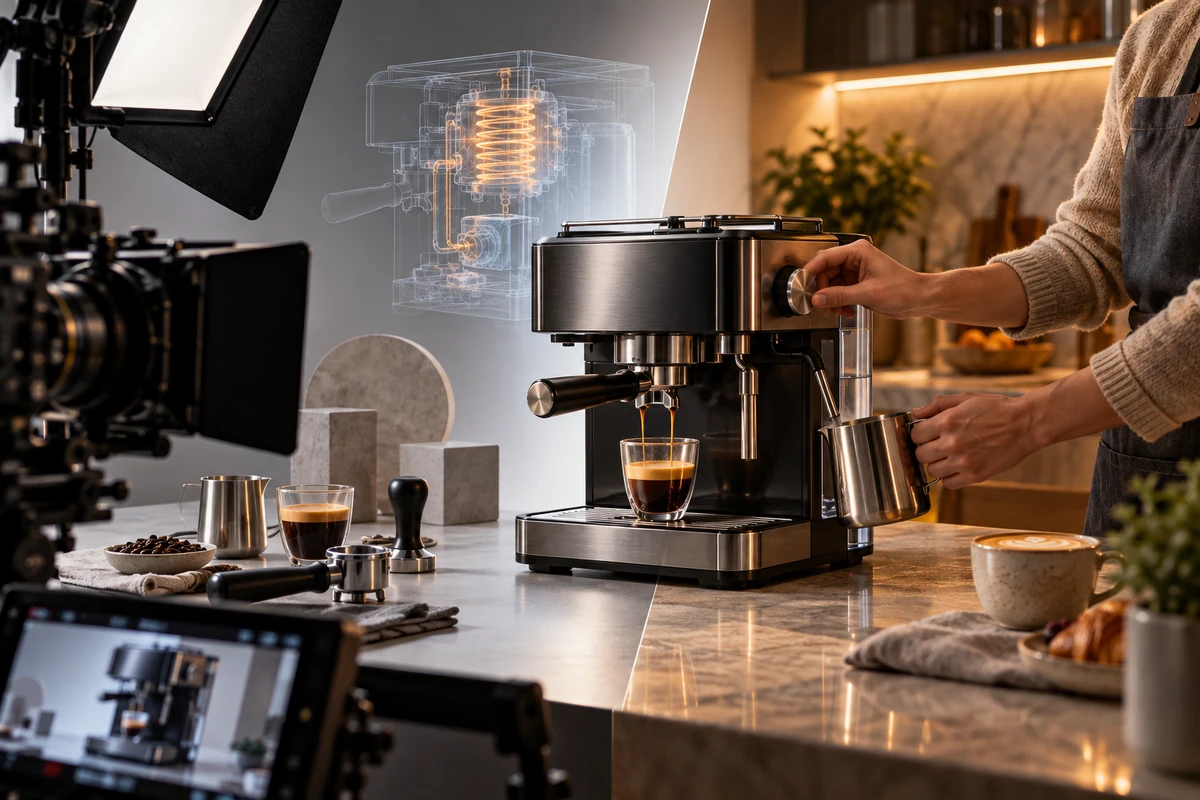
An established premium espresso-machine brand already knows its audience and has sales history. Adding a working kitchen, a performer, and an elaborate internal-mechanism sequence may make the product easier to understand and more desirable. But a high retail price does not make those additions economical. A useful procurement decision starts with the task the current content fails to perform, then asks how much incremental contribution, verifiable cost avoidance, or non-sales improvement the extra production spend must produce.
Video Production Budget Decisions 02/10 · ONCE Guide to Video Production Budget Decisions
This article uses one complete hypothetical model. Every CNY amount, hourly rate, operating input, and performance scenario below is an assumption for calculation—not a market average, supplier quote, ONCE price, or performance promise. A real project must replace these assumptions with written quotations, approved rights, and the buyer's own operating data.
Hold the product, market, use, and time horizon constant
Assume the brand sells a premium smart espresso machine through a US DTC site. The sample is stable, and the next six months of use cover the English product page and already-approved paid media. Existing content shows the industrial design, but not the full grind, brew, milk, and cleaning workflow. Support data also suggests that some buyers misunderstand the machine's scale and daily maintenance.
The comparison is not between three films of different lengths. All three approaches must achieve the same core objective: show one truthful use cycle and clarify scale, cleaning, and operating boundaries. The product lead owns factual approval and sample readiness. The channel lead confirms placements and duration. The production partner turns those inputs into an executable scope, cost model, rights plan, and acceptance checklist. Talent, music, and third-party rights still need explicit territory, media, and term in the contract.
Wistia's April 2026 State of Video Report found that product pages were among the page types with the highest video play rates in its platform sample. That supports treating product-page video as a serious purchase aid. It does not show that a particular production tier will increase sales, and it cannot replace the brand's own incremental measurement.
Three feasible spends: each upgrade must buy a new job
This bottom-up model holds the basic output constant: one English product-page master, a clean text-free master, and agreed core aspect ratios. The difference is whether human interaction and complex visualization are necessary to solve a documented buyer problem.
| Option | Hypothetical total | Primary job | Important exclusions | Suitable when |
|---|---|---|---|---|
| Lean: professional function demonstration | CNY 18,000 | Show a five-step workflow, scale, sound, and cleaning in a controlled setting | No performer, full lifestyle narrative, or complex mechanism animation | The main gap is understanding how the product works |
| Standard: working kitchen and one performer | CNY 48,000 | Show filling, placement, brewing, milk preparation, and cleanup in a usable kitchen | No second performer, perpetual global rights, or complex 3D simulation | Buyer uncertainty depends on human scale, movement, or household context |
| Enhanced: performance plus complex visuals | CNY 95,000 | Add two human scenarios and an engineering-approved internal-mechanism sequence | No unapproved claims, unlimited revisions, or media buying | Live action cannot explain a necessary mechanism and the asset has a funded distribution life |
Lean option: CNY 18,000
| Hypothetical cost | Calculation | Subtotal |
|---|---|---|
| Script and demonstration design | 12 hours × CNY 300 | CNY 3,600 |
| One-day lean crew and basic equipment | 1 day × CNY 6,500 | CNY 6,500 |
| Controlled tabletop and lighting support | one allowance | CNY 2,000 |
| Coffee, milk, and cleaning consumables | one allowance | CNY 500 |
| Edit, color, and sound | 20 hours × CNY 250 | CNY 5,000 |
| Outputs and QC | one allowance | CNY 400 |
| Total | CNY 18,000 |
Standard option: CNY 48,000
| Hypothetical cost | Calculation | Subtotal |
|---|---|---|
| Script, boards, and movement testing | 20 hours × CNY 350 | CNY 7,000 |
| Two-day production crew and equipment | 2 days × CNY 8,000 | CNY 16,000 |
| Operational kitchen location | 2 days × CNY 3,500 | CNY 7,000 |
| One performer and modeled six-month US DTC use | one allowance | CNY 5,500 |
| Props and consumables | one allowance | CNY 1,000 |
| Edit, color, and sound | 32 hours × CNY 300 | CNY 9,600 |
| Music, translation, and output allowance | one allowance | CNY 1,900 |
| Total | CNY 48,000 |
Enhanced option: CNY 95,000
| Hypothetical cost | Calculation | Subtotal |
|---|---|---|
| Creative development, technical script, and boards | 40 hours × CNY 400 | CNY 16,000 |
| Two-day enhanced crew and technical equipment | 2 days × CNY 12,000 | CNY 24,000 |
| Kitchen, set, and motion support | 2 days × CNY 4,000 | CNY 8,000 |
| Two performance scenarios and modeled usage | one allowance | CNY 12,000 |
| Props and art direction | one allowance | CNY 3,000 |
| Technical animation and compositing | 60 hours × CNY 350 | CNY 21,000 |
| Edit, color, and sound | 30 hours × CNY 300 | CNY 9,000 |
| Outputs and rights allowance | one allowance | CNY 2,000 |
| Total | CNY 95,000 |
For calculation, the totals are treated as tax-inclusive cash outlays; that is not tax advice. Cross-border sample shipping, media spend, reshoots after a product revision, new languages, and rights beyond the defined scope are excluded. A real quote should separate quantities, days, unit rates, tax, travel, revisions, and exclusions.
Location photographs show styling, not whether the machine can be operated, reset, drained, and recorded repeatedly. ONCE's public U-STUDIO page describes an 800 m² Shenzhen production space with scene sets and a white cyclorama. Availability, utilities, sound conditions, and any project price still require a current scout and written confirmation.
Calculate the affordable ceiling before ranking the options
An established brand still has a cash constraint. Assume CNY 120,000 is available for this launch-content period. Of that, CNY 45,000 is already committed to distribution, CNY 20,000 must remain available for a product revision or reshoot, and CNY 7,000 is the project contingency:
Maximum production outlay = 120,000 − 45,000 − 20,000 − 7,000 = CNY 48,000.
Under these assumptions, the standard option just fits. The enhanced option is not currently feasible even if it would look better. Forecast sales cannot be used as cash that already exists, and production should not consume the distribution, product-fix, or contingency reserve. If a real quote exceeds CNY 48,000, reduce the scene, rights, or version scope, or stage the work. Do not preserve decorative complexity by borrowing from mandatory reserves.
Use contribution per order, not retail price divided by budget
Assume net revenue on a completed order is CNY 7,200 after discounts and applicable taxes. Product, packaging, and fulfillment are CNY 3,200; payment fees are CNY 250; an average returns and after-sales reserve is CNY 550; and required incremental acquisition cost is CNY 1,600:
Incremental contribution per order = 7,200 − 3,200 − 250 − 550 − 1,600 = CNY 1,600.
Shopify's 2026 ecommerce pricing guidance advises building a contribution-margin floor that includes payment fees, packaging, returns, discounts, duties, and acquisition cost. A product can sell well and still leave little contribution per order. The CNY 1,600 figure remains this model's assumption, not a category benchmark.
| Investment comparison | Incremental cost | Minimum incremental orders if orders alone cover it |
|---|---|---|
| Lean versus no production | CNY 18,000 | 18,000 ÷ 1,600 = 11.25, therefore 12 orders |
| Standard versus no production | CNY 48,000 | 48,000 ÷ 1,600 = 30 orders |
| Enhanced versus no production | CNY 95,000 | 95,000 ÷ 1,600 = 59.375, therefore 60 orders |
| Standard versus lean | CNY 30,000 | 30,000 ÷ 1,600 = 18.75, therefore 19 orders |
| Enhanced versus standard | CNY 47,000 | 47,000 ÷ 1,600 = 29.375, therefore 30 orders |
The 19-order figure is a hurdle, not a sales forecast and not a claim that video independently creates orders. If the brand lacks sufficient inventory, reach, measurement, or a plausible explanation of how lifestyle context fixes the documented comprehension problem, those 19 orders should not be treated as inevitable.
Sensitivity to contribution per order
The standard option costs CNY 30,000 more than the lean option:
| Assumed incremental contribution per order | Minimum incremental orders |
|---|---|
| CNY 800 | 38 |
| CNY 1,600 | 19 |
| CNY 2,400 | 13 |
This is why a premium retail price is not permission to increase the production budget. The client's finance or operating owner should approve the contribution definition first.
Return-cost avoidance can inform the choice, but not be counted twice
Lifestyle production is most defensible when it clarifies physical scale, cleaning, or realistic operation—not when it merely appears expensive. Assume each return caused by a potentially explainable mismatch creates CNY 480 of reverse-logistics, inspection, repackaging, and markdown cash cost. If cost avoidance alone funds the upgrade:
- The CNY 30,000 standard-over-lean increment requires at least 63 avoided relevant returns.
- The CNY 47,000 enhanced-over-standard increment requires at least 98.
Now assume the brand had only 40 returns in six months that were coded to scale, cleaning, or operation expectations, and cautiously estimates that video could influence 20% of them. That is eight returns, worth only 8 × 480 = CNY 3,840 in this model—far below the CNY 30,000 upgrade.
Shopify's July 4, 2026 guide to ecommerce returns management explains that returns add processing and shipping work and may require inspection, grading, restocking, repair, or disposal. Buyers should use reason codes to count only returns that clearer content could plausibly affect. Finance must also confirm whether the CNY 480 is already embedded in the contribution reserve; the same return saving cannot increase contribution and then be added again.
Keep zero-lift and adverse outcomes on the approval page
The standard option costs CNY 30,000 more than the lean option. At CNY 1,600 contribution per incremental order:
| Assumed incremental orders versus lean | Incremental contribution minus added production cost |
|---|---|
| 0 | −CNY 30,000 |
| 10 | −CNY 14,000 |
| 19 | +CNY 400 |
| 25 | +CNY 10,000 |
| −5 | −CNY 38,000 |
These are scenarios, not expected outcomes. Google's About Conversion Lift describes a controlled comparison between people who see ads and a control group who do not; the tool is not available to every account. Even when available, an ad-level increment does not automatically establish the incremental profit of one video version. Creative, media, price, inventory, and page changes may still be entangled.
If traffic cannot support a meaningful comparison, record the result as inconclusive. Do not convert play rate, click-through rate, or a before-and-after sales change into a film-level return claim.
Every addition must solve a problem the cheaper option cannot
When a lifestyle location earns its cost
The scene should reveal physical scale, water and cleaning movement, steam and sound context, or the product's relationship to other kitchen objects. If a controlled tabletop can explain every important action, a more attractive kitchen is decorative. ONCE's public ecommerce product video service outlines a workflow from product-message planning through market-version delivery; any real scope still needs written confirmation for the specific market and outputs.
When talent earns its cost
The performer should communicate hand scale, grip, cleaning effort, a morning routine, or a multi-person interaction. Simply lifting a finished coffee does not justify performance and usage costs. Territory, media, term, and paid advertising must be explicit; “worldwide, perpetual, all media” is not a default inclusion.
When complex visuals earn their cost
Animation or compositing should explain a necessary internal mechanism that live action cannot show. Product or engineering owners must approve the technical boards, and explanatory imagery must not be presented as real performance testing. If the present need is only to clarify cleaning, solve cleaning first rather than buying a launch-film-style cutaway.
Each tier has a different, testable definition of done
For the lean option, target viewers should be able to restate the five-step workflow, judge the machine's scale, and see cleaning clearly. Product facts, English meaning, captions, color, and sound must pass named-owner review.
For the standard option, the kitchen must support actual operation, the performer's actions must answer the prewritten comprehension question, and talent, music, and location rights must match the six-month US DTC scope. Small comprehension sessions can detect communication failures; they cannot prove sales lift.
For the enhanced option, an engineering owner should sign off the internal-mechanism boards. Product appearance must remain consistent, and compositing scope, revision rounds, and master files must be defined. Complex visuals are explanatory tools, not product-performance evidence.
Procurement decision: stop at CNY 48,000 in this model
Under these assumptions, CNY 18,000 is the minimum production cost for a usable function explanation. The CNY 48,000 standard option meets the cash ceiling and is justified only when human scale, kitchen movement, or cleaning expectations are a documented content gap. The CNY 95,000 enhanced option exceeds the current ceiling and should be deferred or separated into a smaller technical-visual validation phase.
Before approving the standard upgrade, require three things: a recorded comprehension or return problem, a script showing how the performer and scene answer it, and enough inventory, distribution, and measurement capacity to learn from the release. Before approving the enhanced tier, add an engineering-approved mechanism task and a separate source for the extra CNY 47,000. If any input is missing, return to the smaller scope instead of using the product's price to justify more production.
The previous study, Your First Product Page Video: Set the Loss Limit Before the Production Budget, covers an unvalidated single-SKU seller. This study moves an established brand to the next decision: whether marginal production investment has a defined job and evidence threshold.
If you are deciding how far to take a premium product video, send ONCE the product, target market, intended channels, existing assets, sample status, launch timing, acceptable budget, and contribution and relevant-return-cost ranges you are comfortable using for a model. We can separate mandatory production tasks from decorative additions and replace the assumptions with written quotations. There is no need to disclose unnecessary private contracts or customer identities.
Source note: reviewed October 9, 2026—Wistia, State of Video Report: Video Marketing Statistics for 2026 (published April 22, 2026); Shopify, Ecommerce Pricing Strategy: 10 Models to Choose (2026 page); Shopify, How Ecommerce Returns Management Works in 2026 (updated July 4, 2026); and Google Ads, About Conversion Lift (no publication date shown on the page). These sources support page-use context, cost definitions, returns operations, and measurement boundaries. None supplies a China production rate or a performance expectation for this example.