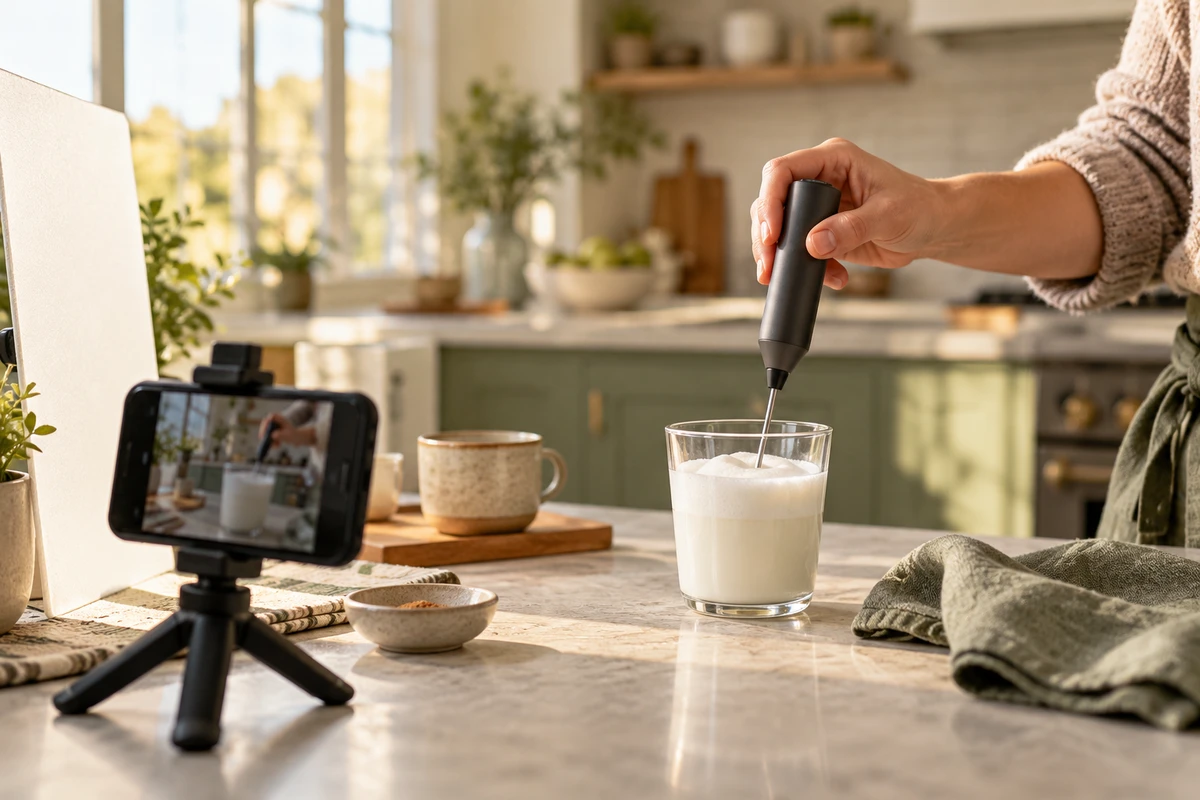
For an ecommerce seller with unvalidated demand, the first useful question is not simply what a professional video costs. Ask what the buyer must understand, what it takes to communicate that reliably, and whether you can still afford the production bill if it produces no additional orders.
In the milk frother example below, the available production cash is CNY 3,000. A CNY 2,000 lean approach is feasible if the seller can supply usable demonstration footage. A CNY 6,000 professional demonstration or CNY 15,000 lifestyle production must clear separate affordability and additional-value tests. These are conditional model results, not market rates, supplier quotations, ONCE quotations, or sales forecasts.
Video Production Budget Decisions 01/10 · ONCE Guide to Video Production Budget Decisions
Fix the scope before comparing costs
Consider a new seller testing demand for one handheld milk frother in the United States. The video is for a product page on its own website, with a planned 90-day use period. Its job is to explain size, operation and the actual result. It does not need to carry an entire brand launch.
All three approaches deliver the same core output: one approximately 25–40-second landscape product page video, an English-captioned version and a clean version, with one consolidated feedback round within an agreed scope. These are project choices, not universal platform requirements. The seller confirms the website player and file specifications before production.
The client supplies a stable sample, accurate operating instructions, approved product claims and existing assets. A product owner checks that the demonstration is truthful. The producer handles the agreed editing or filming, captions and file checks. One client representative gives final approval. Sample shipping, additional languages or aspect ratios, media buying, 3D animation, a second shoot day and reshoots beyond the agreement are excluded from the model.
The ONCE ecommerce video solution explains the scope of planning, filming and post-production services. Editing supplied footage, renting a location and commissioning a complete production assign different responsibilities, even when each ends with a video file.
Calculate what an additional order contributes
A high selling price does not automatically support a large production budget. All amounts below are expressed in CNY on an assumed settlement basis; no currency conversion has been performed. Every business input is hypothetical and should be replaced with the seller's own figures.
| Per-order item | Assumed amount | Basis |
|---|---|---|
| Net revenue after discounts and relevant tax treatment | CNY 299 | Not the displayed price or gross tax-inclusive sales |
| Product, packaging and fulfillment | CNY 135 | Variable cost of an additional order |
| Payment and transaction fees | CNY 18 | Variable cost of an additional order |
| Expected returns and after-sales cost | CNY 12 | Hypothetical estimate; use project-specific evidence |
| Incremental acquisition cost | CNY 54 | Assumes this expense arises for each additional order |
| Remaining contribution per order | CNY 80 | 299 − 135 − 18 − 12 − 54 |
Shopify's Break-Even Analysis, updated August 11, 2026, explains contribution as revenue less variable costs and the basic fixed-cost divided by contribution calculation. Here it supplies a threshold for additional production expenditure, not a demand forecast.
The CNY 54 acquisition assumption needs consistent treatment. Deduct it per order if each extra order really requires that extra expense. If the entire campaign spend is fixed, use the actual incremental spending and the corresponding contribution basis instead. Do not deduct CNY 54 per order and then add the same media expense to the break-even numerator. The calculations below concern incremental production cost, with acquisition handled in the stated per-order assumption.
No repeat purchases or lifetime value are included. This is not a claim that the contribution covers every company overhead. Unproven repeat business cannot fund the first production invoice.
Apply the cash limit before imagining the return
Assume CNY 18,000 is available to allocate. The seller reserves CNY 8,000 for confirmed sample, inventory and fulfillment cash needs, CNY 6,000 for planned distribution and demand testing, and CNY 1,000 as a working cash buffer.
Production cash limit = 18,000 − 8,000 − 6,000 − 1,000 = CNY 3,000.
This is a stage-specific cash allocation, not a recommended percentage of revenue. Reserving test cash does not mean it will all be spent, and the reserve is not deducted again from per-order contribution. Cash planning answers whether the invoice can be paid now; contribution analysis answers the threshold needed to recover an additional investment.
There is also a loss limit. Could the seller accept losing the entire production payment if additional orders are zero? If the actual acceptable loss is CNY 1,500, that becomes the tighter production limit. An optimistic sales forecast cannot raise it back to CNY 3,000.
Three ways to deliver the same product page task
Every rate below is an assumption for calculation, not a market rate or an ONCE quotation. The figures illustrate resource differences between editing usable client footage, a small one-day professional demonstration and a one-day lifestyle production. They were not taken from a confirmed supplier quote. Replace each line with actual quantities, rates and scope after requesting quotations.
The model assumes applicable tax is included in the listed cash amounts. Actual quotations must separately confirm tax, invoicing, accessories, usage rights and revision limits before being treated as complete.
| Cost item | Lean: client footage | Standard: professional demonstration | Enhanced: lifestyle setting and performer |
|---|---|---|---|
| Brief, script and preparation | 4 hours × 100 = 400 | 6 hours × 100 = 600 | 10 hours × 100 = 1,000 |
| External filming crew | 0; client films | 1 day × 2,500 = 2,500 | 1 day × 3,500 = 3,500 |
| Equipment and location | 200 accessory/consumable allowance; existing phone and space | One small tabletop location/equipment block: 600 | Location: 1 day × 1,500 = 1,500; crew equipment included in crew assumption |
| Performer | 0; usable client hand-operation footage only | 0; crew-operated demonstration | 1 session × 2,000 = 2,000 |
| Props and consumables | Included in the 200 allowance | 300 | 500 |
| Editing | 8 hours × 150 = 1,200 | 10 hours × 180 = 1,800 | 20 hours × 210 = 4,200 |
| English captions and output checks | 2 hours × 100 = 200 | 2 hours × 100 = 200 | 8 hours × 100 = 800 |
| Project usage allowance | 0; no purchased music; client confirms supplied assets are usable | 0; no purchased music; operation footage usage confirmed | 1,500; confirm performer usage scope and other asset costs, not unlimited rights |
| External cash total, CNY | 2,000 | 6,000 | 15,000 |
Lean production still requires work: filming stays with the client. Assume another eight client hours. At an assumed CNY 100 per hour, that is CNY 800 of opportunity value. It is not CNY 800 of cash savings unless wages, overtime or external fees actually decrease. For standard and enhanced production, assume two client hours each for sample preparation, product checks and approval, or CNY 200 of opportunity value. These amounts remain separate from the cash totals.
The lean option only meets the task's minimum if the footage is usable: operation is visible, the actual sample repeats the demonstration reliably, captions match the demonstrated function, and the background is workable. If supplied footage cannot explain the function, CNY 2,000 is not a feasible minimum. Capture the necessary missing footage, reduce the scope or defer the project. Editing and captions cannot manufacture demonstration evidence.
A professional demonstration can be justified when the client cannot produce a usable explanation. A lifestyle setting and performer need a more specific reason, such as an interaction that is essential to understanding grip or use context. Wanting a more polished appearance alone does not explain why this seller should add CNY 9,000 now.
The U-STUDIO introduction provides a starting point for discussing and inspecting Shenzhen scenes. A listed setting does not establish that this product has passed a use test there. Location rental does not automatically include directing, filming, operation or editing. The model's location amounts are not quotations for this studio.
What must the additional expenditure recover?
With assumed contribution of CNY 80 per additional order:
Minimum additional orders = round up(additional production expenditure ÷ incremental contribution per order).
| Decision | Calculation | Minimum additional orders |
|---|---|---|
| Choose lean production instead of no video | 2,000 ÷ 80 | 25 |
| Choose standard production instead of no video | 6,000 ÷ 80 | 75 |
| Choose enhanced production instead of no video | 15,000 ÷ 80 | 188 |
| Before ordering: standard instead of lean | (6,000 − 2,000) ÷ 80 | 50 |
| Before ordering: enhanced instead of standard | (15,000 − 6,000) ÷ 80 | 113 |
These must be orders additional to the relevant comparison option. Orders that would have happened anyway do not count. A threshold of 50 does not predict that spending CNY 4,000 will generate 50 orders, or establish company-wide profitability.
The timing matters. If CNY 2,000 has already been paid and the next complete production is quoted at CNY 6,000, the next cash payment is CNY 6,000 and needs 75 additional orders. Use the 50-order threshold only if confirmed reuse, credit or staged work makes the actual next payment CNY 4,000. A previously paid invoice is not automatically credited because two options have different totals.
Test the contribution and the quoted rates
For CNY 4,000 of additional production, low, middle and high contribution assumptions give:
| Assumed contribution per additional order | Orders needed |
|---|---|
| CNY 40 | 100 |
| CNY 80 | 50 |
| CNY 120 | 34 |
Rates matter too. If the standard option's assumed CNY 3,100 crew, location and equipment block rises by 30%, standard cash cost becomes CNY 6,930. That is CNY 4,930 above lean production, requiring at least 62 additional orders at CNY 80 contribution rather than 50. One quotation change can change the decision.
Keep zero improvement in the model
At CNY 80 contribution and CNY 4,000 of additional production cost:
| Assumed orders additional to lean production | Additional contribution less additional production cost |
|---|---|
| 0 | −CNY 4,000 |
| 25 | −CNY 2,000 |
| 50 | CNY 0 |
| 75 | +CNY 2,000 |
These are scenarios, not expected outcomes. If orders decrease by ten, the same contribution basis loses another CNY 800, producing a −CNY 4,800 difference including the production payment. Changes in return rates or acquisition cost require recalculating contribution as well.
Inventory, serviceable demand and the use window also limit recovery. If the client independently establishes capacity for at most 30 additional orders within 90 days, 80 × 30 = CNY 2,400 is the additional production amount recoverable under that assumption. It is below CNY 4,000. Hoped-for traffic is not verified serviceable demand.
Define the next investment and the stopping point
For this example, begin with lean production if the footage meets the task and the acceptable loss is at least CNY 2,000. Preserve testing and fulfillment cash. If the real function cannot be communicated, request a separate quote for the necessary missing demonstration. If that essential work still exceeds the CNY 3,000 limit, reduce the task or defer. Preparing a video does not oblige the seller to commission an unaffordable one.
An upgrade to professional filming needs an identified buyer-understanding problem, a real quote that fits the cash allocation, a stable sample, adequate inventory and remaining reach and use time, and a way to check whether the new version solves that problem. Enhanced production also needs evidence that performer interaction or the environment is necessary to the explanation.
Showing the video to target buyers and checking whether they understand operation can identify communication problems. A small interview exercise cannot establish sales lift. Sales changes between two weeks may reflect price, traffic, stock or other page changes. Google's About Conversion Lift explains exposed-versus-control measurement of advertising incrementality and notes that availability is limited. It does not directly prove incremental profit from a particular video version. When a new seller lacks sufficient observation conditions, the result remains inconclusive.
AI may help organize a script or develop reference imagery. The actual frothing process and product result in this project still require the real sample. The user of any tool must check regional availability, commercial-use conditions and asset provenance. Cheap generation does not establish a cheap completed project. This article's cover is an original generated commercial concept image, not a photograph of an ONCE studio, client or project.
Replace assumptions with a purchasing brief
| Item to complete | Input or responsibility | Budget consequence |
|---|---|---|
| Product, market, page and use period | Product and channel owners | Sets demonstration, language and usage scope |
| Net revenue and relevant variable costs | Aggregates or ranges are enough; private contracts are unnecessary | Recalculates contribution and thresholds |
| Available cash, necessary reserves and acceptable loss | Client's final approver | Use the lower of disposable cash and loss limit |
| Existing assets and sample readiness | Client hands over; producer checks usability | Establishes whether lean production is feasible |
| Quantities, hours, rates, taxes and exclusions | Producer documents; client confirms | Replaces assumptions rather than adopting the model total |
| Performer, music and supplied-asset usage | Responsible parties confirm territory, channels, term and charges | Unconfirmed assets are not used; expanded scope needs a new cost check |
| Revisions, reshoots, file acceptance and approver | Both parties agree before work | Prevents a low starting price from becoming an uncontrolled total |
| Upgrade and stop conditions | Specify the new problem, actual next payment, evidence and deadline | Prevents sunk spending from driving further upgrades |
Acceptance covers accurate product demonstration, English meaning, page playback, captioned and clean files, the version list and confirmed usage scope. Production completion and demand validation are separate results and should be recorded separately.
To assess your first product page video, share the product, market, intended use, existing assets, sample readiness, timing and acceptable budget with ONCE, along with contribution assumptions you are comfortable discussing. Establish the necessary task and responsibilities, then substitute an actual quote. Unnecessary private financial details are not required.
Source note: Shopify's Break-Even Analysis (updated August 11, 2026), its How To Create a Content Budget for Your Business (published July 27, 2026), and Google Ads' About Conversion Lift (no publication date shown) were checked on October 9, 2026. They support cost definitions, budgeting completeness and advertising measurement, not the assumed Chinese production rates above. Every business input, hour and rate in the example is hypothetical and is neither an ONCE price list nor a performance promise.