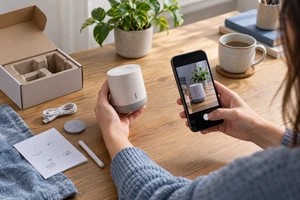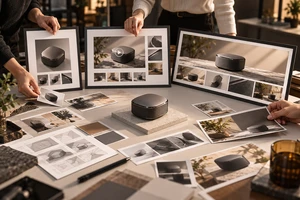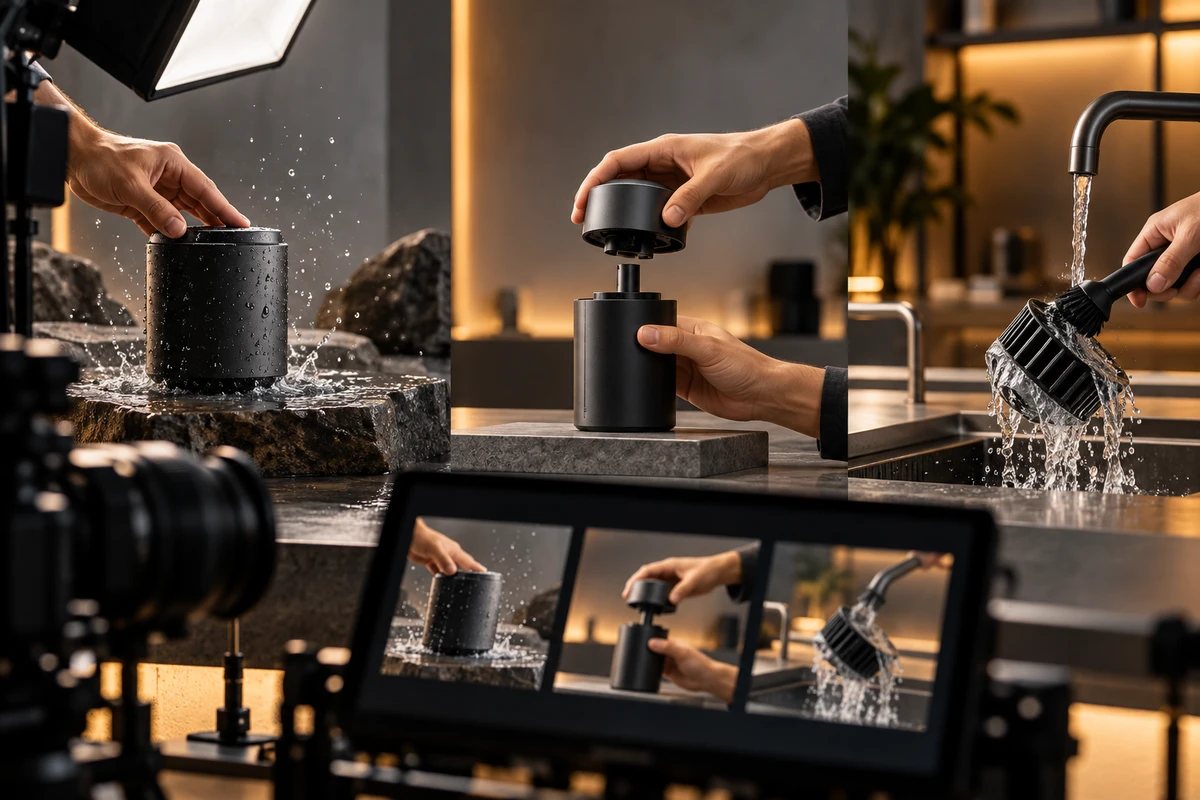
When a product sells on four different questions—water resistance, easy setup, low noise, and simple cleaning—one fixed-sequence hero video is no longer the most useful production unit for Amazon Sponsored Products video. Amazon can accept several feature videos for one ASIN and surface the content it considers more relevant to a shopper’s context.
That changes the buying brief. A brand does not need five different endings to the same edit. It needs independent visual answers: each one reviewable on its own, mapped to a real purchase question, and still intelligible if Amazon shows it first or clips it for a placement.
What Amazon has actually confirmed
Amazon announced Sponsored Products video on November 11, 2025. The company says advertisers can upload one to five product-feature videos per product, with descriptive text for each feature. Shoppers may see up to three feature thumbnails selected for relevance to their search query and browsing history. The same ASIN can also use different feature videos across ad groups.
The current Sponsored Products video guide goes further: an uploaded video may be clipped according to placement, page, or shopper intent. It lists a minimum duration of seven seconds, a 16:9 baseline, 1920×1080 recommended resolution, MP4 or MOV files, and a 500 MB maximum. Audio is removed. Amazon advises making the product the focal point—ideally at least half the frame—and rejects talking-head explanations that depend on sound. Feature names are limited to three words and 15 characters; optional descriptions to six words and 55 characters.
Those facts show what Amazon supports. They do not prove that every marketplace, account, category, or interface exposes the same workflow, and they do not prove that ecommerce video as a whole has completed this shift. Amazon help updated July 27, 2026 still described the format as US-only and unavailable for Books. Confirm the option in the intended marketplace, account, ad group, and child ASIN before commissioning a full set.
Hero film versus feature-answer library
A hero film is built around order. It can establish a world, introduce a problem, demonstrate several benefits, and close on a brand idea. That remains useful for launches, brand storytelling, and products whose value only becomes clear through a connected sequence.
A feature-answer library is built around selection. Every unit must establish the question, show the product action, preserve the conditions, and reveal the result without borrowing context from another clip. Amazon may place “easy cleaning” first for one shopper and “low noise” first for another. If clip three only makes sense after clip two, relevance-based selection breaks the story.
This is why simply cutting a 60-second master into five files is fragile. A mechanical split often creates an opening in the middle of an action, a claim without its condition, a mismatched variation, or a segment whose meaning disappears when the voiceover is removed.
The more efficient production design shares the set, lighting, talent, props, and product preparation while giving each feature its own beginning, proof action, and end state. It captures scale without sacrificing independence.
The ONCE Feature-to-Query Matrix
Before storyboards, give every candidate feature one row:
| Field | Decision question | Acceptance test |
|---|---|---|
| Query cluster | How might a shopper express this need? | Include use cases and concerns, not only product terminology |
| Single claim | What does this clip prove? | Meaning does not depend on another video |
| Visual proof | Which action makes the claim visible? | Real product and real state; animation does not replace key evidence |
| Conditions | When is the claim true? | Variant, accessory, environment, steps, and safety limits remain visible |
| ASIN/variation | Which exact product appears? | Color, size, port, package, and detail page agree |
| Silent legibility | Is the action understandable without audio? | The feature and result are clear from motion and framing |
| Feature label | What will the thumbnail call it? | Short, specific, and faithful to the footage |
| Version owner | Who retires or replaces it? | File ID, moderation status, date, and owner are recorded |
The matrix converts a marketing adjective into a testable shopper question. “High performance” is not a shootable answer. “Does it remain stable under full load?”, “Can it be operated with gloves?”, and “How many steps does cleaning require?” are.
If the team cannot define a visible proof action, repair the product evidence or detail-page content first. Editing should not be asked to manufacture certainty the product cannot support.
A four-part structure for every feature answer
1. Query cue
Let the first frame identify the problem: standing water, a narrow installation space, a late-night noise concern, a stain-prone surface, or the exact action the shopper wants to inspect. Do not spend the opening on unrelated brand atmosphere.
2. Product proof
Show one observable action—sealing, connecting, folding, rinsing, loading, measuring, or installing. The product should carry the proof; talent reaction should not substitute for it.
3. Conditions
Keep the relevant accessory, mode, environment, and procedure in frame. Technical, health, durability, and safety claims need confirmation from product evidence and the responsible reviewer. If the condition cannot be established, the edit should not present the result as unconditional.
4. End state
Finish on a recognizable result. The unit should still close cleanly if Amazon surfaces it first or extracts the most relevant portion.
This mirrors a broader production principle in our guide to filming unboxing, installation, and usage steps: product video creates value when it makes a state the buyer cannot yet verify visible and reviewable.
Cost the approved answer, not the exported file
Five files are not necessarily five usable answers. A clip can lose its commercial value because the variation is wrong, its label overstates the footage, the action is unreadable on mute, or moderation does not approve it.
Use a denominator that reflects acceptance:
Cost per approved feature answer = (feature-fact preparation + dedicated setup and capture + silent-legibility design + title and description work + moderation rework + version maintenance) ÷ feature answers that pass review and map to a defined shopper question
This is not an industry benchmark and it does not predict advertising performance. It simply prevents hidden production work from disappearing before the denominator is calculated.
For a product whose features share one set and handling setup, three to five answers may be captured efficiently in one production day. If every feature requires a different environment, professional test, safety control, or substantiation trail, filling all five slots can increase risk and rework.
A useful estimate therefore separates shared production cost, incremental cost per feature, and post-launch maintenance. “One more feature” might be one additional action—or a new location, prop package, test condition, and approval chain.
When to build the library—and when not to
A feature-answer library makes sense when three conditions hold: the ASIN faces several distinct high-intent questions; each question can be proven through a real visual action; and the media team can connect query or ad-group signals to the content.
It is a poor fit when one feature overwhelmingly decides the purchase, the value requires a continuous story, similar-looking variations have materially different construction, a key claim depends on laboratory or legal evidence, or nobody owns the ASIN-to-asset mapping after launch.
Do not fill five slots because five are available. Amazon’s one-to-five range leaves room for one accurate, approved answer to outperform a larger set of ambiguous fragments.
Rewrite the next production brief
Replace “one 60-second master plus cutdowns” with an ASIN list, a Feature-to-Query Matrix, one-sentence proof tasks, independent shot lists, feature labels and descriptions, mute-state acceptance tests, variation checks, approved version IDs, and a post-launch keep/revise/pause record.
Keep the hero film and the feature-answer library as separate decisions. They can share footage, but they should not be forced into the same timeline. One is designed to be watched in order; the other is designed to be selected, reordered, and sometimes clipped.
The scalable asset is not the number of exported videos. It is verified coverage of the questions that block purchase. When each important question has an independent, accurate, silent-first visual answer, the library becomes an operating asset rather than a folder of edits.
Sources
- Amazon Ads, Show your products in action with Sponsored Products video, November 11, 2025.
- Amazon Ads, Sponsored Products video: A complete guide to setting up effective product feature videos, accessed October 8, 2026.
- Amazon Advertising Help, Understand Sponsored Products video, updated July 27, 2026.
- Amazon Seller Central, Best practices for creating high-quality product videos, accessed October 8, 2026.