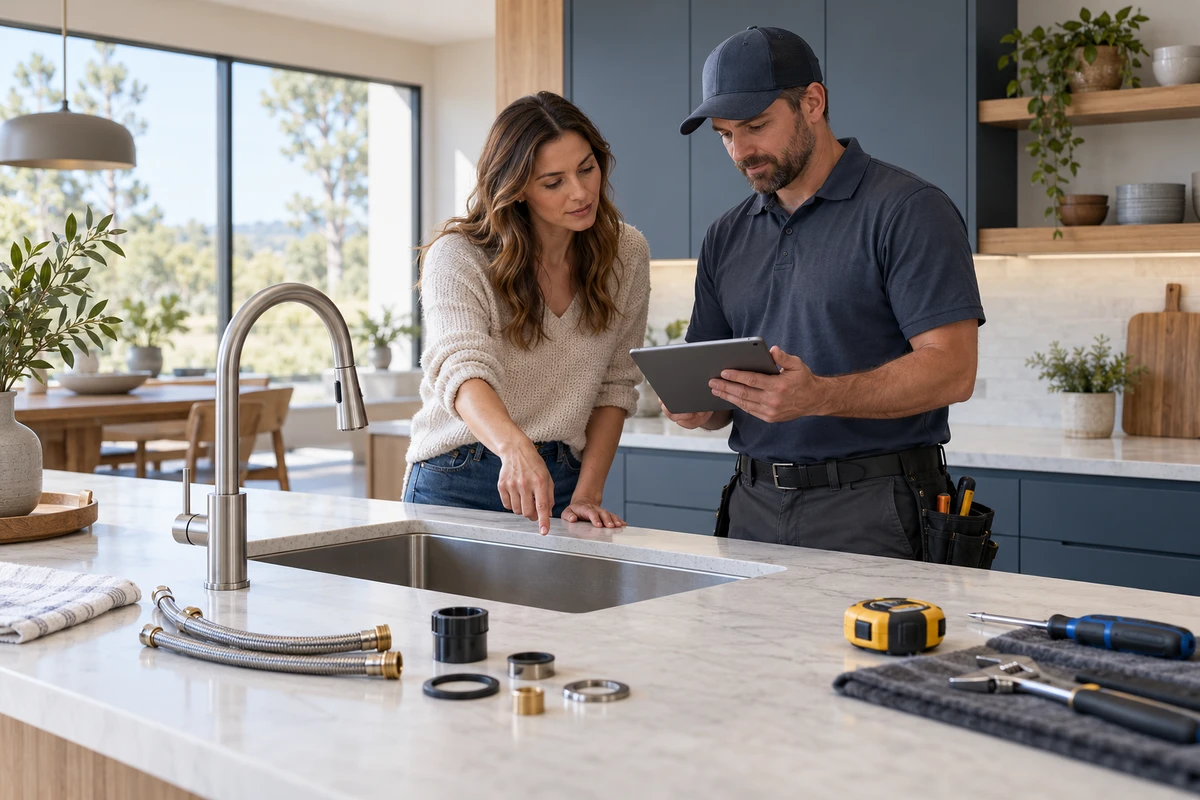
For an installation-dependent product, conversion is not the end of the customer journey. It may be the moment the hardest questions begin: Will this faucet fit the existing cutout? Does the ceiling fan need new wiring? Can the buyer mount the device, or should a licensed professional take over?
Amazon Ads made that gap commercially visible on September 29, 2026, when it announced Sponsored Services. The format can place local-service ads on product detail, order confirmation and package tracking pages. Shoppers can call a provider or request a quote without leaving the Amazon experience. Eligible Yelp advertisers in U.S. home and auto services can use the offering now; broader service-provider access is scheduled through the Amazon Ads Unified API in Q4 2026, with Ad Console access planned for 2027.
Those facts establish what Amazon launched—not that every marketplace has already merged commerce and local services. The useful implication for brands is narrower: when a product creates an installation job, the content system should prepare the buyer, the service provider and support team for the same handoff.
The missing asset sits between the hero film and the manual
Most product videos finish with desire: a clean home, a working device and a call to buy. Installation tutorials begin later, with parts on a table and a sequence of steps. Neither necessarily answers the operational question that connects them: what must be true at the site, where does safe DIY stop, and what does a professional need before accepting the job?
Sponsored Services is designed for service providers rather than as a new video placement for product brands. Amazon says it uses product and search context to connect high-intent shoppers with relevant services. Its own example is a plumber recommendation after a faucet purchase. That makes accurate product and site context more valuable even if the manufacturer is not the service advertiser.
For brands sourcing from China and selling into the U.S., this is a content-supply-chain issue. The factory may own dimensions and interfaces, the brand owns claims and customer communication, and a local professional owns the reality of installation. A polished demonstration that ignores any one of those parties can create confidence before purchase and confusion immediately afterward.
Build a Product-to-Service Handoff Card
Before production, create one handoff card for each material installation scenario. It is a content brief, not a safety certificate or a substitute for model-specific instructions.
| Field | Decision it must support | Visual output |
|---|---|---|
| Customer outcome | What “done” looks like | Product operating in the intended setting |
| Product identity | Which model, variant and accessories apply | Interfaces, labels and included parts |
| Site prerequisites | Required space, utilities, mounting or network | Measured site and connection points |
| DIY stop line | Where the customer should stop | A visible handoff point, not a fast-cut montage |
| Professional scope | What the service provider must assess or perform | Tools, access points and work area |
| Completion check | What can be observed after the work | Approved functional or connection state |
| Exception path | What blocks or changes the job | Incompatible condition and next action |
| Owner and revision | Who approves and updates the scenario | Asset record, not necessarily on screen |
The card should be reviewed by product, support and the responsible service function. If local regulations or qualifications apply, the authorized party defines the technical requirements. A production company can make the information clear; it should not invent an installation standard.
This approach extends the logic in ONCE’s guide to filming unboxing, installation and usage as different communication tasks. The additional step is to define who receives each scene and what decision it is meant to unlock.
Four shots create a reusable handoff scene
Start with a prerequisite shot. Show the cutout, outlet, pipe, mounting surface, clearance or network condition with enough reference to make the requirement understandable. A beautiful installed product does not establish fit.
Next, show the stop line. Separate customer-ready preparation from electrical, gas, structural or other work that belongs with a qualified professional. Avoid compressed “easy install” montages when the real conditions vary.
Then create the handoff shot. Package the model, relevant accessories, site photos and unresolved question into a short module that can live in a product page, support reply, help center or service-request flow. The goal is not to teach every installation step; it is to give the next party a reliable starting point.
Finish with an approved completion state. A smile is not acceptance. Depending on the product, the observable state may be correct opening and closing, a stable mount, expected water flow or a verified connection. The product owner and service owner must define that state from their actual documentation.
Price the confirmed scenario, not the finished minute
A handoff scene can be reused across retail, advertising, support and service operations, so cost-per-video is a weak procurement metric. A better internal denominator is the confirmed installation scenario:
Cost per accepted installation scenario = (product-fact preparation + set and production + installer review + localization + safety/compliance review + version maintenance) ÷ scenarios approved by both product and service owners
The denominator matters. A clip does not become an accepted scenario simply because it was filmed. It must identify the applicable model, prerequisites, DIY stop line, professional scope and completion check. The formula also exposes costs that are often hidden in the edit budget: expert review and future updates when interfaces, manuals or local requirements change.
Do not lower the number by forcing incompatible homes, utilities or product variants into one generic sequence. Reuse is valuable only when the scenario remains accurate.
When to invest—and when to hold back
This system is useful when site conditions are measurable, the professional task can be scoped, completion is observable and service coverage exists in the target market. Start with one high-volume model and one recurring installation question. If the handoff card survives review by product, support and a local service professional, expand it across the line.
Hold back from a service promise when coverage is inconsistent, regulated work is involved, building conditions vary widely, no qualified local reviewer is available, or responsibility is split unclearly among brand, seller, marketplace and provider. Content can still explain preparation and escalation, but it should not imply universal availability, a fixed price or guaranteed completion.
Amazon’s launch does not prove that product-to-service commerce is now universal. It does show that the post-purchase job is becoming an addressable, measurable commercial moment. Brands that turn installation prerequisites, handoff points and completion checks into maintained content assets will be better prepared for that moment than brands that stop their story at the buy button.