Cross-Border Product Video Market Research 03/10 · ONCE Cross-Border Product Video Market Research
This article examines one defined task: how a product video should organize information for Japan-based online shoppers comparing a compact self-emptying robot vacuum for the first time. “Reassurance” here is not a national personality. It means being able to judge whether the machine fits, sets up correctly, completes the relevant job, can be maintained, and has a real support path if something goes wrong.
Translating an English robot-vacuum film into Japanese often produces one of two opposite failures. One merely replaces subtitles while retaining the oversized show home, English app, imperial units, different plug and overseas support route. The language changes, but the buying questions do not. The other tries to put every concern on screen at once: dimensions, suction, mapping, obstacle avoidance, dock, mop, consumables and warranty all compete for attention until the viewer can only read and cannot see how the machine works.
Our central argument is that the most valuable change for a Japanese-market version is not a presumed “Japanese style” but the order in which uncertainty is removed. First let the target buyer confirm that the product works in their space. Then show how first use begins, whether it completes the job they care about, what routine maintenance requires, and where support and returns actually lead. Japanese subtitles alone may be enough only when the product facts, retail version, operating interface and this information order are already aligned.
Scope: one buying task, not a claim about what Japanese people like
We limit the scenario to a compact robot vacuum with a self-emptying dock and an app used for part of the setup, sold online to adults in Japan. The target segment is buying this category for the first time and comparing models on a product page or in a social ad. Home size, household, flooring, pets, technical confidence and price sensitivity can all vary. National averages cannot tell us that every viewer likes cute characters, subtle messaging, slow pacing or dense on-screen explanation.
Online explanation matters here because appliances already occupy a substantial remote-purchase context. Japan's Ministry of Economy, Trade and Industry reported in August 2025 that the 2024 B2C e-commerce ratio for household electrical appliances, AV equipment, PCs and peripherals was 43.03 percent. This category statistic does not say that robot-vacuum shoppers necessarily watch video, and it does not prove that one creative style raises sales. It only gives brands a practical reason to make scale, operation and support legible in a remote buying environment.
For this review we compared two Japanese studies on the design of operating information, a meta-analysis of multimedia segmentation, current Consumer Affairs Agency materials, and published ONCE appliance content. We did not find a field experiment directly comparing dense and sparse subtitles in Japanese robot-vacuum ads using incremental purchases as the outcome. The production judgments below are therefore evidence-constrained inferences, not a claim that a national preference has already been established.
The evidence is less contradictory than it looks: more information is not automatically more reassuring
Explaining why an action works can matter more than adding another specification
A 2024 article by Toshihiro Doi, Saichi Yamamoto, Daichi Seto and Yoshitaka Shimizu, “Effects of Conceptual Information about Mechanisms in Operating Manuals on Product Understanding: A Comparison of Effectiveness in Paper and Video”, compared four microwave-oven explanation conditions: no manual, a conventional manual, a paper explanation containing conceptual information about the mechanism, and a video containing that conceptual information. The journal abstract reports better product understanding when the mechanism was explained, with the video condition showing a particularly large benefit.
This was a study of operating manuals and microwave ovens. Its outcomes included self-evaluation and comprehension tests, not ad liking, clicks or sales. We accessed the public abstract, which did not disclose the sample size or effect estimate, so we do not supply either. The limited production implication is that when viewers lack a working model of the product, connecting an action to its mechanism may help more than presenting an isolated parameter. For a robot vacuum, this means showing a continuous relation—mapping a route, approaching an obstacle, adjusting and returning to the dock—rather than displaying five technical labels at once.
More explanation can also make a product appear harder to use
A 2025 conference study published in 2026, “The Impact of Information Design in Instruction Manuals on Product Purchase Psychology”, used an online randomized comparison with 600 participants in their twenties through sixties. The conference abstract reports higher product attractiveness for a digital manual than for a thick paper manual and argues for removing unnecessary explanation. The outcome was product attractiveness, not correct operation or actual purchase, and a digital manual is not the same thing as a short product film. The result cannot prove that Japanese viewers “prefer fewer words,” but it warns against making the product look as if a book must be read before use.
Segmentation and cues are useful transfers, not e-commerce effect claims
Rey and colleagues' 2019 “A Meta-analysis of the Segmenting Effect” synthesized 56 investigations and 88 pairwise comparisons. It reported small-to-medium overall effects on retention and transfer, lower overall cognitive load, and longer learning time. These were multimedia-learning studies, not Japanese e-commerce ads. Their relevance to editing is not “make more cuts”; it is to let each segment complete one recognizable task and cue the relevant component when the action occurs.
Taken together, the evidence points in one direction: reassurance comes from necessary information appearing at the right moment, not from maximizing information volume. When the buyer needs a mechanism, the explanation should not disappear. When an action has already answered a question, voice-over, captions, icons and fine print should not repeat it four more times.
Reorder the Japanese version around five questions, not the feature list
1. Will it fit? Show the relationship between product and space first
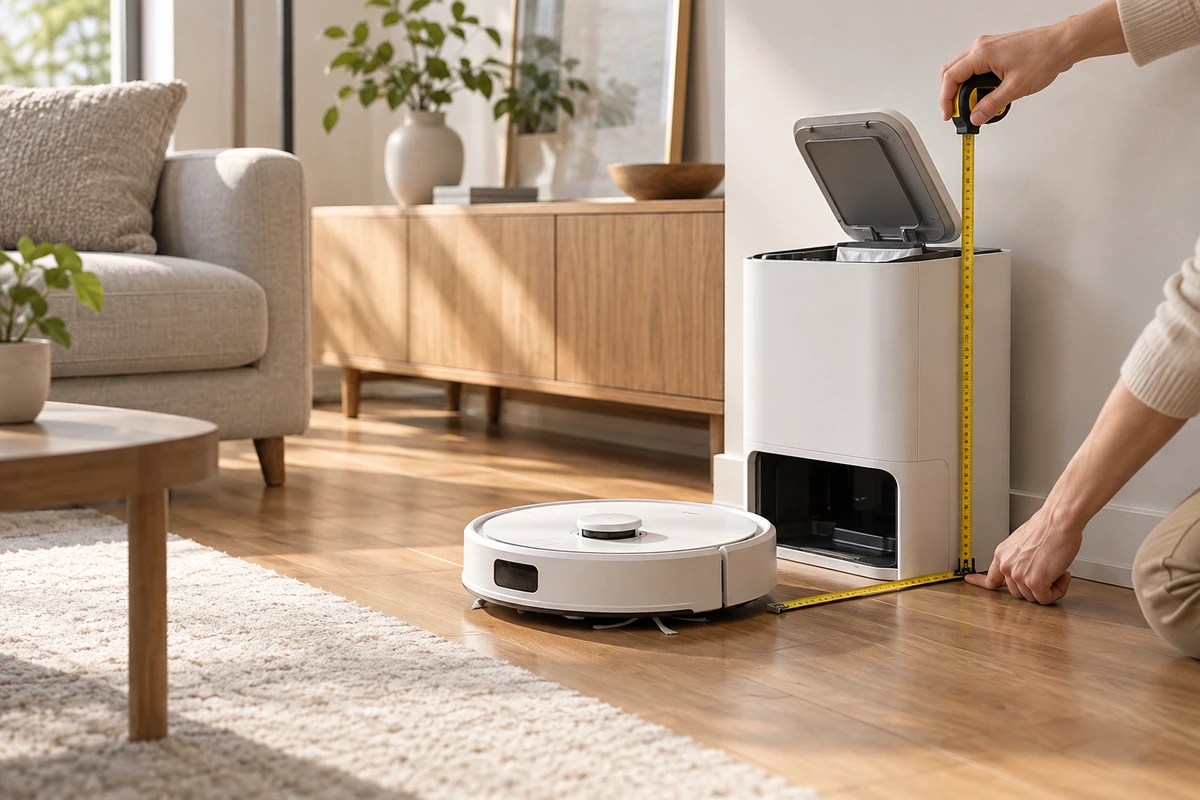
The opening does not have to begin with suction or AI. For the first-time buyer defined here, more basic questions come first: can the robot pass under furniture, where can the dock stand, and is there enough clearance to open the lid and replace the bag? Use the same retail model to establish robot diameter and height, dock footprint and opening direction. Show dimensions in centimetres and include a verifiable cabinet edge, sofa gap or threshold. An exaggerated wide lens, a dock borrowed from another model or the word “compact” without conditions can make a lifestyle scene useless as evidence.
ONCE's published CHiQ built-in refrigerator product-video case is a useful page-level observation of spatial communication. The visible material uses cabinetry alignment, door movement and interior storage to turn “fit” into action, while the page explicitly notes that installation dimensions and clearances must be checked for the relevant model. We read the page text and visible imagery; we do not claim that the case proves a Japanese preference or commercial uplift.
2. Can I get started? Show unboxing, connection and mapping as a completed state
The second segment addresses setup cost. After opening the box, a buyer should be able to see which accessories are included, where the bag or tank goes, whether the app offers natural Japanese, how connection begins and what counts as a completed first map. Reusable footage includes unboxing, clips, charging contacts and genuine machine movement. If Japanese packaging, plug, accessories, app region or interface differ, reshoot or record the correct interface. Covering an overseas UI with a Japanese graphic creates a new inconsistency instead of localization.
Japanese review must go beyond grammar. Button labels, app menus, packaging, quick-start material and support pages should use the same terms. If the picture says one word for mapping and the narration uses another, the viewer may reasonably treat them as different functions. The localization task is to make terms and actions correspond, not merely to make sentences more polite.
3. Can it complete my job? Demonstrate one verifiable problem
Only the third segment moves to capability. Choose one task that matters to the defined buyer: for example, travelling from wood flooring across a threshold whose height can be stated, avoiding a defined set of obstacles and returning to the dock. Use a wide shot to establish conditions, a follow shot that does not hide the causal action, and a result shot. If speed changes, substitute flooring, pre-cleared obstacles, an atypical sample or compositing materially alters the interpretation, it should be documented internally and reflected in the outward claim.
Do not expand one successful demonstration into “never gets stuck,” “never collides” or “best obstacle avoidance.” ONCE's article on planning clear product-use scenes explains how to connect a task, an observable action and a result. Here we borrow the organization of the demonstration, not any performance result from another appliance.
4. What work remains every day? Put maintenance after use
A film that shows only autonomous operation hides labour. After the task, the Japanese-market version can show the real maintenance required by that model: emptying, replacing a bag, removing hair, washing a mop, refilling clean water or handling wastewater. Consumable part numbers, replacement conditions and local purchase routes should match the retail page. If the brand does not have dependable supply in Japan, a caption saying “easy maintenance” cannot substitute for inventory and fulfilment.
The maintenance segment need not reproduce the entire manual. Let the shot show the action and use short text for the object and condition. Put complete steps, safety information and troubleshooting in an accessible Japanese help page. The main film reveals the practical burden, and the details remain available when they are needed.
5. Who helps when something goes wrong? Connect the film to real service
The final reassurance question is an operating capability, not a visual style: who provides the warranty, how Japanese support is reached, where consumables and repairs are available, and where return conditions can be read. Video can show the Japanese support card in the retail package or send the CTA to a clear page. It cannot replace a support process that does not exist. If repair time has not been confirmed, do not promise a rapid response; if returns apply only under stated conditions, do not imply unconditional returns.
The Consumer Affairs Agency's current guidance on mail-order advertising explains that when an advertisement allows consumers to apply for a purchase, statutory information must be displayed, and any special return terms need to state whether returns are accepted, the period and conditions, and who bears the cost. A short video does not need to carry every provision. The video, landing page, final confirmation screen and actual customer-service practice do need to agree.
What can be shared, re-edited or reshot
Prioritize for reuse: text-free footage of the same Japanese retail model—exterior, structure, opening, charging, continuous movement, before-and-after states and authentic product sound that does not change by region. Capture a clean master, separate text layers, interface recordings and enough safe area for horizontal and vertical versions.
Usually re-edit: the target buyer asks questions in a different order; the global film begins with a brand story, while the Japanese product-page version must first establish dock footprint and initial setup; the same action must align with Japanese labels, units, prompts and CTA. Re-editing means changing which question is answered first, not merely shortening the master.
Usually reshoot or re-record: Japanese packaging, plug, accessories or app UI differ; the existing set cannot establish target dimensions; the original shows only the result of autonomous cleaning and omits setup, maintenance or recovery; a performer is presented as a real user without the corresponding experience or identity.
Fix the business before the film: consumables have no dependable Japanese supply, the support route cannot be found, the warranty provider is ambiguous, or product-page dimensions do not match the sample. Video can expose these gaps but cannot repair them on its own. ONCE's Shopify product video production approach shows how page placement and product explanation can be planned as different jobs within one buying journey.
How Japanese representation rules enter the script as of October 6, 2026
Performance imagery can make a claim, and substantiation must match it
The Consumer Affairs Agency's current page on unsubstantiated advertising under the Act against Unjustifiable Premiums and Misleading Representations explains that authorities may request reasonable grounds for an efficacy or performance representation suspected of being misleading. The material must be objectively substantiated, and what it demonstrates must properly correspond to the representation. For robot vacuums, claims about cleaning, noise, obstacle avoidance, runtime or sterilization can be made not only in words but also through comparison imagery, sound treatment and editing. A demonstration under controlled conditions cannot become a universal guarantee across all floors, homes and modes.
The CAA's September 26, 2024 survey on No. 1 representations and its current Q&A also caution that prominent statements such as “No. 1 in sales” or “No. 1 in customer satisfaction” may be problematic when they are not based on reasonable and accurate research. The production team should record the population, scope, period, comparison set and wording actually supported before storyboarding. Without the material, do not smuggle “first” into the film through crowns, podiums or narration.
A creator-like tone cannot hide the advertising relationship
Japan's designation covering representations that are difficult for consumers to identify as business advertising took effect on October 1, 2023. The CAA's current stealth-marketing Q&A explains that the party primarily regulated under the Act is the business involved in deciding a representation about the goods or services it supplies—the advertiser in ordinary terms. A contracted influencer or affiliate is generally not the direct regulated party under this designation unless, exceptionally, that person jointly supplies the goods. That distinction does not remove the advertiser's responsibility.
Brand-actor performance, brand-produced UGC-style footage, a real customer testimonial, paid creator content and an unsolicited user post should therefore remain separate in project records. Handheld camerawork, casual speech and an ordinary home are formal choices; they do not turn a scripted scene into real user experience. When the brand participates in deciding the content, the commercial relationship should be identifiable to the audience in a manner appropriate to the placement and cooperation.
This article is not Japanese legal clearance. Applicability still depends on the seller, product category, specific representation, channel and commercial relationship. Electrical safety, privacy, radio requirements and platform rules require separate review where relevant.
A minimum comparison: determine whether the problem is language, order or missing facts
Test proposal, not an experiment we have run: create two 20-to-35-second edits for the same Japanese retail SKU. Keep the product, price, first-frame recognizability, primary actions, placement, audience and opportunity for exposure as comparable as practical. Have both Japanese versions reviewed by a native editor.
- Version A: retain the global-master order and replace only Japanese voice-over and captions.
- Version B: reorder around fit, setup, task completion, maintenance and support; show text only when the corresponding action occurs.
Do not begin with purchase. Ask target viewers to complete five tasks: identify dock-space requirements, restate first setup, describe the floor or threshold conditions of the demonstration, identify one maintenance action, and find the warranty or return route. Record correct understanding, completion time and unanswered questions separately from credibility, relevance and desire to learn more. If Version B improves understanding but increases viewing time, decide whether the product-page placement can support it. If both versions are misunderstood, fix missing facts and Japanese terminology. If understanding and behaviour do not differ reliably, there is no basis for a large reshoot merely to appear “more Japanese.”
Conclusion: rebuild the order of understanding before surface style
For the compact robot vacuum and first-time buyer defined here, subtitle-only localization has strict conditions: the Japanese market receives the same model and accessories; dimensions, plug, interface, units, claims, maintenance and support all match; the original is already organized around the target questions; and text does not cover the operation. If one condition fails, consider re-editing, interface capture or additional shooting as well as language work.
Reassuring the buyer does not mean making the film more subtle or adding more explanation. It means letting a viewer confirm space, start, task, maintenance and support in sequence. Interviews, usability checks and a small controlled comparison can refute or revise that sequence. That makes it a better production brief than a claim about the style “Japanese consumers prefer.”
This extends the series' Episode 02 analysis of what to share and reshoot across EU markets: reuse truthful product actions, and localize the parts that change understanding and responsibility. If you are preparing a Japanese launch, bring the retail SKU, packaging, app interface, manual, support path and current master to ONCE. We can map the assets against the five questions and decide what can be reused, re-edited or must be reshot before assigning the budget.
Research note: Sources were checked through October 6, 2026. This is an ONCE editorial analysis, not a systematic review, peer-reviewed paper or legal opinion. We accessed the public abstracts of the 2024 journal study and 2026 conference paper; the segmenting meta-analysis was read through its abstract and visible methodological information; Japanese rules were checked against CAA pages available on the date. ONCE articles and case pages were read in full at page level; the referenced case film was not fully played, so we make no audio, time-code or performance claims.