Cross-Border Product Video Market Research 02/10 · ONCE Cross-Border Product Video Market Research
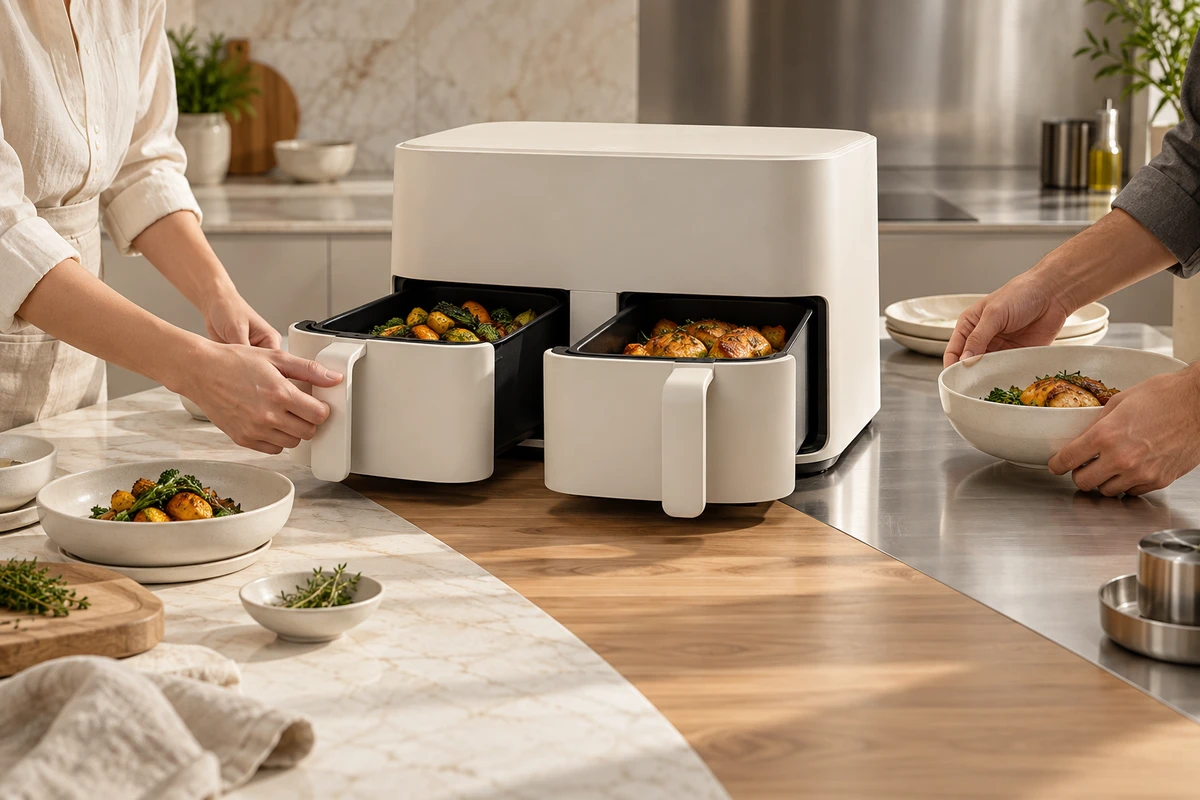
Can the same dual-basket air fryer enter Germany, France, and Spain through one “European” film with three subtitle files? More can be shared than many teams assume, but what must change extends well beyond translation. The reusable core is product truth and visible action, not an abstract European style. The local layer is what a buyer needs to understand now, in which language, through which promise, and whether that promise is supportable in the market.
Our central judgment is to shoot one verifiable evidence base, then rebuild the decision layer for Germany, France, and Spain; reshoot only when a local proposition requires a different person, setting, or product action. This demands more judgment than assigning “rational” imagery to Germany, “elegance” to France, and “warmth” to Spain. It also maps much more closely to the real cost and risk of cross-border production.
The scope is general small appliances sold to adult consumers through ecommerce pages and social advertising. This is not complete legal clearance for the EU or its Member States. Category rules, platform accounts, selling entities, and exact territories still require project-specific review.
“Can we reuse it?” is really three questions
First, can the product facts travel? If the model sold is identical and the filming conditions are accurate, the geometry of two baskets, separate timer controls, opening and closing, cleaning steps, included accessories, and the completed result can usually form a shared asset base. Second, can the information order travel? One segment may first ask whether two dishes can finish together; another may begin with cleaning, counter space, or operating difficulty. The footage can stay the same while the opening and shot order change.
Third, can the promise travel? “Energy efficient,” “eco-friendly,” “easier family dinners,” and “EU-certified quality” are not ornamental phrases. They concern substantiation conditions, environmental claims, a specific use context, and the accurate meaning of a compliance mark. If the evidence, sales version, or local-language duties do not support the line, copying the same subtitle into three languages multiplies one problem across three markets.
A unified shoot therefore does not require one final film. It should begin with a shared evidence layer, followed by a decision about which markets need new voice-over, captions, and editing, and which need different settings, people, or additional shots.
Research does not support writing national labels into the storyboard
Hornikx, Janssen, and O’Keefe’s Cultural Value Adaptation in Advertising is Effective, But Not Dependable: A Meta-Analysis of 25 Years of Experimental Research appeared online in 2023 and in a 2026 journal issue (DOI: 10.1177/23294884231199088). It synthesized 121 persuasion comparisons involving 12,201 participants, based on searches ending in 2018. The mean effect was r=.049, while the 95% prediction interval ran from -.187 to .281 and crossed zero. A small positive historical average and failure in the next campaign can both be true.
The European subset matters here: the pooled persuasion estimate was close to zero, and ad liking did not show a stable advantage. The evidence spans countries, media, and experimental materials; it is not a sample of 2026 appliance videos. It nevertheless rules out an easy inference. A country-level cultural mean cannot establish that every buyer in that country prefers one appeal.
A language-adaptation study published online in 2026, Depecik and colleagues’ Effective Advertising Through Language Adaptation: Tailoring Ads to Diverse Purchasing Contexts, also complicates the dubbing-versus-subtitles shortcut. The research spanned Italy, Spain, and Mexico and used a roughly 40-second fictitious chocolate video, with audio and subtitles varied in parts of the program. One Spanish study retained 205 native Spanish speakers with high English proficiency. Its implications concern matches among purchase context, psychological distance, and language format, not a universal Spanish preference for dubbing or subtitles. Outcomes centered on processing fluency and brand evaluation, not orders, and the product was not a small appliance.
Together, these sources suggest a better production method. Replace “make the German version more rational” with “does this selected audience need to see operating conditions first?” Replace “make the French version more aesthetic” with “can natural French and the picture explain the benefit together?” Replace “make the Spanish version more emotional” with “for this self-purchase, gift, or household task, which combination of dubbing, captions, and context is easiest to process?”
Share product evidence, not a locked master film
For a dual-basket air fryer, the common shoot should preserve continuous action rather than only polished food close-ups:
- Product identification: body, two-basket layout, control area, and included accessories corresponding to the actual sales model;
- Operational causality: loading different foods, setting both zones, starting, and showing the completed state without jump cuts that conceal essential steps;
- Size and capacity: a real counter and checkable vessels that establish scale, without wide-angle distortion that exaggerates volume;
- Cleaning and storage: complete removal, cleaning, and reassembly, without implying that a part is dishwasher-safe when it is not;
- Conditions and limits: time, temperature, food weight, preheating, and accessory conditions consistent with approved documentation.
These assets let each market version reorder the answer. A selected German segment might begin with operation and safety, a French purchase situation might establish use before detail, and a Spanish household context might first show how two dishes finish together. The order can change; product truth cannot change with the edit.
This is why “make one hero, then cut everything from it” often fails. A master locks plot, speech, and graphics into the frame, leaving later versions able only to become shorter. A shared evidence library retains product actions, textless environment shots, reactions, and separated sound stems. For delivery decisions around captions, textless masters, and real players, see ONCE’s guide to Shopify product-video captions.
Common EU rules limit which phrases can become universal selling points
As checked on October 6, 2026, Directive (EU) 2024/825 has applied since September 27, 2026. The European Commission’s sustainable-consumption overview and the official Directive text address generic environmental claims such as “green” or “environmentally friendly” when recognized excellent environmental performance relevant to the claim cannot be demonstrated. They also address claims about an entire product when only one aspect is supported, sustainability labels without an approved certification scheme or public authority, and future environmental-performance claims without a public, verifiable plan.
Pictures can participate in the claim. Leaves, a planet, recycling imagery, natural colors, and an “energy saving” voice-over may collectively imply a substantiated environmental advantage for the whole appliance. Before filming, write down the comparator, conditions, model, and whether the claim is absolute, relative, or merely describes a feature. Evidence for one cooking condition cannot support expansive green imagery that implies more.
CE marking should not become a European quality trophy. The Commission’s official CE marking explanation defines it as the manufacturer’s declaration that applicable EU requirements have been met. It does not apply to every product, does not mean an EU authority approved the product as safe, and does not indicate origin. A film may accurately show a required mark on the sales product; it should not enlarge and animate it under a “premium EU certification” claim.
The General Product Safety Regulation, Regulation (EU) 2023/988, applicable since December 13, 2024, also requires distance-sales offers to display manufacturer details clearly and visibly. Where the manufacturer is outside the EU, information about the EU responsible person is relevant, along with product identification, an image, and warnings or safety information. Every short video does not need to narrate every listing field, but the film must not hide, alter, or contradict them. Video, listing, packaging, and warnings belong in the same version review.
Germany: a German-language duty is not proof that Germans only want specifications
Section 6 of Germany’s Product Safety Act, the ProdSG, addresses products within the scope of the GPSR. The official German text requires relevant instructions and safety information, including warnings and safety information in online offers, to be provided in German. The practical conclusion is not that every marketing line must become a dense specification panel. It is that information needed for safe and correct use cannot remain only in an English master.
A German version can reorder shared footage: show separate basket settings first, then place power, capacity, temperature range, or cleaning conditions next to the corresponding action. A native-language review is necessary; long German compounds should not be forced into the same layout by shrinking the type. A warning that flashes only at the end or sits underneath a platform button may be translated without becoming understandable.
Whether the chosen audience values specifications, household relevance, or saved steps more still depends on category, price band, channel, and buying stage. Regulation identifies a minimum information responsibility; it does not prove an aesthetic preference.
France: French is part of the buying decision, not an accessory caption
Article 2 of France’s Law No. 94-665 of August 4, 1994 requires French in the designation, offer, presentation, instructions, warranty conditions, and written, spoken, or audiovisual advertising of goods and services. The French competition and consumer authority’s official explanation of French-language use adds that the French version should be as comprehensible as the original, without necessarily being word-for-word.
This changes the script, not just the export list. If an English voice-over begins with a pun and only later lets the image explain the function, literal translation may be neither natural nor clear. The French version should preserve approved product facts, rewrite them in natural French, and keep material conditions equally visible in sound and image. Foreign-language packaging, interface terms, and warranty details must also match the real sales version.
None of this proves that French viewers always prefer cinematic imagery. A buyer actively comparing capacity and cleaning may benefit from direct demonstration. A new-product awareness task may need setting and relationships to explain the benefit. The buying question chooses the style; the language duty remains a condition of any style.
Spain: explain mandatory information at least in Castilian, but do not turn language into a personality test
Spain’s consolidated consumer-protection law, current on February 28, 2026, states that labeling and presentation must not mislead and must provide truthful, sufficient essential information clearly and accessibly. Its official BOE text says mandatory labeling and presentation information for goods marketed in Spain must appear at least in Castilian, subject to EU law, exceptions, and sector-specific rules. Co-official languages, autonomous-community rules, channels, and categories may require further review.
For the air-fryer film, the safer method is not mechanical replacement of English subtitles. First define the viewing task: comparing two models, buying an appliance for oneself, planning family meals, or choosing a gift. The 2026 experiment above suggests that purchase context can change how dubbing and subtitles are processed. It supplies a hypothesis, not a conclusion for this product.
If the placement is a product page viewed on mute, key steps and conditions should stand independently in Spanish on screen. If it is an audio-on social ad, compare natural dubbing with a captioned version while keeping footage, product facts, offer, and exposure opportunity as similar as possible. Measure liking, comprehension, trust, clicks, and incremental purchase separately; none substitutes for all the others.
When re-editing is enough, and when the camera must return
Re-editing and language production can be sufficient when all three markets sell the same model and accessories; the demonstration contains no territory-specific action; claims and test conditions are identical; textless shots leave room for voice-over and captions; the talent does not imply first-person experience or a local identity; and music, talent, and asset rights cover the territories.
Additional product shots are needed when a local buying reason requires a visible action that is absent. A claim that the appliance suits a smaller counter cannot be supported by a wide, empty kitchen shot. A local accessory cannot be explained using footage of another set. A common local serving or vessel cannot be understood from food beauty shots that provide no scale. Subtitles cannot manufacture missing evidence.
People and settings need reshooting when the original context creates a false use relationship. The plug, packaging, interface, utensils, household role, or routine conflicts with the target version; an actor is scripted as an actual customer without the experience; or an English joke loses the function when translated. Localization here means restoring a credible use logic, not adding flags, landmarks, or stereotyped palettes.
The IEETek P2400 case page in Chinese offers a limited public observation of one product distributed across distinct information tasks: the readable page places outage, kitchen, workshop, and camping settings alongside product close-ups and connection actions. We read the page copy and visible imagery during this run but could not play the complete film or verify its sound. It illustrates expression and organization, not European preference or client growth.
Use one minimum comparison to decide what should change first
Proposed experiment, not yet conducted: begin with one country, one segment, and one buying question. Keep product facts, price, principal actions, media placement, and brand foundation constant. Compare a context-first opening with a demonstration-first opening. Both use native-reviewed language and equally visible qualifications.
First test comprehension: can viewers explain how the two zones are set, under what conditions the result holds, and which accessories belong to the sales version? Then record relevance, credibility, liking, and willingness to continue separately. A small sample can reveal misunderstandings; it cannot establish a national preference. In live media, document random assignment, comparable exposure, stock, price, reviews, and landing-page changes. A platform allocating variants to different users does not by itself identify a creative causal effect.
A falsifiable prediction is more useful than a national impression. If a lifestyle opening raises relevance but delays operational understanding, shorten it or move the action earlier. If the demonstration is clear but unbelievable, inspect conditions and substantiation before changing the actor. If the country versions show no reliable difference in comprehension or behavior, keep the shared actions and avoid low-value reshoots.
Conclusion: lock product truth before choosing what may vary
German, French, and Spanish versions can share product structure, actual operation, result states, textless environment footage, and approved conditions. They need distinct work on natural language, information order, captions and dubbing, mandatory consumer information, local sales versions, the scope of claims, and calls to action. Reshoot people and settings only when they carry a different buying reason.
This continues the series’ first study of authenticity and credible buying reasons in US product videos: market difference should become an observable question and a comparable treatment, not a national adjective. For a practical claims workflow, see ONCE’s guide to reviewing performance claims in cross-border product videos.
If you are planning EU product-video versions, bring ONCE the target countries, sales model, product documentation, current script, and the three most common buying questions in each market. We can first divide the shared shoot from what genuinely needs rewriting or reshooting, then decide whether budget belongs in language, editing, or new production.
Research note: Searches ended on October 6, 2026. This is ONCE editorial analysis, not a systematic review or peer-reviewed paper. We read the methods, results, and prediction intervals in the cultural-adaptation meta-analysis; for the 2026 language-adaptation paper, we used the publisher abstract and visible method information. EU, German, French, and Spanish rules were checked against official texts or official explanations readable on that date; a real project still requires verification by entity, category, channel, and territory. ONCE internal articles and the case page were read in full. The case film itself could not be played completely, so no sound, timecode, or performance inference is made.