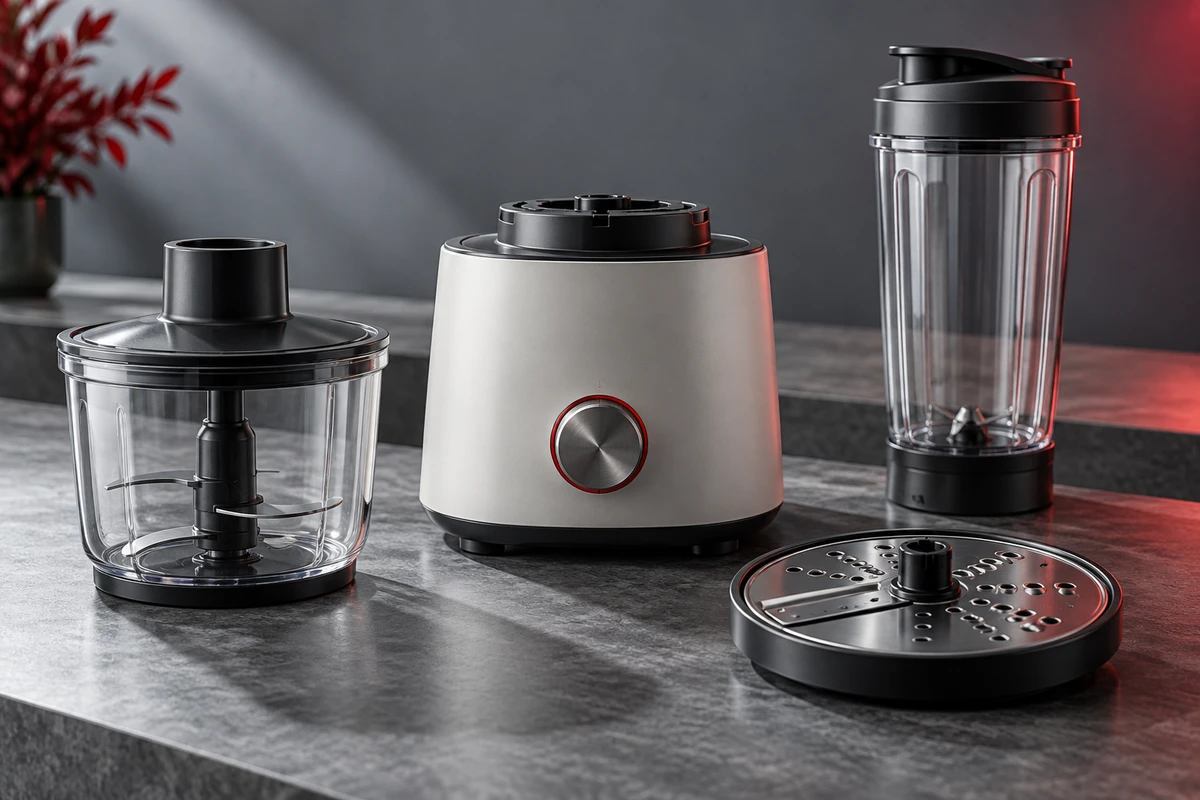
Suppose a product has three useful features: grinding, heat retention, and easy cleaning. A conventional brief might turn them into one linear film—introduce the product, explain the three benefits in order, then close with a reason to buy. Amazon's newer Sponsored Products product-feature video format changes that assumption. The platform may surface features according to search and browsing context, while a longer upload may be clipped to the segment Amazon considers relevant to the placement or shopper intent. A film that only makes sense from beginning to end is therefore a fragile asset.
The more useful procurement unit is a set of self-contained feature-proof modules that can play alone, change order, or survive clipping. Each module should answer four questions by itself: What feature is being demonstrated? What action can the shopper actually see? Under what conditions does the result hold? Is the product shown the same version as the advertised ASIN? This is not a long film chopped into five equal pieces. It is a production design in which each buyer question becomes a complete, observable loop before the cameras roll.
Sponsored Products video is not a new name for the listing film
Amazon Ads' current UK guide describes Sponsored Products video as a product-feature format for one ASIN. An advertiser can upload one to five feature videos, and shoppers may see up to three feature thumbnails selected for relevance to their search or browsing context. The guide also says that the same ASIN can use different feature videos in different ad groups and that a longer upload may be clipped according to placement, page, or shopper intent. These details come from the Amazon Ads UK guide, checked on October 6, 2026. Availability, account eligibility, and market-specific implementation still need to be confirmed inside the advertiser's own account.
This format has a different job from two other common Amazon video assets:
- Product-detail-page shoppable video helps a shopper who is already on the page understand use, assembly, size, materials, or troubleshooting. Amazon's May 12, 2025 official article lists product overview, unboxing, how-to, setup, and troubleshooting among the available types. It can support a more complete explanation.
- Sponsored Brands video introduces a brand or product collection. Amazon's current video specifications state that these videos run for 6–45 seconds and autoplay muted when at least 50% of the ad is visible. The opening, brand attribution, and relationship to the landing page therefore matter.
- Sponsored Products video works more like a set of feature entry points for one ASIN. The current guide says each video should show a product feature, benefit, or use; the product should occupy at least 50% of the frame; and audio is removed. It also rejects a talking-head approach that depends on a script or captions to explain the product.
A single production can share products, sets, and source footage across these uses, but the three placements should not be forced to share one edit. ONCE's Amazon product-video production service similarly separates listing demonstrations, feature content, and advertising cutdowns. “One production” should mean shared, approved product facts and footage—not one finished timeline expected to survive every use.
The real risk is not a changed order; it is evidence that depends on the previous shot
Imagine that a coffee-machine film first establishes, in a wide shot, that the appliance includes a grinder. The second section shows beans falling into an unidentified internal component. Only the third section reveals the finished coffee. If the second section appears alone, the shopper sees motion but may not know which component it is, what the action is supposed to prove, or whether the result came from the same machine. The shot is not necessarily false; it has simply lost its diagnostic value.
Teams often try to rescue this problem in post-production with more titles and subtitles. Yet the no-audio condition and product-led requirements of Sponsored Products video mean that text cannot substitute for product action. Amazon also requires the feature title to match what the video actually demonstrates. A module labelled “waterproof” that only shows a person walking in rain—without showing the material, water exposure, or the relevant result—still has not completed the proof.
A storyboard review should therefore ask more than “Does the full film flow?” It should also ask:
- If this feature module is removed from the timeline and played silently, can an unfamiliar viewer say what the product did?
- Can the viewer see the material conditions that affect the result, such as distance, capacity, connection method, duration, sample version, or accessory?
- If playback begins midway through the module or the platform clips a section, do product identity, action, and result still appear within the same unit?
- Does the feature title name an already visible fact, or is it being asked to explain an otherwise ambiguous image?
Write each selling point as a feature-proof sheet
A shootable feature-proof sheet does not need a complicated score. It does need five clear fields.
1. The buyer question. Replace a vague phrase such as “powerful suction” or “easy to clean” with an observable question: Can the vacuum remove debris along the edge of a rug? Can the dust cup be detached without the user's hand touching the debris? One module should resolve one primary uncertainty.
2. The visible action. Specify what the hand, product, material, and camera must show together. To demonstrate easy cleaning, a continuous action can be more useful than three stylish jump cuts: unlock, detach, rinse, and reassemble, with the critical connection steps still visible. Waiting time may be accelerated, but the action that causes the result should not disappear.
3. The conditions. The filmed sample, accessories, material, software version, and use environment must match approved product information. Size comparisons need a stable reference. Strong claims involving waterproofing, battery life, load, or temperature require evidence supplied by the brand and an approved scope of wording. A camera can show one occurrence; it cannot, by itself, establish universal performance.
4. A result inside the module. Do not leave the result for the next segment. A dual-zone air-fryer demonstration should show more than two baskets: the module should connect separate ingredients, settings, completion, and removal. A remote-control feature for a smart feeder should pair the app action with the device's physical response.
5. Feature and file identity. Assign an accurate, concise feature name and keep file name, ASIN, version, language, and shoot record aligned. Amazon's current guide asks for clear labels when multiple feature videos are supplied. Upload visibility for colour or specification variants still needs to be checked in the actual account.
This is closely related to ONCE's broader cross-border ecommerce video planning: product facts and source footage can be shared across a listing, DTC site, advertising, and social media, but each destination needs its own task. The feature-proof method adds a more specific requirement for a placement where modules may be selected or clipped independently.
What the crew needs to capture for independent modules
Modularity does not automatically require a larger shoot. It changes what counts as complete coverage. For every important feature, capture a clean product-identity view, a complete action angle, a hand or structural close-up, an observable result, and any reference needed to understand conditions. Keep a safe continuous section for operations that must not be broken by editing. Every accessory, colour, or interface change should be logged against its ASIN and version.
Also record clean plates without text and leave enough subject space for 16:9 and any separately planned crops. Amazon's Sponsored Brands specifications warn against placing critical information in the lower-right interactive area; safe zones and aspect ratios from one placement should not be assumed for another. Before final export, the person responsible for upload should recheck the target market, account, and current official requirements.
There is a useful production boundary here: if a feature can only be understood through a person speaking to camera, first ask whether it belongs in Sponsored Products video at all. The team may be able to replace the explanation with product action, structural change, or a visible outcome. If the claim cannot be shown, it may belong in listing copy, an FAQ, customer support material, or an audio-enabled explainer instead of being forced into a silent feature module.
One shoot should deliver an asset tree, not one timeline
An Amazon production can share a factual layer: the same approved samples, actions, specifications, structural details, and use conditions. The deliverables then branch from that layer:
- The detail-page version retains complete steps and necessary explanation so a shopper can move from understanding to evaluation.
- Sponsored Products feature modules each close their own loop and remain usable when surfaced alone, reordered, or clipped.
- The Sponsored Brands version redesigns the opening, brand attribution, pace, and landing-page relationship rather than simply taking the first 15 seconds of the listing film.
At review, run a “disassembly test”: shuffle the feature modules, mute all audio, and remove supplementary explanations. Ask someone who has not read the script to identify the product, action, conditions, and result in each module. If the answer is only “it looks premium” or “I think it has that feature,” the module is not yet functioning as product proof.
This also defines the limit of the argument. Modular production can make footage more robust to different presentation orders. It cannot guarantee impressions, clicks, or incremental sales. Those outcomes also depend on the product, price, listing, media delivery, competition, and account eligibility. Views, clicks, attributed orders, and ROAS answer different questions; last-touch reporting alone cannot establish the causal increment produced by the creative.
Before the shoot, replace “how many videos?” with “which questions must be proven?”
A brief that says “one 30-second master plus three cutdowns” gives the production team only a duration budget. A brief that says “three buyer questions, each with an independently visible action, condition, and result” gives the brand, crew, and reviewer a shared acceptance standard.
Before commissioning the project, assemble the target marketplace, ASINs, recurring buyer questions, approved claims, sample versions, filmable actions, and intended video placements. Then decide which features deserve standalone proof modules and which belong in the fuller detail-page film or brand ad. The reusable asset is not a universal master. It is a set of product facts that remain clear when the surrounding context changes.
Sources and access scope
This article was checked on October 6, 2026 against Amazon Ads UK's “Sponsored Products video: A complete guide to setting up effective product feature videos,” the current Sponsored Brands video specifications, and Amazon Seller's May 12, 2025 public article, “Let Amazon product videos show customers what images can't.” Some performance figures on the Sponsored Products page come from Amazon internal data or commissioned research; this article does not use them as causal evidence of sales impact. It uses only the publicly described format, specifications, and creative requirements. Eligibility, placements, and formats can vary by market, account, and date, so final delivery should be checked against the current pages inside the target account.