Advertising Aesthetics Research 07/10 | Bodies and Performance
“Be more natural.”
It may be one of the most common and least actionable notes on an advertising set. A performer can reduce the smile, slow the delivery and make a gesture look more casual. The next take may then feel emotionally flat. The problem is not necessarily acting ability. The note has failed to define the relationship: whom is the character addressing? Are they inviting the viewer, proving something to the viewer, or temporarily forgetting the camera so we can observe from the side?
Advertising performance is not mainly a question of how much emotion appears. It is a design of distance. Where a person looks, how the body carries an action and when the product enters that action determine whether viewers are summoned, allowed to follow, or kept outside a beautiful spectacle.
The previous essay examined how sound makes space appear. This one returns attention to the body. Once the camera and soundtrack are in place, what must a performer actually do for a brand proposition to become a felt relationship?
Performance Is a Viewing Relationship, Not an Inventory of Emotions
Brand teams often ask for a performance that is happy, relaxed, powerful or authentic. Those words can suggest a direction, but they cannot fully direct a shot. A smile may be convincing while the eye line, camera position and product action contradict one another.
It helps to separate three common relationships:
- Direct invitation: The performer looks into the lens and treats the viewer as a conversational partner. This can explain, summon, challenge or establish spokesperson authority, but it can also feel aggressively promotional.
- Permitted observation: The performer looks toward an object or another person inside the scene. The viewer enters as an observer, which may support narrative immersion while reducing explicit information.
- Shared experience: Viewers understand the product by following movement, effort and reaction. The relationship is carried by what the body undergoes in space rather than a line of copy.
The 2021 Journal of Consumer Research paper How the Eyes Connect to the Heart compared direct and averted gaze across five field and laboratory studies. Its public abstract reports that, under the study conditions, averted gaze supported narrative transportation for emotional appeals, while direct gaze could support spokesperson credibility for informational appeals. This is not a rule that emotional advertising must avoid the lens. It is a more useful reminder: eye line is not a decorative acting choice; it assigns the viewer a position.
Old Spice: The Character Does Not Merely Face the Camera. He Controls It
Wieden+Kennedy’s official project record dates The Man Your Man Could Smell Like to February 2010 and frames the campaign as a conversation between couples. The agency says its buying insight was that women made a substantial share of men’s body-wash purchases. The creative task was therefore not simply to show a man using a product but to provoke a conversation between partners. The script preserved by Communication Arts begins, “Look at your man, now back to me,” repeatedly commanding the viewer to switch attention between “your man” and the speaker.
For this essay we checked the Wieden+Kennedy project page, the official Old Spice YouTube entry, and the Communication Arts script and production credits. The video page did not provide a complete frame-by-frame record suitable for quotation here, so the following reading is limited to the published text, available stills and the work’s direct-address structure. It does not invent undocumented director intention.
The sense of proximity does not come from everyday naturalism. The character’s body and delivery are highly stylized. He keeps speaking to the lens while the environment moves from bathroom to boat to horseback. The world changes, but the frontal relationship does not.
That is why “make it bigger” is not the real method. If the performer delivered the same copy while frequently looking away, searching for props or appearing uncertain, the words would survive while their command weakened. Yet the opposite can also fail: if every product is sold through the same unwavering confidence, performance becomes a replaceable pose. Old Spice binds scent, masculinity and the couple’s conversation into one rhetorical character; it is not merely a shirtless spokesperson.
The practical question for a brand is therefore not whether someone should look at camera. It is why that person has earned the right to address the viewer. Do they possess expertise, lived experience, comic authority or a deliberately constructed fictional status? Without that basis, a firmer gaze can produce more sales pressure rather than more trust.
AirPods Bounce: Let the Body Speak Instead of Explaining
Apple AirPods’ Bounce creates a different distance. The One Club’s 2020 archive credits TBWA\Media Arts Lab, Pulse Films and Framestore, with Oscar Hudson as director. Its published description says the city becomes a trampoline during a young man’s commute. To make that physical freedom believable in camera, the production raised an entire city set six feet above the ground so the performer’s movement could be choreographed and captured without relying on visual effects for the principal bounce.
We reviewed The One Club and British Arrows descriptions and published stills; we did not obtain an unpublished master or rehearsal record. Those materials support a limited but important reading. The feeling of freedom does not begin with an actor displaying happiness. It begins with a body-surface relationship: the foot presses, the environment responds, and takeoff and landing have direction. Commuting becomes a metaphor for the product experience through weight and release.
“Look happier” might produce a larger smile without producing believable lightness. The actual task concerns when a foot leaves the surface, how the body loses and regains balance, how the arms recover, and how one landing feeds the next movement. Facial expression is one result of the action, not its entire cause.
The AirPods are not repeatedly raised toward the lens as a handheld prop. They remain on the character while listening changes his relation to the city. Product and body form a causal relationship. Viewers can observe the pleasure rather than hear a direct explanation that wireless listening equals freedom.
This more observational distance has its own risk. The better the movement and environment become, the easier it is for spectacle to swallow the product. If the earbuds, the listening trigger and the change in bodily state can all be removed while the bounce remains complete, the brand should ask whether the product organizes the performance or merely licenses it.
“Put a Real Person in It” Is Not a Performance Plan
Short-form platforms often recommend visible people and direct-to-camera delivery. TikTok for Business’s August 2023 creative guide presents direct-to-camera narration as one common approach and distinguishes shot functions: close-ups expose facial reactions, medium shots reveal more body movement, and wide shots place the subject in context. These are platform production recommendations, not universal aesthetic laws.
A creator speaking into the lens usually places viewers in the role of listeners. A character who ignores the camera and completes an action places them closer to observers of a situation. Both relationships can work. The problem arises when versioning changes the relationship by accident.
A brand film might move from a wide shot that establishes person and space into a medium shot that lets us study an action. A vertical cutdown that retains only a face and one spoken line may turn “following” into “being sold to.” In the other direction, chopping a direct creator explanation into atmospheric cutaways can remove the credible speaking subject. Adaptation is not merely a new crop. Each version must decide where the viewer stands.
Generative performers face the same problem. Facial realism is only the first layer. A consistent eye line, believable weight transfer and fingers that genuinely alter product state determine whether the figure acts or merely wears a moving surface. Synthetic or replaced performance also introduces separate consent, disclosure and territorial compliance questions; this essay does not treat any one tool’s capabilities as stable fact.
Replace Abstract Acting Notes with Gaze, Load and Contact
A performance proposal can be reviewed before anyone debates whether it feels premium. Check three things shot by shot.
1. Gaze: Whom Does the Character Treat as a Partner?
Mark the eye line at each key moment: lens, product, another person or off-screen space. Then define the viewer’s role. Are they being persuaded, observing, or travelling alongside? A change of eye line should produce an intentional change of relationship.
2. Load: What Does the Body Actually Carry?
Movement needs weight, resistance, inertia and recovery. Lifting a metal device and lifting an empty shell do not produce the same wrist, shoulder or pause. If a chair promises support while the performer never gives it any body weight, the proposition remains in the copy. Auditions should use the real product or a substitute with similar weight, dimensions and operation whenever practical, rather than asking talent to mime everything in empty space.
3. Contact: Does the Product Change the Action?
Record when the hand reaches the product, whether the product state changes, and how the body responds. If the performer says “it is light” while carefully supporting it with two hands, or claims instant startup while still waiting for an indicator, language and action dismantle each other. The product need not dominate every frame, but it needs to enter the chain of cause and effect.
These checks do not make a performer mechanical. They define the conditions of natural behavior, showing where interpretation is free and which product actions must remain exact.
Make Three Distance Tests Before the Full Shoot
Choose one eight-to-ten-second action that genuinely involves the product: putting in earbuds before entering a street, starting a device and waiting for feedback, or placing a portable object into luggage. Keep copy, prop and task constant. Change only the viewing relationship.
In the first pass, use a medium close shot and direct eye contact for explanation or invitation. In the second, remove direct gaze and observe the action from the side or through a following camera. In the third, reduce the face and assign attention to body-product contact. These do not require a finished-ad budget; rehearsal footage or a low-cost previs is enough.
Do not ask only which version feels most natural. Ask target viewers whether the person is speaking to them, letting them observe a life, or helping them understand a product. At which action did weight, ease or convenience become credible? If the product disappears, does the performance still mean the same thing? These answers cannot predict sales, but they can expose whether the relationship is legible.
Carry the chosen relationship into the production documents: shot size, eye-line partner, action start and finish, product contact, any landing or breath that must survive the edit, and what each aspect ratio is permitted to remove. Performance direction, camera, props and editing can then work on one relationship instead of independently chasing “more feeling.”
In brand-film and campaign production, performance works best when it is designed with product action, camera distance and version planning at storyboard stage. A performer is not emotional material added to an image. The body is one of the ways a brand lets viewers approach or keeps them at a deliberate distance.
Direction Ultimately Decides Where the Viewer Stands
Old Spice uses frontal gaze and continuous address to hold the viewer inside a conversation. Bounce lets body and city surface respond to each other, inviting us to observe lightness from the side. One builds proximity through command; the other builds identification through physical causality. Neither treats “natural” as an unconditional virtue.
The next time someone asks for a more natural performance, continue the question. Who is looking at whom? What is the body carrying? Which action does the product change? If those relationships remain undefined, ten more takes will only search for facial expressions on behalf of an unresolved idea.
Reviewing a people-led brand advertisement or product film?Send ONCE the script, storyboard, casting references and product actions. We can begin with gaze, load and contact, turning the performance into a relationship that can be shot and compared.
Sources and Observational Scope
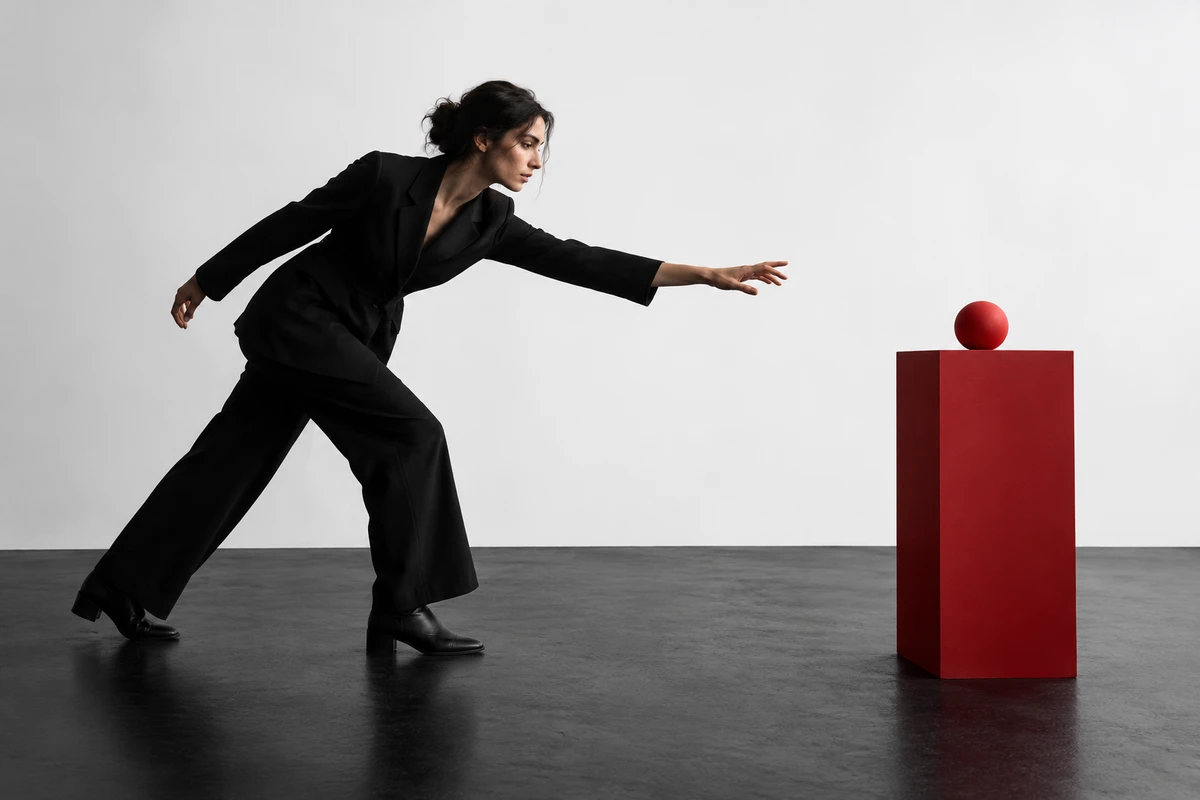
This essay checked Wieden+Kennedy’s Old Spice project page dated February 2010; the official Old Spice YouTube entry; the script and production record in Communication Arts; The One Club and British Arrows archives for Bounce; the public abstract of a 2021 Journal of Consumer Research paper; and TikTok for Business’s August 2023 creative guide. Direct observation was limited to public text, stills and accessible records; no unavailable master or rehearsal footage is claimed. The gaze-load-contact comparison and its conclusions about emotional distance are ONCE Editorial analysis, not undocumented creator intent, a universal psychological law or evidence of commercial effect. The cover is an original generated commercial concept, not a client advertisement or production still.