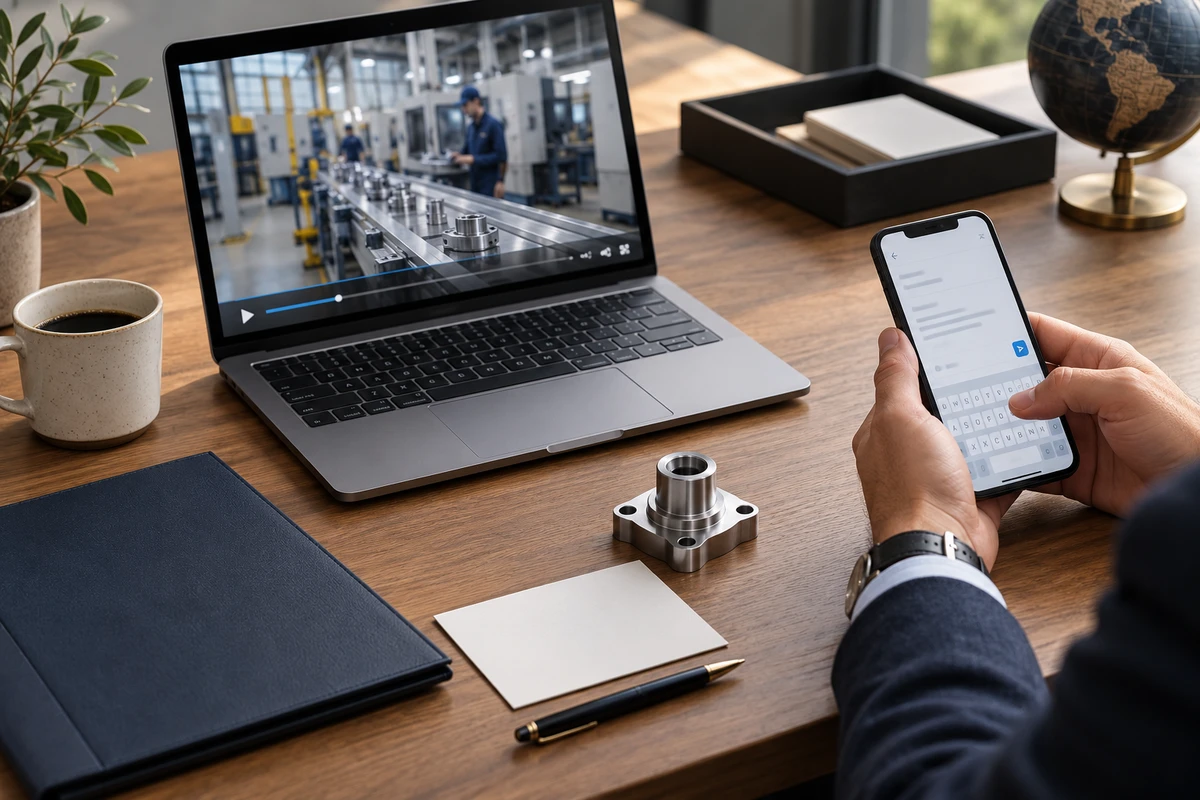
Imagine a sales rep sends a factory video to an overseas buyer with one line: “This shows our production line and quality capabilities.” The buyer replies: “Is this the line for the model in our quote? Does the inspection shown cover every unit?”
This is an explicitly hypothetical example, not an ONCE client or project. The problem is not that the video looks insufficiently polished. The edited clip does not automatically carry its model, date, scope, or evidence limits. If the salesperson has to fill every gap verbally, both sides can leave with different ideas about what the video actually supports.
A clearer handoff is the clip + a short evidence note + one next verification step. The note is not another sales brochure. It tells the buyer what is on screen, which specific claim has supporting documentation, and what still needs to be checked.
Separate what the footage shows from what it can support
A factory video records selected images. It can help a buyer understand a product, process, or operation. Without context in the email, however, the buyer may not know:
- which product model, revision, or configuration appears in the clip;
- when and at which site or line it was recorded;
- whether the footage shows routine production, a sample demonstration, or a specially arranged test;
- whether one visible action supports the performance, capacity, or quality claim in the email.
Avoid turning “the footage shows this” into “this proves we can always deliver that.” Keep three layers distinct: what can be observed in the clip, the document that supports a specific claim, and the question that still needs verification.
If your team already built a procurement question card before the shoot, do not paste it into the email unchanged. A shooting card asks what the crew should capture. The send-off note records what made it into this exact edit, which claims still need documents, and how the buyer can verify the next question. Post-production may remove planned shots, so check the version you are actually sending.
Put six things on the note card
- Clip identity: File name or link, duration, edit version, and recording date. Include the product model, revision, or configuration. If the date or site cannot be shared, confirm permission and redact it as needed.
- Scope: Identify the site, process, equipment, or sample shown. Say whether it is a routine process, a one-time demo, or a specific lot. Leave uncertain details blank instead of guessing.
- What is visibly happening: Describe the action in plain language. Add timecodes when useful, such as “[00:xx] an operator checks [part/step].” Avoid conclusion words like “advanced equipment” or “strict quality control.”
- The supporting source for each claim: Link a measurement to the applicable report or record, and note the product or sample, test conditions, and date. For capacity, state the period, shift, or line covered. If you mention a certification, link the actual certificate and identify its issuer, standard, scope, and expiry date if shown. A document supports only the scope it explicitly covers.
- What the clip does not cover: State what cannot be seen or confirmed from this video alone, such as sustained capacity, a long-term defect rate, a full-process audit, or a contractual delivery date. A precise boundary helps prevent one scene from being read as a universal promise.
- One next step: Choose the action that best answers the buyer’s current question: a live demo of the specified model, a sample test under agreed conditions, a shareable inspection record, or a conversation about an on-site or third-party review. Offer one clear option instead of turning the email into a task list.
Before sharing, check that screens, work orders, customer names, employee images, and production details are approved for disclosure. If a file contains confidential or personal information, share only the necessary page or a controlled link; do not forward an entire internal file set just to make the email look better supported.
Match the attachment to the buyer’s question
- “Can you make this model?” Attach the model or configuration description and point to the operation shown in the clip. A sample demonstration is not the same as evidence of long-term production capability.
- “What is the quality like across batches?” Share relevant inspection or test records and explain the sample, acceptance criteria, and time period. A single inspection on camera is not a long-term statistical result.
- “Can you cover this order volume?” Attach a capacity basis relevant to the order, including the period, shifts, line, and key assumptions. Do not infer sustained capacity from a short clip.
- “Do you meet this certification requirement?” Link a certificate or report that matches the claim about the product, site, or management system. Make it possible to check the issuer and scope. A wall plaque, video caption, or logo on screen is not a substitute for the applicable document.
- “What results have you achieved for customers?” Share only authorized case material with clear context and metric definitions. Do not present an unverified customer statement as fact.
If an email or accompanying video is advertising directed to the U.S. market, the Federal Trade Commission’s advertising guide says objective claims need a reasonable basis, and the evidence required depends on the claim. This is U.S.-specific guidance, not a statement of global law. A practical habit for any sales team is to make sure the evidence covers the full breadth of the claim.
A reusable evidence note
The example below is a format to adapt. Replace every bracketed field with details from the actual clip and documents; it is not a customer case or a ready-made capability claim.
Subject: [Product / model] factory video — scope and next check
Hi [Name],
Here is a [duration] clip of [specific operation], recorded on [date] at [site], using [product model / revision]. It shows [observable action or condition] within [scope].
For [specific claim], please see [document name and link]. It covers [product / sample / site / period / test condition].
The clip does not establish [capacity / long-term quality rate / certification scope / another item not shown]. To verify [your question], would [one proposed demo, sample test, report review, or audit step] be useful?
Best, [Name]
Before sending, check: Are the model and revision correct? Are the date, site, sample, and scope clear? Can each objective claim be traced to its supporting source? What still needs verification? Is there just one next step, and does it answer the buyer’s question?
A factory video does not need to carry every answer by itself. A short note that connects the footage, documentation, and next verification step helps buyers decide what to review next without expanding the promise beyond the evidence.
If you are still choosing what to film, see our Factory Footage Is Not Manufacturing Proof: What B2B Buyers Need to See First for a pre-shoot procurement question card, or our Shenzhen Factory-video Shot List for on-site shot planning. Those guides cover filming; this article covers the handoff after the clip is ready.