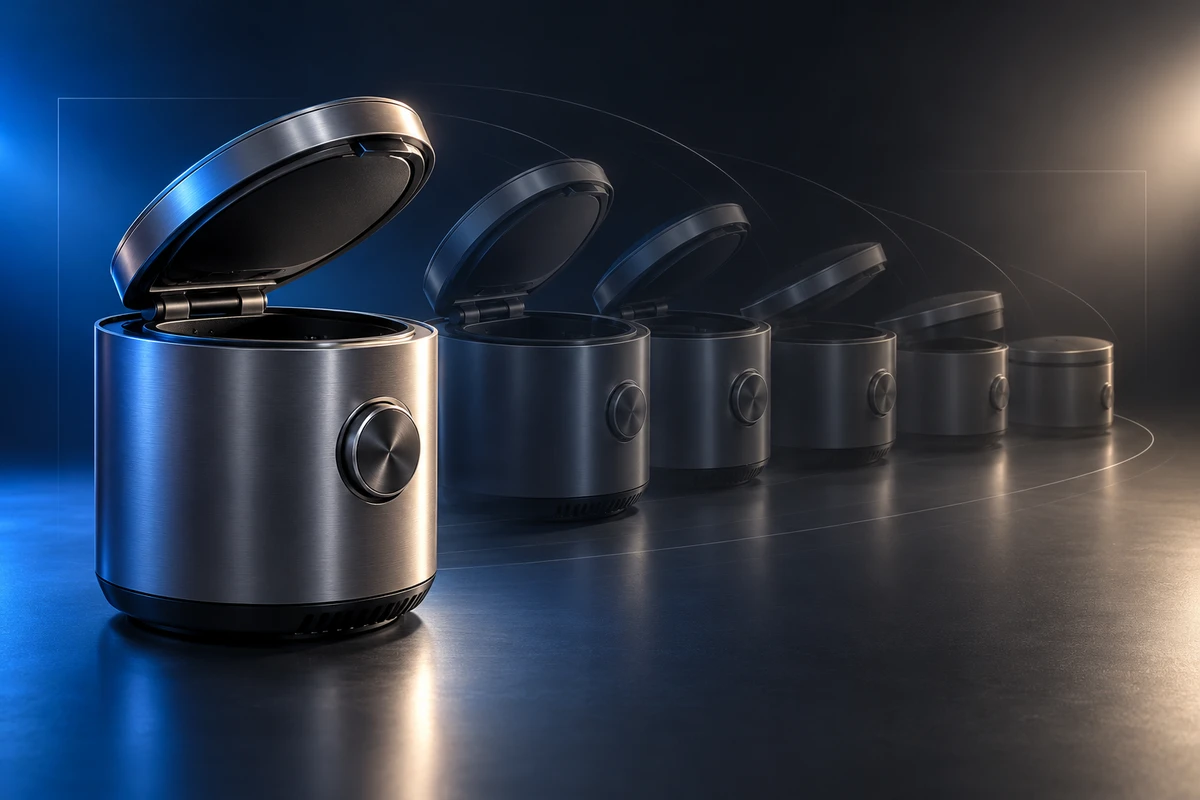
Meta’s October 6, 2026 announcement sounds simple: existing product images can now become video. The scope is more precise. Video generation from static assets in Advantage+ creative is broadly available, while turning catalog product images into product videos at scale remains a beta for eligible advertisers.
For brands with large catalogs and supply chains in China, this lowers the cost of attempting motion. It does not remove the cost of proving that the moving product is still the real product. A label that drifts, a cap that opens the wrong way, a reflective highlight that becomes a port, or a package that unfolds by itself can turn a polished clip into a false product representation.
The procurement unit should therefore change from “videos generated” to “motion variants verified for product truth, function, and channel use.”
Scale multiplies errors as quickly as it multiplies variations
Meta’s announcement confirms the expansion of image-to-video tools and the eligibility limits around catalog-scale product video. It does not prove that every product image can be animated safely, or that the broader market has already changed its production standards.
Research on video-generation evaluation also separates qualities that are often collapsed into “looks good.” VBench, presented at CVPR 2024, evaluates dimensions such as subject consistency, temporal flicker, and motion smoothness separately. That does not certify a commercial SKU, but it reinforces an operational point: smooth motion and accurate product representation require different checks.
The U.S. Federal Trade Commission says advertising must be truthful and non-deceptive, with evidence behind express and implied claims. Its guidance looks at the overall message conveyed by words and pictures. A synthetic demonstration can therefore create a product claim even when the script never states it directly. The FTC’s small-business advertising guide is a useful baseline for U.S.-facing work.
Our conclusion is that catalog-scale generation makes source-asset design and verification more valuable than prompt volume. A model can create motion. The brand still has to define what may move, what must never change, and which actions need real evidence.
The ONCE Product Motion Contract
A Product Motion Contract is a short production document shared by the brand, studio, generation team, and reviewer. It turns product truth into rules that can survive multiple tools and versions.
1. Product invariants
List the features that may never change: silhouette, proportions, colorway, label position, ports, controls, included parts, package construction, material, and finish. Attach the exact reference image or sample version for each item. “Keep it consistent” is not a testable instruction.
2. Permitted motion
Identify only the parts that actually move: hinge travel, dial rotation, zipper path, liquid direction, fabric deformation, or a wearable adjustment. Record the start state, end state, direction, range, and speed. If there is no manual, engineering reference, or real footage, the motion is a creative hypothesis—not a product demonstration.
3. No-motion zones
Mark areas the system may not rewrite: logos, regulatory copy, measurement scales, port count, seals, button order, safety components, and package quantity. Riskier categories may also prohibit generated hands, unsupported load demonstrations, or synthetic before-and-after outcomes.
4. Scale and physics references
A single isolated packshot says little about size, balance, contact, or weight distribution. Add multiple angles, a hand or standard-object reference, component views, and a low-cost real motion clip where useful. The goal is not to make every shot live action. It is to give generation and review teams enough evidence to understand how the product occupies space.
5. Shot purpose
Decide whether the shot exists to attract attention, explain construction, or prove performance. Mood shots can place most of the motion in the camera, light, or environment. Proof shots require stricter references and may need live action or validated 3D. An attention hook should not accidentally become a performance claim.
6. Review and fallback
For every draft, inspect the first frame, a middle frame, the key contact or deformation frame, and the final frame. Then verify audio, captions, and the destination SKU. If a version fails, reviewers should be able to choose among improving the source, narrowing the motion, changing the edit, repairing a section, or returning to live action. “Generate again” is not a complete repair strategy.
Source photography must become motion-ready
This shift does not make strong product photography less important. It raises the standard for source assets.
A motion-ready source pack can include front, side, three-quarter, and critical rear views; a clean product cutout without a baked-in dramatic shadow; label and port close-ups; a scale reference; short clips of real opening, pressing, pouring, wearing, or folding; and a record of the approved release model, colors, and included accessories.
When a global brand needs to approve that pack remotely, ONCE’s pre-shoot visual approval workflow helps separate mood references, physical sample tests, and short motion tests. Each approves a different kind of truth.
The source images do not all need to appear in the final ad. Their first job is to tell the system and the reviewer what the product actually is.
Choose the production route by product risk
Good candidates for scaled generation
Rigid, structurally simple products with stable packaging and no delicate operation can begin with camera, lighting, and environmental motion while the product remains fixed. This produces testable variation without asking the model to invent product mechanics.
Better candidates for hybrid production
Reflective, translucent, textile, foldable, mechanical, or hand-operated products benefit from a “real proof plus generated environment” approach. Shoot the product-critical action and use generation to expand settings, transitions, pacing, or non-critical camera movement.
Keep live action or controlled 3D at the center
Safety, medical, durability, precise assembly, load, sealing, food-effect, and regulated claims should not be inferred from one image. If a reasonable viewer may treat the visual as proof of performance, use a production method that can be reproduced and checked.
Price the verified variant, not the generation
A practical comparison is:
Fully loaded cost per verified motion variant = (source preparation + generation + frame review + repair + rights and disclosure review + fallback production) ÷ approved variants
This is a project equation, not an industry benchmark. It explains why a low generation price does not guarantee a low usable-video price. If a hundred drafts produce only a small number of approved assets—or each needs manual label, port, hand, and product-page corrections—scale has amplified review debt.
The next brief should ask more than “Can you generate fifty videos?” It should name the owner of the source pack, frozen product attributes, frame reviewer, error codes, stopping rule, live-action fallback, and final record connecting the SKU, source version, generation settings, and approval.
Meta also says AI information labels are part of its ad-transparency approach. Its updated transparency explanation makes clear that labeling is one component of broader safeguards. A label is not a substitute for the brand’s accuracy review.
Start with one low-risk SKU
Do not begin by uploading the full catalog. Select one low-risk SKU, write a Product Motion Contract, and create a few controlled variants: camera movement only, lighting movement only, and one permitted product movement. First test whether the team can detect errors consistently, repair them efficiently, and retain an approval record. Then expand the SKU count.
If that system works, AI product video becomes more than a way to avoid a few shoots. It becomes a shared asset layer across live action, generation, and post-production. For production partners, the margin opportunity shifts away from repetitive execution and toward source-asset design, motion rules, batch review, and reusable product knowledge.
Sources and scope
- Meta, “Advertising Week New York 2026: New AI capabilities to guide campaigns and reach customers,” October 6, 2026.
- Meta, “Expanding GenAI Transparency for Meta’s Ads Products,” published February 3, 2025 and updated June 1, 2026.
- Huang et al., “VBench: Comprehensive Benchmark Suite for Video Generative Models,” CVPR 2024.
- U.S. Federal Trade Commission, “Advertising FAQs: A Guide for Small Business.”
- TikTok Shop, “Content Policy,” October 9, 2026, used only as an adjacent platform example requiring AI-generated product content to match the real item and product detail page. It does not establish Meta’s review rules.