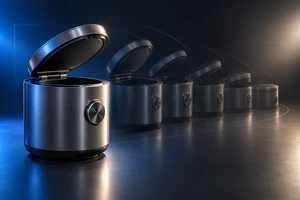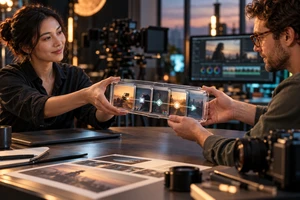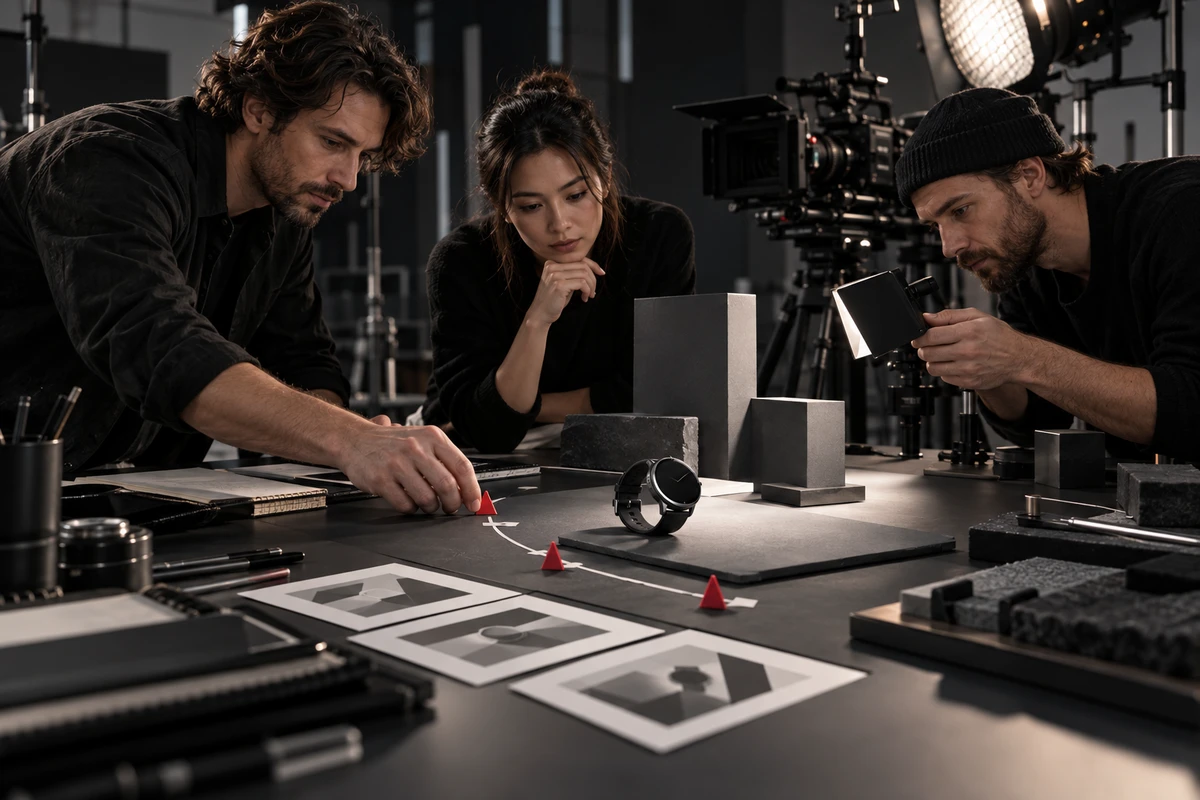
AI previsualization reduces commercial-production rework only when it turns unresolved choices into reviewable pictures. Before the shoot, it should make the team decide when the product appears, where the performer looks, how a hand meets the product, why the camera moves, and what carries one shot into the next. It is a decision prototype, not a low-resolution promise of the finished commercial.
As checked on October 10, 2026, Epic Games still describes previsualization as roughing out the principal images and actions before production so filmmakers can test different scenarios. Epic also distinguishes previs from techvis, stuntvis, and postvis. That distinction matters to a brand team: creative previs asks what the film should show; technical visualization asks how the planned shot can actually be executed.
Turn “it looks good” into four production questions
Consider a hypothetical 12-second commercial for a sports smartwatch. This is an illustrative project, not an ONCE client case. The script is one sentence: a runner stops at night, raises their wrist to check recovery status, and the city lights extend from the watch face.
An attractive AI test can quickly produce neon streets, a runner, and a luminous display. A useful previsualization must answer four more exact questions:
- Composition: Do we establish the runner’s situation first, or begin on the product? Does the watch remain the visual priority in both horizontal and vertical frames?
- Action: Where does the wrist raise begin? When does the finger touch the display? Is there enough time for the viewer to understand the operation?
- Continuity: How does the arc of light on the watch motivate the transition into city light trails, instead of leaving post-production to invent a decorative effect later?
- Product facts: Which button positions, strap details, interface states, and operating steps require a real sample or approved source asset?
If those questions remain unanswered, a polished AI sequence can create false confidence. A rough grey-box test can be more valuable when it shows shot size, subject distance, action start and end points, and edit rhythm accurately.
Use three levels of fidelity for three different decisions
Every shot does not need the same finish. The right level depends on the decision at risk.
Style frames approve the visual proposition
Style frames can establish palette, lighting direction, performer state, and the product’s visual weight. At this level, the brand should answer, “Is this the world we want the brand to inhabit?” It should not assume that every reflection or lighting effect can be reproduced unchanged.
Style frames are useful when comparing two genuinely different directions, such as controlled technical precision versus a more physical, human performance. They cannot confirm continuous action, final materials, optical depth, or the exact behavior of practical light.
An animatic approves time and action
Once key frames enter a timeline with rough motion, dialogue, music beats, and temporary sound, the team can judge how long the product remains legible and whether transitions have a cause.
For the hypothetical watch film, the runner might begin raising the wrist at 3.2 seconds, enter the close-up at 4.0, touch the display at 4.6, and hand the frame to the city-light transition at 5.1. These times are creative assumptions for this example, not an industry standard. Their value is that the brand, director, cinematographer, and post team can discuss the same interval rather than four private versions of it.
Techvis approves production conditions
Complex camera moves, physical rigs, and live-action-to-generated transitions need another layer: camera position, lens intent, operating range, set dimensions, product stand-ins, and safe movement. Unreal Engine’s current cinematic documentation shows that a sequence can include cameras, lights, objects, characters, shots, and takes. That makes the tool useful for planning relationships; it does not prove that a physical location, lens, performer, or rig will behave identically.
If technical visualization shows that a camera cannot complete the planned move from the available distance, the useful result is a production change: shorten the move, relocate its start or finish, or redesign the transition around a controllable occlusion, cut, or composite.
Use a green, amber, and red approval card
Separate what the preview can lock from what still requires a test. Green items should remain stable after approval. Amber items have an approved direction but need evidence from a camera or production test. Red items must never be treated as solved because the preview looks convincing.
| Status | How to review it |
|---|---|
| Green: lock it | Story order, product entrance, shot-size relationships, action start and end points, edit rhythm, subject placement across formats, and the live-action, generated, or composite method for each shot. |
| Amber: direction approved, test pending | Lighting character, material reflections, performance intensity, real movement speed, sound design, and continuity inside a generated environment. Record the validation method with the approval. |
| Red: previs cannot replace proof | Exact product geometry, genuine operating results, physical and safety conditions, formal advertising claims, talent and asset permissions, and the commercial-use terms for models or third-party inputs. |
The colors matter less than attaching each note to an object. Replace “It still doesn’t feel premium” with “At 00:06, the product close-up still uses a conceptual material; amber until we run a same-angle lighting test with the real sample.” Replace “The transition has no feeling” with “The wrist raise does not provide a visual or action bridge into the close-up; the green continuity item has not passed.”
Frame.io’s September 2026 review documentation distinguishes single-frame, range-based, and anchored comments. The same discipline works in any review system: attach feedback to a shot, time range, or area of the frame, then identify whether it changes creative intent, product truth, or execution conditions.
Put three approval gates before the shoot
Gate one: lock non-negotiable facts before generation
Prepare official product views, dimensions, operation order, interface states, brand colors, prohibited claims, and intended channels. In a live-action and AIGC hybrid production, identify which shots must preserve the real product and which areas are open to environmental, atmospheric, or transitional exploration.
If the sample is still changing, label it as a placeholder. Otherwise an unresolved shape can gradually become an “approved” product fact simply because it survives several attractive rounds of visual development.
Gate two: approve only what the animatic has demonstrated
Review the complete timeline and ask, shot by shot: What must the viewer understand now? Why does the action happen? Is the product competing with the environment? What carries this shot into the next? Does the vertical version need its own composition rather than a crop?
Google Ads’ current specification page lists horizontal 16:9, vertical 9:16, and square 1:1 assets for several video-ad contexts. Platform requirements can change, so teams should check the applicable page at delivery. The production implication is more durable: if the campaign needs multiple orientations, subject position and action paths should be tested during previsualization. See the current Google Ads video specifications.
Gate three: test the highest-risk shot under real conditions
Do not pre-shoot the entire commercial. Select the riskiest shot and use the real sample, a near-final lens choice, and the intended action. Does the display reflect the lighting unit? Does a finger cover essential information? Can focus follow the wrist at the planned speed? Does the planned transition have a trackable physical origin?
A failed test does not mean the previsualization was wasted. It turns an amber assumption into a specific production choice: change the angle, action, light, generated region, or production method. That is more valuable than discovering after principal photography that the final image cannot match the preview.
Do not overbuild previs for every job
AI previsualization is not a mandatory package. A single-angle demonstration, a familiar talking-head format, or a small pickup that must match an existing film may need only a shot list, references, and a blocking test.
High-fidelity previs is also premature when the product design is still changing, the brand has no authorized approver, the principal selling point is undecided, generation inputs have unclear rights, or essential physical information about the location, rig, sample, or performer is missing. More finish only places a polished surface over an unresolved decision.
Previsualization becomes more useful when a commercial combines complex product interaction, continuous action, live-action handoffs to CGI or AIGC, special camera movement, and several aspect-ratio versions. Those conditions make it valuable for different departments to see the same problem earlier.
A one-page previsualization acceptance standard
End the approval document with six fields. They are more useful than “Overall approved.”
| Field | What to record |
|---|---|
| What this round approves | For example: a 12-second narrative order, four shots, action start and end points, and horizontal and vertical subject placement. |
| What this round does not approve | Final materials, production UI, talent performance, finished sound, or city-environment detail. |
| Green items | Shot number, locked decision, approver, and date. |
| Amber items | Open question, validation method, owner, and final decision date. |
| Red items | Items requiring live action, technical testing, legal review, or the owner of the product claim. |
| Change rule | Which boards, sets, shoot tasks, or post tasks will be affected if a green item is reopened. |
If you are planning a commercial that combines live action, CGI, or generated imagery, send ONCE the product references, target channels, current script, the three shots most likely to fail, and the sample status. We can assess how far the previsualization needs to go before recommending a hybrid production route.