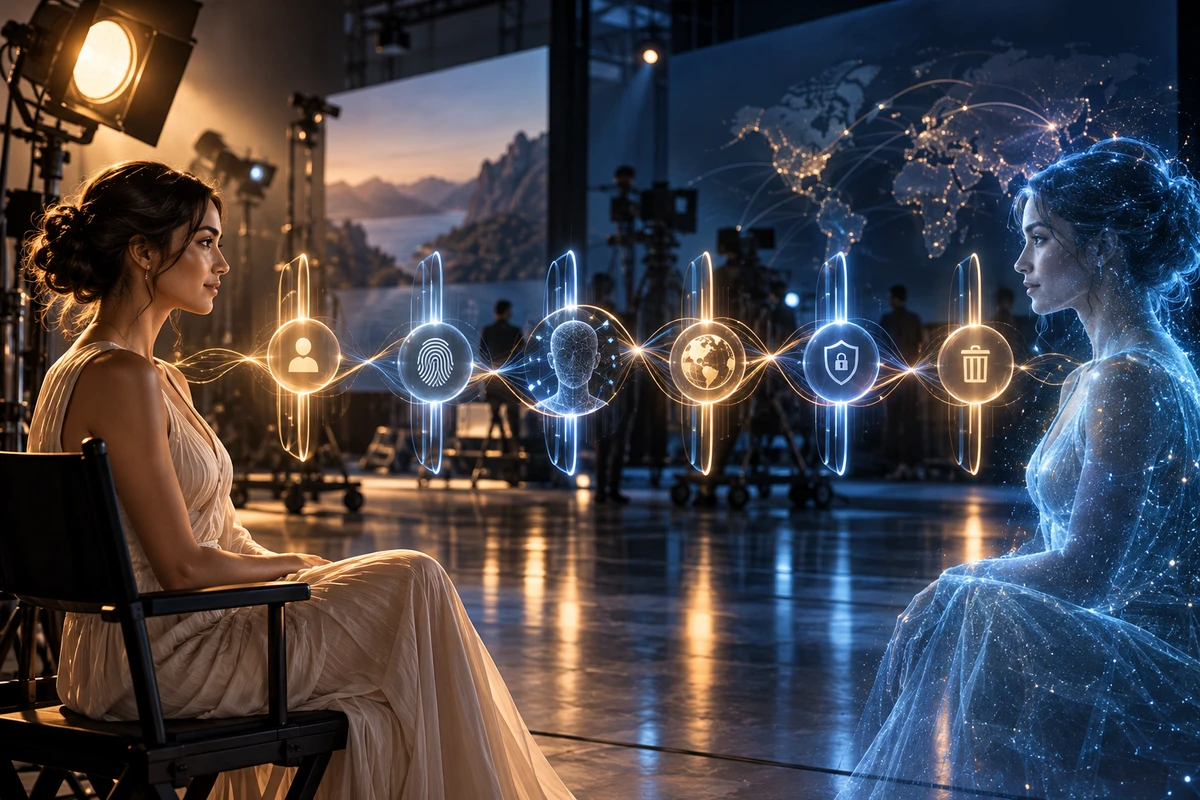
A global brand films a performer once, then uses generative tools to make the same face speak new languages, demonstrate new products and appear in scenes that were never shot. The original release says “worldwide, all media, in perpetuity.” Does that authorize distribution of the footage, creation of a reusable digital double, new synthetic performances, model training and indefinite storage of biometric source files?
Those are different permissions. As platforms make identity misuse easier to surface and regulators start treating synthetic performers as an advertising-disclosure issue, a human likeness is no longer just a production input. It is an asset that procurement, legal, production and media teams must manage together.
Classify the person before negotiating the rights
Three outputs can look equally realistic while carrying very different obligations.
Track A: a generic synthetic performer
This is a generated person who is not recognisable as an identifiable real individual. The key questions are not about a traditional talent release. They concern the commercial licence for the model and inputs, accidental resemblance, truthfulness of the demonstration, and whether the ad needs a disclosure.
California's governor signed SB 1050 on September 16, 2026. The chaptered text requires a clear and conspicuous disclosure when an audio or video advertisement prominently features a synthetic performer, with defined exceptions such as some translation and accessibility uses. Its definition focuses on a realistic AI-created performance that is not recognisable as an identifiable natural person. That is a specific market rule—not evidence that every AI-assisted ad worldwide needs the same label.
Track B: an identifiable digital replica
If an audience can recognise a model, creator, employee, founder or actor, the project enters a different rights track. The crucial questions become whether that person agreed to the replica's creation and whether they agreed to the specific new performance.
New York General Obligations Law § 5-302 makes some digital-replica provisions unenforceable when a contract lacks a reasonably specific description of the intended use and the performer lacks specified legal or union representation. The SAG-AFTRA 2025 Commercials Contracts similarly separate consent to create a replica from consent to use it, and address new performances, training, retention and deletion. These are jurisdiction- and contract-specific references, not universal defaults. Their procurement lesson travels well: creating the double and using the double are separate transactions.
Track C: AI-assisted footage of a real performer
Denoising, clean-up, caption translation, background work or limited lip adaptation may carry less identity risk than a wholly new performance. “AI-assisted” is not a safe harbour, however. If the system makes someone say something they never said, puts them in a situation they did not experience, or sends their data into model training, the use should return to the approval workflow.
The distribution layer can now surface what the contract missed
On September 23, 2026, YouTube said likeness detection was coming to mobile and that speaking-voice detection would begin integrating with facial detection. Its Help Center describes an experimental system that scans newly uploaded videos for enrolled creators' faces that may have been altered or generated by AI. A creator can review a potential match and decide whether to file a privacy or copyright removal request.
A match is not an infringement ruling, and removal is not automatic. YouTube says it considers factors such as parody and satire; the feature also has eligibility and country limits. The procurement change is narrower but important: identity use that once stayed buried in a vendor folder can now be surfaced to the person at distribution time.
The contract therefore needs to answer more than “may we use this face?” It must define what may be generated, who may generate it, where it may run, how long the sensitive files may remain, and how a disputed use will stop.
The ONCE two-track, six-gate rights chain
Use six gates in the estimate, statement of work and delivery checklist. Both tracks pass through them, but the evidence is different.
Gate 1: identity and source
Label every character as a generic synthetic performer, identifiable digital replica or AI-assisted real performance. Record the tool, base model, input images, voice samples and asset provider. Track A needs commercial-use and resemblance checks. Track B also needs the rightsholder's identity, contracting party and any representative's authority.
Gate 2: consent to create
For Track B, obtain a separate answer on scanning, cloning, modelling and voice generation. Consent to be filmed should not silently become consent to build a reusable identity. For Track A, require the vendor to state that the character was not intentionally built from a real person and specify how an accidental resemblance will be replaced.
Gate 3: generated performance
Describe permitted and prohibited outputs in reviewable terms: product category, claims, dialogue themes, action limits, emotion, nudity, sensitive contexts, and changes to age or physical traits. A new generated scene may be a new performance, not merely a post-production variation.
Gate 4: distribution coordinates
Define rights as product line × market × channel × term × language. A perpetual global buyout appears simple because it pushes unknown future uses and disputes into today's fee. A more controllable structure grants a defined operating term and sends new categories, markets or high-risk media back for approval.
Gate 5: training and third-party access
State separately whether the vendor may use inputs, the replica or finished ads for model training, product improvement, portfolios, subcontracting or sublicensing. “No training by default” is more operational than a generic confidentiality clause. If training is authorised, identify the model, purpose, permitted users, isolation method and end-of-contract treatment.
Gate 6: retention, security and deletion
Set different periods for biometric source files, model artefacts, prompts, rejected generations and approved masters. Name who can download them and what happens at expiry. A deletion record should list the objects, completion date, responsible party and written confirmation—not just say “handled.”
The same fields can extend an existing traceable creative-asset workflow: every cut carries not only format and copy IDs, but also human type, rights coordinates and disclosure status.
Treat disclosure as a deliverable, not a legal footnote
The IAB's AI Transparency & Disclosure Framework V2, released on August 18, 2026, uses a risk- and materiality-based approach. Highly realistic synthetic video, voice and digital twins may warrant stronger disclosure, while routine post-production, obviously fantastical work or immaterial automation do not necessarily receive the same treatment. The framework also stresses that local rules vary and that industry guidance does not replace law.
Turn that principle into version control:
- maintain a market matrix for law, platform policy and voluntary brand standards;
- assign responsibility for on-screen, audio and metadata disclosures;
- test legibility in six-second, 15-second, vertical and sound-off cuts;
- preserve a clean master and market-specific compliant versions;
- have counsel confirm target-market requirements instead of asking an editor to guess a global rule.
Price the usable performance, not the generation count
One hundred generations can be cheap while only three are cleared to run. ONCE recommends comparing proposals with this full-cost formula:
Full cost per deployable human-performance variant = (capture or generation + identity/performance permission + legal and disclosure localisation + approval rework + secure retention and deletion) ÷ variants approved for a specified market, channel and term
This is a procurement formula, not an industry benchmark. It exposes three costs that “unlimited variations” tends to hide: the approval load, rework caused by ambiguous rights, and sensitive assets that must still be governed after delivery.
Ask vendors to separate at least five lines: human capture or character generation; replica creation; new-performance and variant review; market disclosure adaptation; and asset custody plus deletion. “Unlimited AI versions” is not a meaningful single SKU unless those obligations are priced and assigned.
Choose the production path by the job the person performs
Use a generic synthetic performer when identity does not carry trust, endorsement or creator relationships; product demonstrations can be independently verified; and source licensing plus market disclosure are clear. It can reduce capture and adaptation costs. It does not erase authenticity, claims or compliance work.
Use a real performer for founder statements, expert endorsement, sensitive efficacy claims, genuine experience and stories where “this person actually did or said this” creates the value.
Use a tightly scoped digital replica when the brand already has a clear talent relationship, needs repeatable multilingual adaptations, and can operate variant approvals, expiry dates and deletion. A digital replica is not a permanent purchase of a person. It is an ongoing rights asset.
A 48-hour action for the next brief
On day one, mark every human image in the project as Track A, B or C and map the existing paperwork against the six gates. Do not fill gaps with “industry standard.” On day two, put production, legal and media around one market-version sheet: who approves a new performance, who owns the disclosure, who stores the model, and who deletes it at expiry.
If a supplier cannot explain where the digital human came from, what it may perform and how long it will remain, its low generation price is not comparable. Scalable AI-human production is not the ability to copy a face without limit. It is the ability to account for every copy and shut it down cleanly.
Sources and scope
- California Governor's Office, September 16, 2026, Governor Newsom signs new law to protect workers, require disclosures on AI-generated advertising; California SB 1050 chaptered text.
- YouTube Blog, September 23, 2026, Innovation for the YouTube Era: What's new for viewers and creators; YouTube Help, Likeness detection on YouTube.
- SAG-AFTRA, 2025 Commercials Contracts and related FAQs; cited only as a union-contract benchmark.
- IAB, August 18, 2026, AI Transparency & Disclosure Framework V2.
This article is a production-procurement framework, not legal advice for a specific contract or jurisdiction. Have qualified counsel review the target markets before launch.