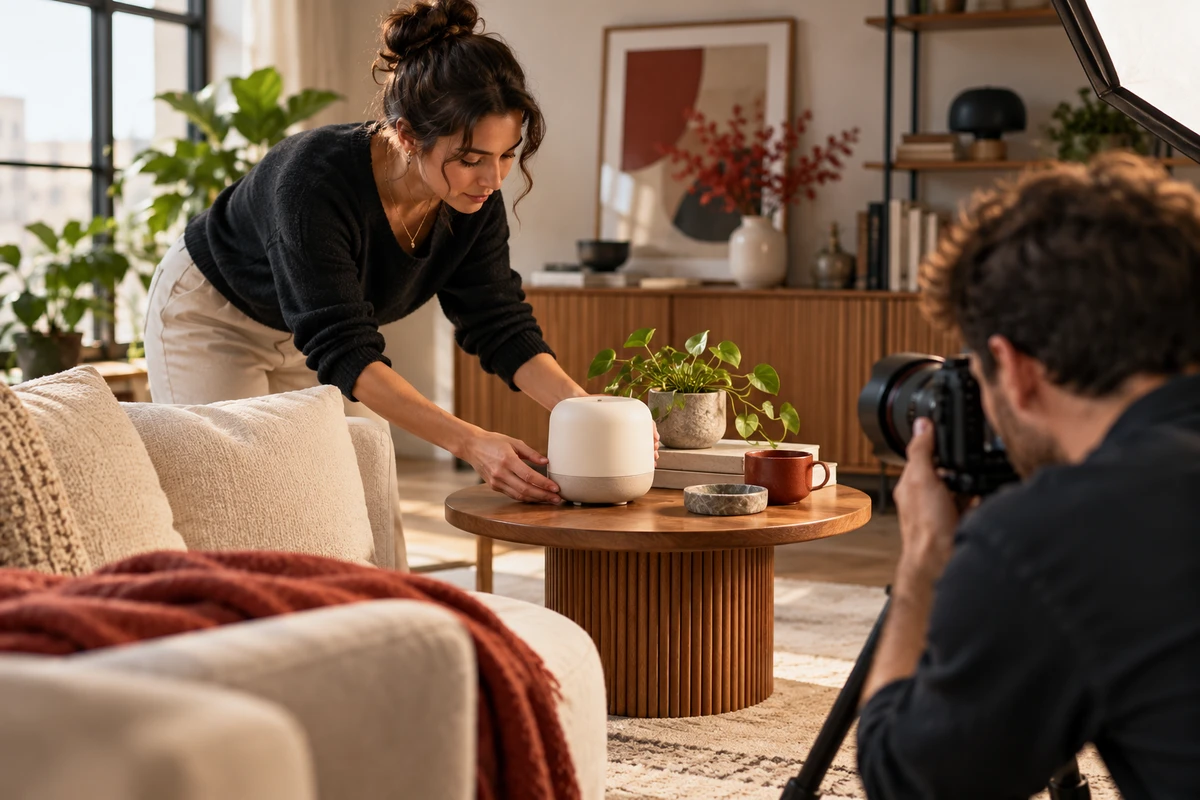
Imagine a US shopper asking ChatGPT to generate a warm, wood-toned living room for a small apartment. They are not scrolling past a feed or searching for a brand. They are turning an unfinished idea into a picture. An ad that appears in this moment is not interrupting passive attention; it is entering an active act of imagining, comparing and deciding.
On October 5, 2026, OpenAI announced a new visual ad format. The company says the initial test will begin later in October with a small group of advertisers in the United States, first during image generation in ChatGPT. The ad will be clearly labelled and remain separate from the image being created. OpenAI describes three useful visual roles: product inspiration, product usage and the experiences a product makes possible.
That does not mean the format is broadly available, and it does not prove that it will outperform search or social media. It does, however, change the preparation question for product marketers. The reusable asset may no longer be one polished hero image. It may be a governed set of scenes that can answer different decision tasks without changing the truth of the product.
The visual is there to complete an idea, not merely win attention
Traditional e-commerce imagery often compresses product, claims and promotion into one frame. Short-form video frequently tries to earn a pause in the first seconds. Image generation begins somewhere else: the user has already expressed a room, activity, style or mood. The commercial question becomes, “Can this product honestly fit the life I am trying to picture?”
A beautiful packshot still matters, but it is not automatically a complete ad asset. A white-background image does not show scale or use. A cinematic lifestyle image may hide the exact SKU. An exaggerated concept image can turn an unverified performance claim into something that looks factual.
OpenAI's current creative guidance asks advertisers to keep images simple, relevant and aligned with the title, copy and landing page. Its ad policies require consistency across creative and destination, prohibit misleading claims, and reject assets that imitate the ChatGPT interface. Even when AI tools generate or adapt the work, OpenAI's advertising terms leave the advertiser responsible for accuracy, rights, currency and compliance.
The production bottleneck is therefore not the ability to produce more variations. It is the availability of accurate source imagery that keeps every variation anchored to the same real product.
ONCE's decision-scene unit
ONCE recommends changing the smallest procurement unit from “one finished image” to one decision-scene unit. Each unit should contain five fields.
1. Product truth
Lock the SKU, colour, material, ports, dimensions, included accessories and non-negotiable design features. Capture front, side and rear views, functional states, critical details and scale references. Generative expansion must not quietly change button count, construction, finish or package contents.
2. User job
Replace “premium lifestyle” with a real task: creating a reading corner in a rental apartment, powering equipment at a campsite, storing earbuds during a commute, or making breakfast on a narrow kitchen counter. A precise job is easier for a person to understand and easier to match to genuine intent.
3. Use relationship
The relationship between product, hands, people, furniture, light and space must be physically credible. Is the scale right? Can the action actually be completed? Is the cable connected to a real port? Do working distances match the instructions? These production details become the constraints that keep later generation and localisation honest.
4. Permitted claim
Separate what the image directly demonstrates from what still requires copy, testing or certification. A shot may show one person folding a product; it does not prove “fastest.” Rain on a surface does not establish a specific ingress-protection rating. Every material claim needs evidence, territory and an expiry or update action.
5. Matching destination
The colour, model, offer condition and use case in the ad must continue on the landing page. The visual should not lead to an unavailable variant or use one country's promotion for another market. If the product page, inventory or policy is not ready, the scene has not passed acceptance.
Only the combination is an operable asset. Ten exports, twenty background swaps or one hundred AI-generated compositions should not be counted as one hundred new decision scenes.
Produce three scene families, not one universal hero image
OpenAI's announcement names inspiration, usage and experience. Brands can turn those directly into a production brief:
- Inspiration scenes show the space, style or plan the product can enter, while preserving clear product identity.
- Usage scenes show how to hold, install, connect, open, wear or store it, with credible action and scale.
- Experience scenes show an observable change—such as a cleaner desk, easier movement through a room or more convenient sharing—without jumping to unsupported health, income or performance outcomes.
All three families should share a product-truth master and colour reference. Production should also preserve clean product layers, human-action layers, environment plates and sufficient composition room. That supports current ads while leaving controlled options for new markets, crops and AI-native surfaces.
If an ad later connects to a question-led experience, the visual library should also connect to the product answer layer. The image makes the use relationship visible; the answer layer explains specifications, compatibility and limits. When they disagree, a stronger image simply creates a stronger contradiction.
Do not compare suppliers by image count
Build total project cost from:
product-truth master + three scene families + territory/language versions + talent/location/asset rights + metadata and approval + measurement setup and refresh
Then calculate:
cost per qualified decision scene = total project cost ÷ scene units that pass all five fields
This is not an industry benchmark and it does not guarantee media performance. It separates assets that a brand can operate from unreviewed AI variants, duplicate crops and raw file volume.
Measurement should not stop at clicks. OpenAI's October 5 measurement update says ChatGPT Ads supports Pixel, Conversions API, click attribution and a growing set of partners, while incrementality work remains early. Assign each decision-scene unit a stable ID, landing page and conversion event. Test which combination of job and image produces qualified visits, leads or purchases before funding a larger production system.
Who should invest now?
Allocating new production budget for this format makes sense only when several conditions hold: the product sits in an eligible consumer category; the advertiser actually has access to the US test; the product serves several visually distinct jobs; landing pages can accurately continue each scene; and the team can manage versions and conversion signals.
Without access, the sensible move is not to commission “ChatGPT-only ads.” Build the product-truth master, the three scene families and the rights record instead. Those assets can also serve product pages, independent stores, social platforms, visual search and later generative systems.
Brands in restricted or high-risk categories, with unstable product facts, weak SKU-level destinations or no process for reviewing generated variants should delay incremental media production. Fixing facts, rights and version control will create more value than another batch of attractive images.
From the best single image to the best-supported decision
The structural importance of ChatGPT's visual ad test is not another image placement. It is the movement of advertising closer to the moment when a person is actively imagining what a product could do in their life. Product creative must therefore be compelling, identifiable, accurate and consistent with its destination at the same time.
On the next production brief, ask one fewer question about file count and one more question about the decision each scene helps a shopper make. When product truth, user job, use relationship, permitted claim and destination can all pass acceptance, a visual library stops being a folder of files and becomes a long-lived input for AI-native commerce.
Sources and scope
- OpenAI, “Building advertising for the way people use AI,” October 5, 2026.
- OpenAI Help Center, “Create Ads for ChatGPT Ads,” verified October 6, 2026.
- OpenAI, “Ad policies,” updated September 10, 2026.
- OpenAI Ads, “More ways to measure ChatGPT Ads,” October 5, 2026.
- “Decision-scene unit” and the cost formula are ONCE procurement frameworks derived from the mechanisms above. They are not OpenAI terminology or a performance guarantee.
Production examples and next steps
Use the TVC brief to connect the selling point, performance and product presentation. The Red Devils × Tencent Games commercial is a finished-film reference.
Review TVC and commercial production and Red Devils × Tencent Games: A Passionate Competitive TVC for Young Players. To discuss your project, send the script, storyboard, required formats and approval dates through the English project enquiry form.