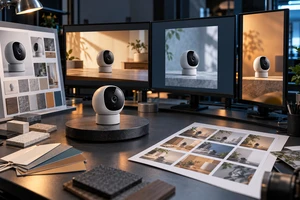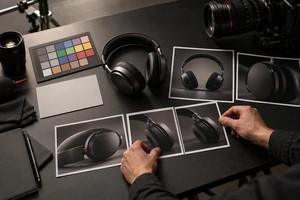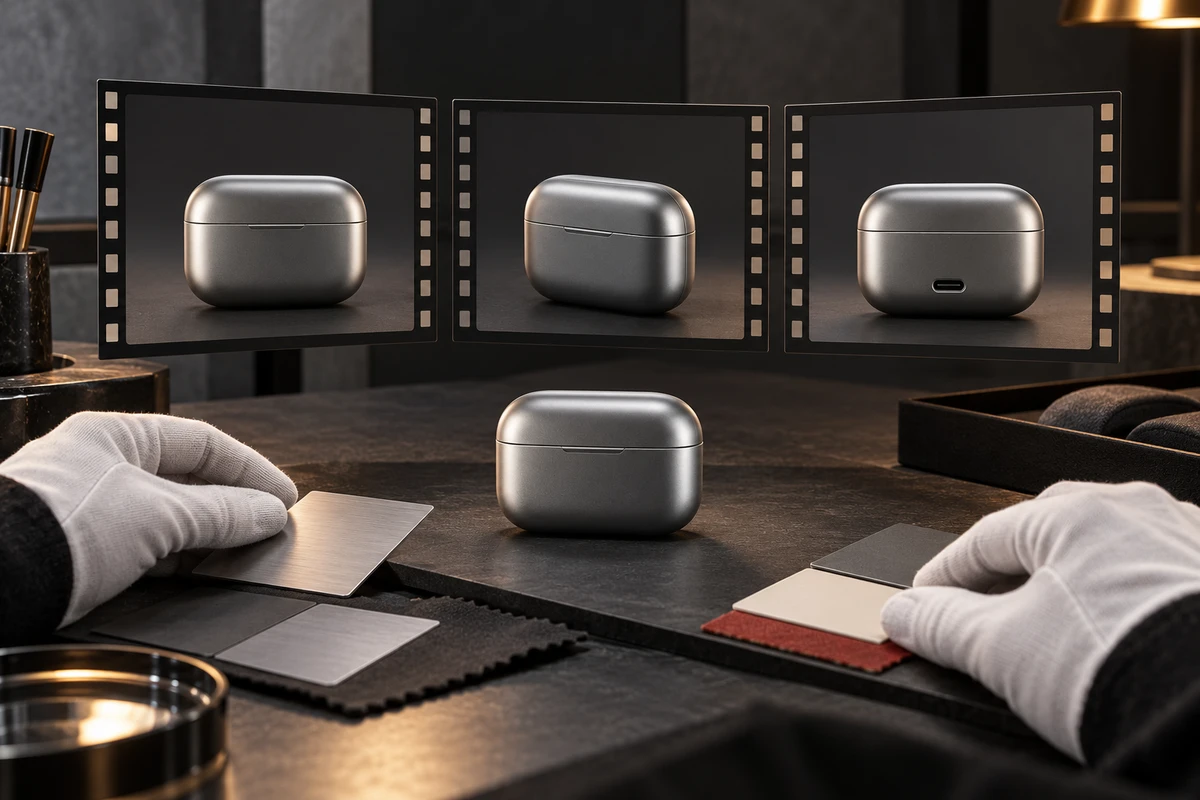
Turning one product image into motion is easy to demonstrate. Keeping the product itself unchanged is the harder production problem.
A charging case rotates and its port moves to the opposite side. A bottle passes through a transition and the label begins to rewrite itself. A precision device is accurate in the opening frame but gains an extra button halfway through the shot. The clip may still feel fluid and polished, yet the brand is no longer showing the same product.
That is why an AI image-to-video project should not begin with prompt writing. It should begin with a product identity passport: a checkable record of what must never change, what the model may interpret, when another generation is worthwhile, and when the shot should be rerouted to live action, controlled 3D, or compositing.
This is a production-management problem, not merely a model-capability problem.
A reference image is an input, not an acceptance standard
As verified in October 2026, Adobe's Firefly documentation says creators can provide first and last keyframes as visual guides. Google Flow's official help describes start and end frames as well as visual ingredients, while noting that feature availability varies by model and region. These controls show that reference material can enter the generation process. They do not promise that packaging text, port count, material response, or geometric proportions will remain correct throughout a clip.
Recent research also treats subject consistency as a distinct evaluation problem. OpenS2V-Nexus, presented at NeurIPS 2025, introduced a fine-grained subject-to-video benchmark that separates subject fidelity, naturalness, and text relevance. Its practical lesson for a brand is not that one model will always win. It is that a smooth-looking video and a video that preserves subject identity are different outcomes.
ONCE's interpretation is simple: a reference image tells the model where you want to start; the production still needs a written specification of what it is not allowed to rewrite. Without that specification, every failure becomes another prompt adjustment, even when the real problem is damage to product truth.
Build the product identity passport first
The identity passport is not another hero image. It is a formal comparison set covering at least five areas:
- Silhouette and proportion: dimensions, corners, openings, fold lines, and component count.
- Recognition details: logo position, packaging copy, model name, marks, and orientation.
- Ports and functional parts: buttons, lenses, screens, hinges, and movable elements.
- Colour and material: approved colour references, gloss, transparency, texture scale, and acceptable exposure variation.
- Motion limits: what can physically rotate, fold, open, illuminate, or detach—and what is only a creative invention.
The reference pack should cover angles that are easy to occlude or misread. A hero three-quarter view explains the overall form; front, back, side, and macro images fill structural gaps. Packaging artwork, approved colour values, and production 3D files help verify copy, graphics, and proportion. There is no universal number of images. A compact earbud case and a multi-port industrial device do not require the same coverage. The useful test is whether a reviewer can point to the reference set and explain exactly what is wrong.
Separate hard constraints from soft variables. Geometry, copy, ports, colour, and real functions are hard constraints. Environment, camera path, lighting mood, particles, speed, and transitions can be soft variables. The model's creative range should live mainly in the latter—not in redesigning a product that has already entered production.
Route every shot by risk before generation
Brands do not need to choose between an entirely generated film and an entirely live-action one. The better decision is made shot by shot, based on what each image must prove.
| What the shot must do | More suitable production route | Primary acceptance criteria |
|---|---|---|
| Atmosphere, abstract transition, large environment, unreachable space | Test generation first | World, motion, composition, emotion |
| Hero product shot inside a complex environment | Live-action or 3D product plate plus generated environment and compositing | Silhouette, contact, reflection, perspective |
| Packaging copy, port close-up, functional demonstration, regulated claim | Prioritise live action or controlled 3D | Text, structure, true operation, verifiable fact |
The principle behind the table is product-truth density. The more likely a viewer is to use a frame to judge the item they will receive, the less tolerance that shot has for stochastic change. A distant silhouette may allow a small lighting variation. A close-up explaining a port or hinge on a product page has almost no room for identity drift.
ONCE's AIGC commercial production approach follows the same shot-level logic: generated imagery can extend conceptual space, while shots responsible for appearance, material, function, or identity need live action, formal assets, or controlled compositing. The service page illustrates a production choice; it is not a promise about any model's performance or commercial results.
Do not inspect only the first frame
Start-and-end-frame controls can create a false sense of security: if both endpoints are correct, the motion between them should be correct too. In practice, identity drift often appears at the moment of maximum rotation, occlusion, deformation, or camera movement.
Every candidate clip should pass three static gates:
- First frame: Does the shot begin with the correct product version and angle? Have copy or structure already changed?
- Middle frame: At peak movement, do the outline, component count, ports, label, and contact points still hold?
- Last frame: Does the product finish in a correct state that can support an edit, a hold, or the next shot?
Then review the moving clip for flicker, edge instability, reflection direction, and speed continuity. A sequence that is correct as stills but unstable in motion is not deliverable. A fluid sequence that has turned the product into a lookalike is not deliverable either.
Make review notes specific enough to act on. “Make it more realistic” does not locate a problem. “At 3.2 seconds, the USB-C port duplicates on the right side,” “the third line of packaging copy rewrites at 4.0 seconds,” or “the hinge becomes wider relative to the body during the rear rotation” identifies the object, timecode, and comparison point.
Route failed shots instead of rerolling forever
The cost that most often escapes control in generative production is not one generation. It is failing to decide when to stop. Four failure classes lead to four different actions:
- If framing, shot size, or movement misses the creative intention, revising the inputs, frames, or prompt can justify another generation.
- If a local part of the environment drifts while the product plate is correct, mask, clean, or composite the area instead of rebuilding the whole shot.
- If geometry, copy, ports, or model details continue to drift, a hard constraint has been breached. Route the shot to a controlled product plate, 3D, or live action rather than gambling on more outputs.
- If a real functional action cannot be made credible, return to verifiable live action or physically correct animation. “Looks similar” cannot replace product fact.
This routing turns “try again” into a production decision with an exit condition. A failed shot can still create value if it reveals whether the references are incomplete, the soft variables conflict, or the shot was never suitable for generative reconstruction.
A hypothetical earbud-case test
Imagine a brand wants to turn one hero image of a wireless earbud case into a six-second rotation, while the tabletop expands into an abstract metallic environment. The identity passport would lock the case proportions, hinge width, indicator position, USB-C port, logo, colour, and opening direction. Environment, particles, camera speed, and light streaks remain soft variables.
If the first test merely produces a background that is too busy, adjust the generative direction. If the middle frame adds a second port, the product identity has been rewritten. A more rational route is to preserve a live-action or 3D rotation of the real product, let the generative model create only the environment, and composite shadow and reflection into one shot.
The same logic applies to cosmetic labels, appliance controls, tool teeth, medical-device interfaces, food packaging, and consumer-electronics screens. These are not finishing details. They are evidence people use to recognise the product, understand its function, and decide whether to trust it.
The ONCE AIGC case collection shows the range of concept worlds, lifestyle scenes, and product content in published work. Those pages can demonstrate visual organisation and production scope; they should not be extended into claims about conversion or sales when such data is not public.
Deliver the production record with the final film
A deliverable AI product video should not end as a lone MP4. The production record should identify the approved source assets, model and version, shots that preserve a real product plate, regions generated by a model, manual modifications, selected output, and the review point at which the brand approved product identity.
This record is not technical theatre. It preserves an editing path. When packaging changes, a new colour launches, or regional copy is updated, the team can see what can be replaced locally, what must be regenerated, and what has to be reshot. It also makes rights, source assets, and approval boundaries easier to inspect. Commercial rights still depend on the applicable tool terms, asset licences, and project contract; they do not arise automatically because an image was generated.
The valuable part of AI image-to-video production is not simply making a still image move. It is keeping the product recognisably the same through motion, transitions, and multiple versions. If a project does not yet have an approved reference set, a hard-constraint list, and a failed-shot routing rule, the smartest first step is usually not batch generation. It is one minimum test of the highest-risk shot.
Bring ONCE the product images, 3D files, packaging artwork, and structures that must remain unchanged. We can divide the shot list among live action, generation, and compositing before deciding which single shot is worth testing—giving imagination room without leaving product truth to chance.