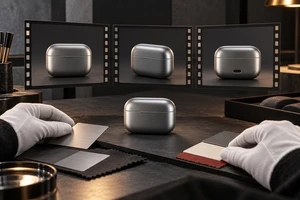
The old production sequence was simple: a brand wrote a brief, a creative partner made the assets, and the media platform distributed them. Google Ads is compressing those steps. Asset Studio can now interpret a URL, marketing brief, product photographs, video clips and brand guidelines, then generate coordinated text, image and video directions.
That does not make the brief less valuable. It makes the brief executable.
For global brands working with Chinese supply chains, the procurement question is no longer “How many AI ads can we get?” It is “What inputs must we own so that any platform can produce accurate, recognizable and testable variations?”
What Google has actually connected
In its September 2026 Creative Drop, Google said Gemini Omni in Asset Studio can work from a URL, marketing brief, product shots, video clips and other references. An advertiser can select one of three narrative directions, refine a storyboard scene by scene, and produce horizontal, vertical and square video assets. Google also recommends uploading current brand references covering fonts, hex codes, logo rules, patterns, textures and examples of strong brand work. The announcement describes a global rollout inside Google Ads.
The operational details matter. Google Ads Help currently says prompt and model understanding in this workflow support Global English, and access still depends on eligibility for generative AI features. The platform can reduce production friction; it does not remove the need for a usable source system.
Google also states that generative AI output may be inaccurate, that generated assets are not guaranteed to pass Ads Policy, and that advertisers must review assets for accuracy, misleading content, policy and applicable law before publishing. That is why “the platform made it” is not a defensible approval process.
The ONCE five-layer generative production brief
A one-page moodboard is no longer enough. We recommend a five-layer specification: Truth, Invariants, Anchors, Variation and Evaluation.
Truth: define what the system is allowed to say
Start with publishable product truth: SKU, specifications, compatibility, materials, package contents, eligible markets, warranty, certifications, price conditions and prohibited claims. Give important claims a source, owner, effective date and retirement trigger.
If a landing page mixes old and new product versions, a model cannot perform the brand's internal fact arbitration. It will simply receive ambiguous context. Our earlier product-claim version ledger addressed obsolete footage; generative workflows can turn one stale input into an entire family of fresh-looking mistakes.
Invariants: state what optimization may not change
Invariants include logo use, core colors, forbidden colors, typography, packaging proportions, product geometry, interface placement, material appearance, voice and unacceptable people or settings.
A useful brand guide also contains negative examples. Which gradients make the brand look like another category? Which camera angles exaggerate size? Which backgrounds distort the product's finish? Adjectives such as premium, youthful or innovative are too loose to operate as production constraints.
Anchors: decide which proof must come from reality
The ability to animate one image does not make one image sufficient product evidence.
Live action or approved 3D assets should usually anchor:
- dimensions, construction, ports, package contents and assembly relationships;
- reflective, transparent, textile, metal or leather surfaces that are easy to misrepresent;
- real operation, fitting, folding, load, water resistance, sound or mechanical motion;
- demonstrations supporting compatibility, safety, use steps or a functional claim;
- identifiable talent, locations, uniforms and other rights-bearing elements.
The shoot changes accordingly. It should deliver more than a hero edit: multiple verified angles, clean backgrounds, action starts and finishes, detail shots, textless plates and crop-safe frames. These are not anti-AI precautions. They are reliable inputs for AI.
Variation: release one class of change at a time
Background, hook, lighting mood, shot order, supers, CTA, music, voice and aspect ratio can all vary. They should not all vary in the same test.
If a treatment changes the setting, copy, pace, character and offer, better performance does not reveal which creative decision mattered. Give each round a named hypothesis: product-first versus context-first; functional proof versus emotional benefit; silent readability versus sound-led storytelling.
The platform can create volume. The brand should constrain the variable. Asset count is not acceptance; a variation is useful when it helps answer a decision.
Evaluation: define evidence before generation
Google's Performance Max asset testing beta lets advertisers compare control and treatment assets with a chosen traffic split. Once the experiment starts, the tested asset group is locked from editing. Google says the Experiment Guidance System calculates duration and recommends at least four to six weeks as a best-practice range; new treatment assets still undergo standard policy review.
Every test package should therefore contain the hypothesis, control assets, treatment assets, common assets, primary metric, observation window, stop condition and post-test action. Early movement should not trigger a total rebuild, and a platform correlation should not be relabeled as universal creative causation.
What belongs in Asset Studio, and what belongs in production
Use two questions: Could an error change the product truth? Does this image carry proof?
If either answer is yes, favor live action, verified 3D or controlled compositing with human approval. If both answers are no—nonessential backgrounds, mood colors, layouts, supers, end cards, crops or contexts that do not alter the product relationship—the platform is a strong place to generate and test.
Most work will be hybrid: a real product plate in a generated environment, verified operation with localized voice and captions, or live-action hero footage with platform-made cutdowns. The production partner's role shifts from manually making every variation to creating accurate anchors, designing safe variable zones and keeping outputs traceable.
Stop pricing the work by file count
A controlled generative program has a more useful cost structure:
Total controlled creative work = truth and guideline setup + verified anchors + generation and adaptation + approval and rights review + test media and analysis + version archive and retirement
A quote for 50 generated ads is only a file count if it omits product truth, source references, allowed variables, review ownership and test design. A smaller set that can be explained, reused and fed into the next learning cycle is a more durable asset.
This extends ONCE's argument about buying AI work as qualified work units. Model calls and output volume are not the value. For advertising creative, a qualified unit combines correct inputs, one identifiable variable, an approved asset and a readable result.
Add five pages to the next brief
A brand does not need to wait for every Asset Studio capability to reach every account. Start with one priority SKU and prepare five pages: product truth, brand invariants, verified anchor list, variation matrix, and test-and-retirement rules. Then decide what Google Ads may generate, what a production partner should capture, and what product, legal or marketing owners must approve.
Google is moving the path from brief to ad into one interface. The opportunity is not to eliminate the brief. It is to turn the brief into a brand-owned creative operating system—portable across tools, durable across model changes, and capable of remembering what the last test actually taught.
Sources
- Google Accelerate, “Inside Drop #1: Your top questions on Gemini Omni in Asset Studio answered,” September 2026.
- Google Ads Help, “How create image, text, and video assets with a prompt in Asset Studio,” checked October 5, 2026.
- Google Ads Help, “How to build a Performance Max asset group using generative AI,” checked October 5, 2026.
- Google Ads Help, “About Performance Max optimization experiments: A/B testing assets (Beta),” checked October 5, 2026.
- Google Ads Editor Help, “Use AI content label settings and disclosures,” checked October 5, 2026.