The serum has just been spread across the face. The cheekbone shines, but so do the nose and forehead, as if the skin were wrapped in plastic. The image is brighter, yet it does not necessarily feel hydrated. Viewers may read some highlights as soft, supple, freshly cared-for skin, while reading others as oily, sticky, or unreal.
In skincare ad filming, the useful question is not simply whether skin looks luminous. It is where the light lands, how the highlight moves, how much texture remains, and whether the shot still explains the product experience after the hand leaves the skin.
Dewy and greasy begin with the distribution of shine
A 2023 study in the International Journal of Cosmetic Science modulated surface reflections in 64 facial images and asked 15 participants to classify them as matte, glossy, or greasy. The sample was small and limited to Korean women's skin, so it should not be treated as a universal beauty rule. Its practical value for image-making is narrower: perceived greasiness was related not only to brightness, but also to the number, area, and evenness of highly reflective regions. Read the study.
A 2025 study in the Journal of the Optical Society of America A examined cheek images from 283 Japanese women and asked 59 observers to distinguish preferred from unpreferred gloss. It likewise found that the spatial pattern of specular reflection mattered, not brightness alone. Read the study abstract.
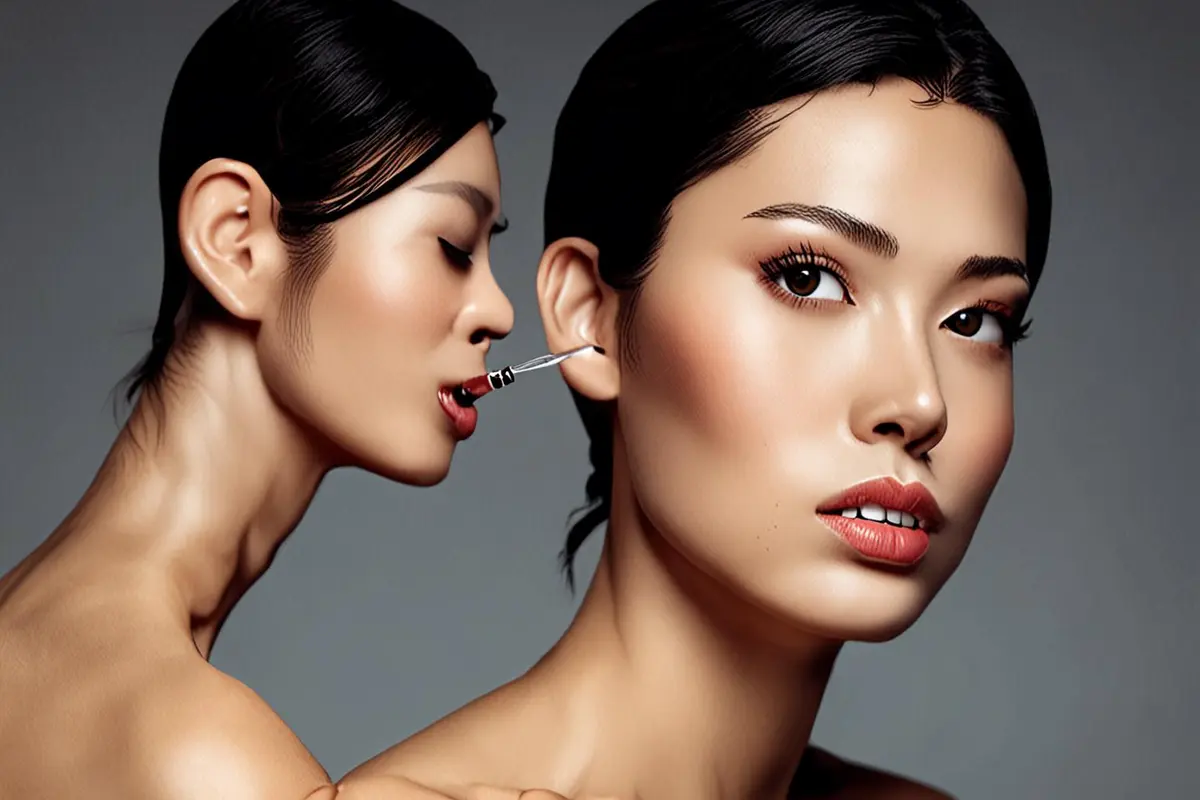
For a cinematographer, this shifts the lighting conversation away from "make it softer." A directional highlight along the upper cheekbone, temple, or cupid's bow may read as moisture. When the forehead, nose crease, and cheeks all carry the same smooth sheen, the result is more likely to resemble an oily film. Dewiness has structure; greasiness often looks uninterrupted.
Preserve the skin before asking the product to change it
The most common distortion in beauty imagery is not an excess of flaws. It is the removal of every cue that tells us we are looking at skin. Pores, fine hairs, small colour variations, and the boundary between damp and dry areas make the surface believable. If diffusion, filtering, and retouching erase all of them, the product loses the surface on which its story is supposed to happen.
Treat the image as three layers. First, diffuse reflection carries skin colour and micro-texture. Second, a narrower specular highlight defines the damp area. Third, the eyes, fingertips, and pack remain clear enough to anchor the action. The highlight does not have to cover the whole face, and texture does not need equal sharpness everywhere. The essential message is simple: the skin is still present, and something about its surface has changed.
Exposure matters because small specular areas can be much brighter than the surrounding face. ARRI's dynamic range paper explains that once a sensor reaches saturation it can no longer distinguish detail above that point. See ARRI's technical paper. On set, that means protecting the highlight on the cheek from becoming a featureless white patch. Adjust the light position, angle, and negative fill first; use polarization selectively rather than removing every reflection.
The application is not a transition shot
A drop landing on skin, the fingertip spreading it, the hand lifting away, and the skin settling should feel like one continuous event. If the drop is filmed with a thick substitute, the spread suddenly becomes watery, and the final skin shot has no reflection at all, each frame may be attractive but the sequence describes three different products.
Performance changes the apparent texture as well. Rapid rubbing suggests cleansing or exfoliation. Short tapping gestures emphasize bounce and rhythm. A slow spread can show glide, but if the finger meets no visible resistance, a cream may start to resemble water. Instead of asking a performer for an elegant gesture, decide whether the formula should appear to flow, wrap, grip, or disappear. Then design finger speed, contact area, and release around that verb.
Sound can add a tactile cue, but it should not contradict the picture. A heavy tacky sound can turn a light serum into glue; a dry crisp rub can make a rich cream feel powdery. Our discussion of sound design for product movement offers a related way to align sonic weight with visible material behaviour.
A useful test compares four variables, one at a time
Before the main shoot, use the same model, product, lens position, and basic grade to record a short test. Change only one variable per take: highlight direction, application amount, finger speed, or retouching strength. Review the moving sequence instead of judging a single hero frame.
If the bright area stays fixed while the product moves, it may read as makeup or surface oil. If the skin becomes instantly perfect at the first touch, the action has no believable cause and effect. If retouching removes the damp boundary between product and skin, the texture has nowhere to land. A convincing finish usually permits some incompleteness: texture remains, the treated area changes within limits, and the face still looks like skin a few seconds later.
This test is not a procurement checklist. It is a creative choice between freshness, softness, occlusion, and radiance. Different formulas deserve different surface behaviour; one generic combination of pale skin, flat glow, and invisible pores cannot represent all of them.
A picture can show use, but it cannot replace substantiation
A camera can honestly record the colour, flow, application, and immediate appearance of one sample under specific conditions. A luminous face alone cannot prove long-term hydration, barrier repair, or suitability for every skin type.
China's National Medical Products Administration requires cosmetic efficacy claims to have adequate scientific support and the evaluation method to be scientific, reasonable, and feasible. See the NMPA standard. In the EU, Commission Regulation 655/2013 similarly requires truthfulness, evidential support, and honesty in cosmetic claims. See the European Commission source.
The practical distinction is between "the skin looks luminous immediately after application" and "the product delivers a substantiated benefit." The first may be visible in the shot; the second needs appropriate evidence. Keep that distinction in the creative brief, on set, and in the final edit.
The most believable glow still looks like skin
A strong skincare film does not confuse realism with roughness or luxury with erasure. It gives highlights direction, allows texture to breathe, and keeps cause and effect intact across the application. What remains is not a permanently perfect face, but a specific product experience viewers can understand without the image promising more than the evidence can support.
If you are preparing a campaign for a serum, cream, or beauty-care product, assemble the sample, approved claims, intended skin finish, and target channels in a one-page brief. Then explore ONCE VISUAL's video production work and use a short camera test to define the lighting, texture, and movement language before the full shoot.