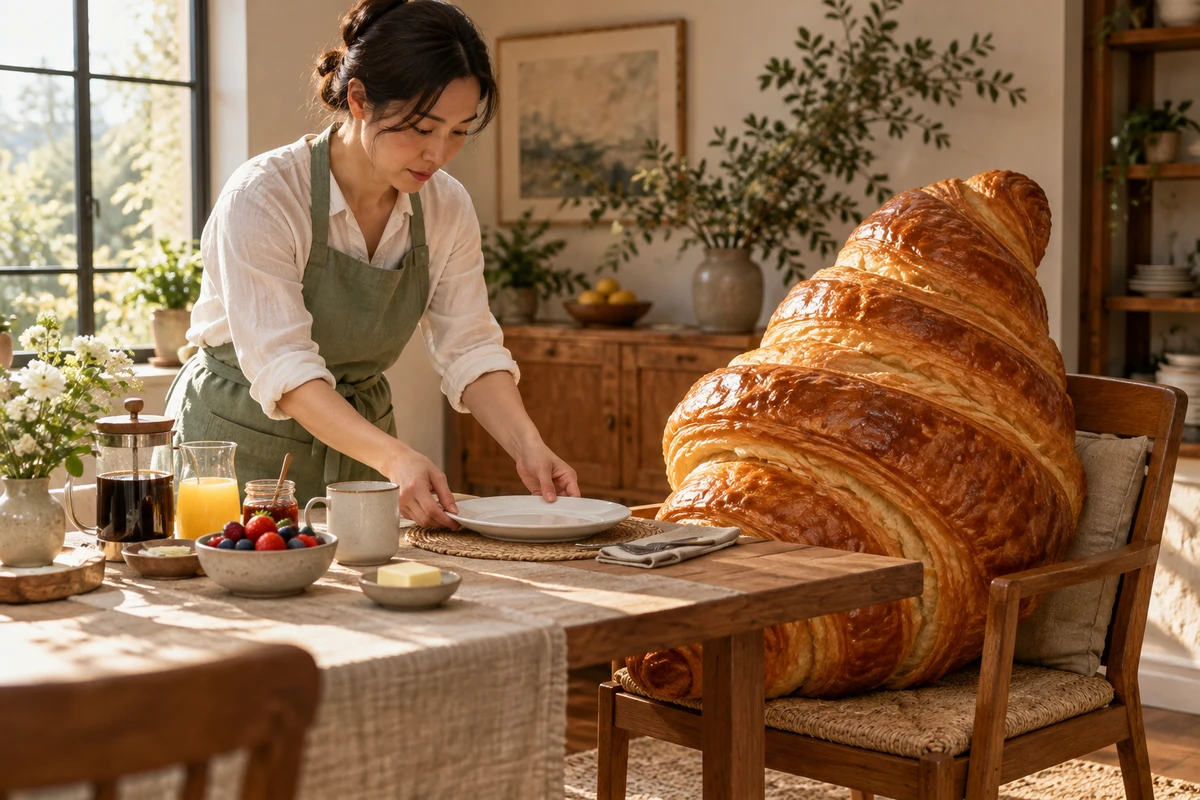
A host sets a place for a breakfast guest. The guest is an enormous croissant sitting in a chair. The host does not gasp, retreat or wink at the camera. Instead, they notice that the plate is too close to the guest and move it forward a little.
This is an entirely fictional exercise for an apron commercial, not an existing campaign. It raises a performance question: when the situation is already absurd, does the actor need to perform its absurdity for the audience as well?
Deadpan acting in ads can work in another way. The character responds, but to a specific, practical problem within this strange world. The audience sees something extraordinary; the character concentrates on getting something done. Deadpan does not remove the performance. It changes where the character puts their attention.
Put the absurdity in the situation and conviction in the person
Epoch Films’ introduction to director Carl Sundemo brings deadpan humour and surreal escalation together with controlled compositions and grounded performances, describing a tone that stays consistent even as the idea becomes ridiculous. This is the production company’s account of his approach, not independent evidence of effectiveness. It is not a claim that we have watched his films shot by shot.
The distinction is useful: a situation can grow stranger without the people growing louder. The giant croissant already supplies the absurdity. If the host adds a string of exaggerated screams, the film moves towards another kind of comedy. That may be a valid choice, but it no longer depends on treating the extraordinary as an ordinary practical matter.
Nor must every character accept the world in the same way. The host might welcome the pastry without question, while another household member briefly hesitates and then brings the tea anyway. They understand the situation differently, but each has something to do. If everyone stops to wait for the audience to laugh, the scene can lose its everyday momentum.
On his own About page, director Andy Lambert suggests that, in film pastiche, a more serious and authentic reference can make a humorous twist funnier. This is his judgement about his practice, not a universal law of comedy. For the breakfast exercise, the useful starting point is not a borrowed shot from a commercial. It is making the ordinary act of hosting credible before introducing an impossible guest.
Replace “play it colder” with something to accomplish
Telling an actor to remain expressionless can produce little more than an unchanging face. Giving the character a task provides something to play. The host wants every guest to sit comfortably: a plate blocks the space, so they move it; a napkin is out of reach, so they offer it. They need not be oblivious to the giant pastry. They can choose, politely, not to make an issue of it.
Rehearsal can explore different treatments of the same action. In one take, the host notices the guest and looks at the camera, inviting the audience into a shared secret. In another, they suppress a smile but change nothing they do. In a third, they notice the distance between chair and table and carefully adjust the place setting. The first two may have their own appeal; the third keeps attention on the character’s purpose.
The useful questions are not whether a take is sufficiently deadpan, but what the person noticed, why their action changed and whether they are still caring for the same guest afterwards. If the only answer is that their face never moved, the character has not yet been given a playable action.
Small expressions can therefore remain: concern, hesitation or dissatisfaction. A frown might mean the place setting is not good enough, rather than “this cannot be real”. The same expression, directed at a different problem, changes the scene’s position. A directing note should identify the object of attention and the purpose, not simply ask for a flatter face.
There is no need to demand an identical blink on every take. Keep the task and circumstances clear while allowing the actor to find credible details. Then consider whether those details still belong to the character or have become a display of jokes for the camera. The comparison concerns this performance, not a permanent verdict on someone’s comic talent.
Let the audience see what matters to the character
Begin by considering a composition that includes the host, the plate and the enormous guest. The audience can compare an ordinary act of hospitality with an extraordinary visitor in the same frame. A close-up of hands arranging a plate followed by a separate pastry close-up may show both clearly while separating the relationship that matters.
That does not mean deadpan requires a locked camera or a single take. Lambert describes three rules for his personal, non-advertising project The MUTE Series: no dialogue, no camera movement and one shot. Those are choices for that particular series, not a specification for every commercial. Camera movement should follow what the audience needs to discover, not an assumption that deadpan must stay still.
A pause is not an empty slot reserved for laughter
After moving the plate, the host might briefly watch to see whether the guest can settle in. That gives the pause something to contain. If there is nothing to wait for and the actor simply freezes, extending the shot will not necessarily make it funnier. Let attention and expectation motivate the hold, rather than adding a standard number of seconds.
The same applies to reaction shots. A household member can glance at the pastry and put down the tea, continuing their task. An immediate wide-eyed reaction, comic sound effect and emphatic push-in instead tell the audience how to read the moment. Try removing those cues temporarily and see whether the relationship between attentive hosting and the absurd guest remains clear. Then decide what to restore. This is an editing comparison, not a report of audience testing.
The soundtrack need not be silent. A cup landing, a chair shifting or an ordinary “A little further in” can keep this world functioning. The question is whether sound serves the people or repeatedly announces a punchline. If the basic event becomes unintelligible without music, reconsider the situation and actions before searching for a louder comic cue.
Make that conviction belong to the brand
In this fictional scene, the apron belongs to someone determined to host breakfast thoughtfully. Adjusting it, carrying plates and continuing to work can make the product part of that way of doing things, without giving it magical powers. The idea might express an attitude towards hospitality, cooking or everyday life. It does not establish stain resistance, heat protection or suitability for every body type.
If the communication needs to explain a material or function, provide a separate, clear and truthful demonstration. A successful joke does not automatically communicate the product. Nor should a universal end-line recast considerate hosting as proof that the product solves everything. If a different brand could use the scene without changing a word, ask where this brand’s particular attitude appears.
Deadpan is not a default tone for every subject. A person showing no concern about real harm, service failure or customer inconvenience can seem callous rather than funny. Even in fiction, avoid treating a body difference, accent or unfamiliarity with local rules as the laughable abnormality. Establish whether the humour comes from the invented world, excessive etiquette or a character’s fixation, so the performance knows whose dignity it should protect.
For another language, check the motivation as well as the words. “A little further in” expresses consideration here. A commanding dub or a subtitle that turns concern into irritation changes the relationship. Ask target-language readers to explain what the host is worried about before discussing whether the tone is funny. Do not assume a restrained performance will mean the same thing to every audience.
Good deadpan does not drain warmth from the person. It gives them a conviction of their own. The audience may first laugh at the oversized croissant, then realise that the host has only been concerned with looking after a guest.
If you are developing a brand film with deadpan humour, bring the brand attitude you want to preserve, an absurd premise and the thing your character genuinely needs to accomplish. Explore the performance and visual direction through ONCE’s brand film production service.
Source note: Epoch Films’ Carl Sundemo introduction and Andy Lambert’s About page were consulted on 20 October 2026; their original publication dates were not confirmed. This article discusses public written descriptions, not a completed film viewing, shoot or audience study. The breakfast scenario and original AI-generated cover are independent fictional concepts, not ONCE client work.