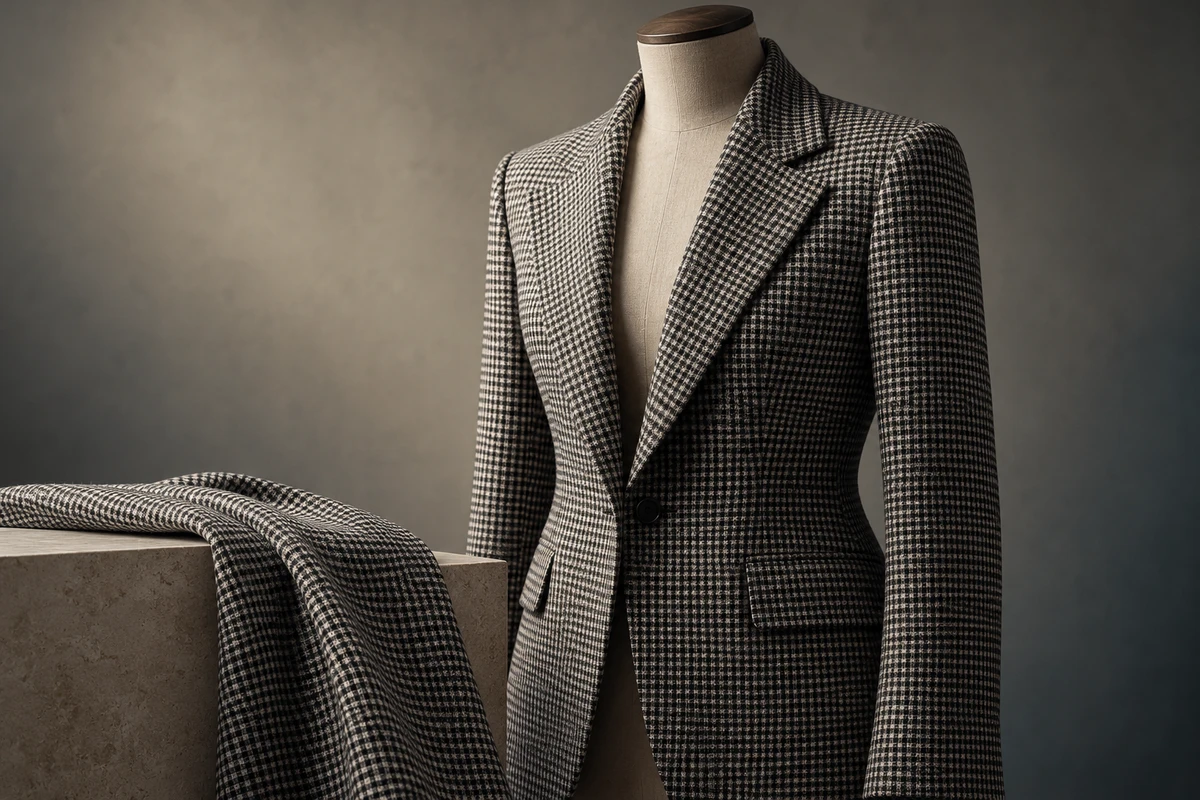
A small-check jacket needs a product film. In a medium-shot trial, colored waves appear across the chest, although they are absent from the garment. Replacing it with a solid-color jacket would avoid the immediate problem, but this is the item being sold. Softening the whole image might make the waves less noticeable while also losing the weave the film was supposed to show.
Handling moire in apparel video requires more than removing strange patterns. Viewers should still recognize the actual check, silhouette, and behavior of the garment without mistaking imaging artifacts for product features. That may mean giving different shots different jobs rather than asking every framing to explain everything.
More visible pattern does not mean more faithful fabric
Nikon's official article Moire and False Color explains that fine repeating patterns can produce moire and colors absent from both the object and its lighting. Its discussion concerns older still-photography systems including the D800 and D800E. This article uses the explanation, not its specific aperture or software advice as a current video recipe. Sources were checked on October 20, 2026.
Imatest's official Nyquist frequency, Aliasing, and Color Moire, in its 22.2 documentation, explains that detail beyond a system's reproducible range can appear as a different, coarser pattern. An apparently detailed image is therefore not necessarily a more faithful record. This explanation is not a camera or lens ranking.
For product imagery, preserve the garment's pattern rather than waves created in the image. Keep the physical item or a trustworthy original reference available: what colors are the checks, which lines are continuous, and where are the actual folds? A newly appearing pattern should not be accepted as fabric character simply because it looks intricate.
Nor must every thread be individually countable in every shot. A full view can explain length, shoulder shape, and fit; a detail can introduce the weave. These are complementary tasks rather than competing demonstrations of resolution.
Give one jacket several distinct views
Consider an original, fictional small-check jacket. It represents no ONCE client, actual product, or completed camera trial. The film needs to communicate three things: the standing silhouette, the check near the collar, and how the garment follows its wearer through a turn.
The medium shot protects outline and proportion first. If artifacts appear across the chest, compare modest changes in camera angle, distance, or lens setup under the real shooting conditions. Look for less interference without losing the intended view of the cut. Do not automatically stop the model moving or assume that greater distance is always safer.
Nikon's article lists camera-to-subject angle and lens or focal-length changes among approaches that may alter moire. Treat them as options to investigate, not guaranteed fixes. If moving the camera is followed by zooming back to the original framing, a changed camera position alone is not proof of improvement. Inspect the recording.
A closer shot can allocate more of the frame to the check and its relationship to a seam. An identifiable area from lapel to front panel can connect this detail with the jacket previously shown. Whether closer is better still depends on the footage; no universal minimum distance is proposed.
The turning shot explains movement. Have the wearer perform the turn at the speed the film actually needs, and examine the front, sleeves, and back throughout it. Approving a stationary pose does not approve a moving shot. Nor should avoiding one difficult angle turn the garment demonstration into an unrelated performance.
Compare information lost as well as artifacts reduced
Ask two questions of each adjustment: did the unwanted pattern improve, and what became harder to recognize about the garment?
A modest change in sharpness may be acceptable in a silhouette shot. Smoothing away the weave in a shot intended to explain it does not fulfill the same task. Conversely, a fit demonstration need not be rejected because individual yarns are not visible, provided the pattern is not misrepresented and another shot supplies necessary detail.
This also helps determine where to cut. If a continuous movement remains unsatisfactory, consider two more stable views. The edit should retain meaningful product information and action, rather than becoming disconnected fragments selected only to evade a problem. Reducing interference and explaining the garment must happen together.
Judge recorded movement, not just an approved frame
Retain an untreated recording, then output a short passage using the intended finishing approach. Compare the recording with the processed version, and play the passage at its intended viewing size. This is a proposed production method, not an experiment performed for this article.
Magnification helps examine local lines and unexpected color; normal-size playback helps assess their effect on viewing. Neither replaces the other. A scaled preview in one player alone should not establish whether the source file is defective or clean. If necessary, return to a defined viewing size and compare the same file.
Review the jacket's shots together, too. If the check has one color impression in the medium shot and another in the close-up, return to the physical garment, original footage, and processing steps to locate the change. Making each shot individually attractive does not settle their relationship.
No universal resolution, aperture, sharpening, or removal strength is prescribed. Camera, recording mode, lens, finishing chain, and required detail differ. Applying settings from an older camera article to every video project would turn a comparison into an unverified promise.
A cleaner picture must not become a different product
Finishing choices return to the same question. If a treatment makes interference less visible while changing check spacing, line continuity, or seam position, compare those changes with the real garment. A smoother-looking result is insufficient. No particular software is claimed here to cause or solve those changes.
Generative repair is not a source of fabric facts. Even an attractive result needs comparison with real records if it will represent an actual product detail. A prompt asking to restore the original texture does not establish that a newly rendered pattern is the original. Concept imagery can suggest a mood; it cannot supply unrecorded yarn or pattern facts.
For ordinary interview wardrobe, changing clothes may be sensible. When the garment is the subject, the solution must work around that garment. The goal is a recognizable record of this jacket, not merely a jacket-shaped image without waves.
For an apparel product film, bring the sample, intended movement, and fabric areas that matter most to ONCE's commercial production solutions. Decide what viewers must see faithfully, then compare how technical choices help retain it.
Sources checked October 20, 2026. This article uses the official Nikon and Imatest text identified above. It includes no camera, fabric, software, or platform-export test and promises no elimination of moire. The jacket scenario and original AI cover are fictional illustrations, not optical comparisons or records of an actual product.