Imagine a fictional record-player commercial. The shot begins with the tonearm in focus, then shifts attention to a listener seated farther back. The camera stays still, yet the image seems to push in slightly and the platter's edge changes position within the frame. During a product-video focus pull, lens breathing may cause this change. Asking for more accurate focus alone will not address it.
Two judgments are needed: has focus taken attention to the intended subject, and has the changing angle of view altered something the composition needed to retain? Breathing compensation can help with the second issue, but its framing and operating conditions also matter. The useful choice may be compensation, a revised composition, or accepting a small change that does not interfere with the film.
Focus changes, and the relationships inside the frame may change too
Sony's ILME-FX3 Ver.2 or later Help Guide, in its Lens Compensation section, describes breathing compensation as addressing changes in angle of view associated with focusing distance during movie recording. This section was checked on October 20, 2026. The issue here is the changing field of view during a transition, rather than making both subjects sharp simultaneously.
In the record-player concept, shifting focus from the object to the listener could express a product becoming part of someone's life. If the same transition makes the record player noticeably larger within the frame, it may also emphasize the product again. Those changes need not conflict, but the director should recognize that both are contributing meaning.
During review, consider sharpness and composition separately for a moment. Establish what receives attention at the start and end, then watch the platter's outline, the cabinet edges, and the space around the person. If attention has reached the listener while the product suddenly crowds the frame, that change may matter more to the shot's sense of ease than whether focus landed precisely.
This does not mean every change of view must disappear. Recognize what it changes before deciding whether it is acceptable lens character or an unrelated distraction. The record player and listener described here are an original fictional scenario, not a client project or an actual lens test.
What fits inside the compensated frame?
Sony's ILME-FR7 / ILME-FR7K breathing-compensation guide explains that the feature electronically crops part of the image to maintain a consistent angle of view. It also notes that angle of view and image quality may change slightly. This particular implementation helps explain why compensation can change the available frame rather than simply erase movement. It does not establish a universal crop amount for every camera.
If the fictional shot initially fits the entire tonearm only just inside the image, check it again with compensation enabled. Reduced image expansion has not completed the product-presentation task if the tonearm is now clipped. Recompose, adjust the positions of the object and listener, or revise the focus endpoints, then reconsider whether the transfer of attention still works.
More spare space is not automatically better. Making the product small and surrounding it with empty room for a possible correction may weaken the material details the shot was meant to show. Identify the outlines and relationships that must remain, then compose for the actual compensation setting instead of applying a standard percentage to every job.
Compare the distances this scene needs
Record a focus transition with camera position, zoom setting, and set arrangement held constant. Where the equipment supports it, compare a compensated version. If the shot moves from the record player to a listener in a chair, use those actual positions. An extreme minimum-distance-to-infinity demonstration need not represent the problem this film will encounter.
Watch the whole transition as well as its endpoints. One version may look good at both ends but change framing conspicuously in between. Another may hold a steadier view while losing a necessary product edge. Considering both reveals what the correction gains and what it costs.
Check the specific equipment conditions. The FX3 guide above lists breathing compensation for firmware Ver.3.00 or later and limits it to compatible lenses; complete correction may not be possible with every lens. The FR7 guide also lists recording-mode restrictions. These are model-specific instructions. A menu option on one camera cannot establish compatibility for another camera, lens, and recording mode.
A stable frame still needs a reason to change focus
Once the technical issue is addressed, ask why attention should leave the tonearm at this moment. If the listener simply sits there and the transition reveals no new expression, action, or information, the shot may achieve little beyond a photographic maneuver.
Give the handover a specific moment: the listener has been reading, then closes the book and begins listening attentively. Moving attention with that change creates a relationship worth discussing. This is a script proposal, not a claim about a record player's acoustic performance or a tested audience response.
Whether minor breathing needs treatment also belongs within that relationship. In a Sony Cine interview published September 30, 2020, Matthew Duclos discusses breathing in relation to the project, noting that effects work requiring consistent framing may place greater importance on it. This is an interviewee's professional judgment, not an equipment comparison conducted for this article or a ranking of lens categories.
A small shift that does not compete with the listener's change may be acceptable. A shift that repeatedly crowds the product's outline deserves attention. If the compensated composition remains unsuitable, give the product and person separate, stable shots and transfer attention through a cut. A continuous focus pull is an expressive option, not a difficulty requirement for product films.
Judge the transition within the complete passage
Make the final judgment at the intended viewing size and alongside neighboring shots. Does a change noticeable in isolation still distract within the passage? Does the compensated image connect to the next shot with the intended product scale and rhythm? A compensation icon cannot answer these questions.
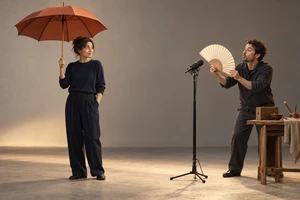
Generated concept footage can help discuss the sequence of attention from object to person. It cannot establish how an actual camera and lens will breathe. Equipment decisions still require the relevant documentation and recorded footage. A single concept-cover image likewise cannot demonstrate a focus transition.
When planning a product film, bring the object, the near and far subject positions, and the moment when attention should shift to ONCE's commercial production solutions. Where focus arrives should also be where something in the story begins to change.
Sources checked October 20, 2026. This article uses the specified sections of two Sony help guides and the dated Sony Cine interview. No filming, optical measurements, or consumer testing were conducted. The record-player scenario and original AI concept cover are fictional illustrations.