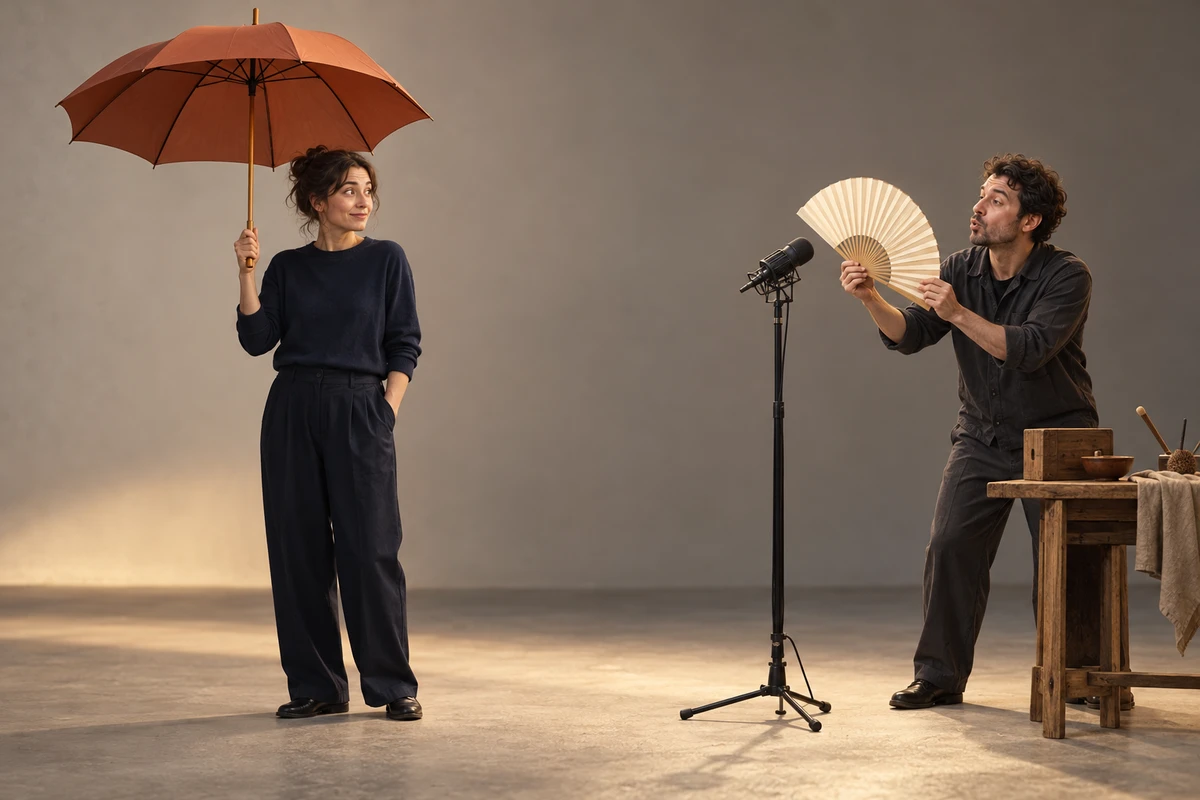
Imagine an umbrella advertisement that has not been made. An actor opens an umbrella while a Foley performer beside them uses a paper fan to suggest an extravagantly dramatic gust. The person holding the umbrella does not pretend to battle a storm. They glance sideways. The sound maker takes the hint and makes the next gesture smaller. Eventually, the two find a lighter shared rhythm, as though completing a small rehearsal together.
This fictional proposal demonstrates no wind resistance, waterproofing or other product performance. Its question is different: when the sound maker enters the picture, Foley can do more than make an object sound real. It can become an interaction between performers. Viewers watch both the product action and how two people bring that action together.
From behind the image to sharing the stage
Adobe's How to add sound effects to videos introduces Foley as sounds created for a particular production, often timed to the action on screen. Checked on October 19, 2026, that definition describes a production method. It does not require the performer to remain invisible.
Hornet's public COS - Sound of COS project page offers a reference for visible Foley. Its description brings together two models and two Foley artists, pairing everyday actions such as dressing with unconventional sound sources. This article discusses the structure described in that text, not a shot-by-shot viewing of the film. No audience or sales effects are inferred.
Revealing sound-making can serve several purposes. A behind-the-scenes film can explain how a sound was made. A tutorial can explain why a particular prop was chosen. An advertisement can give the sound maker something to pursue within the scene. All are valid, but a microphone, props and diligent hands do not by themselves create the third kind of film.
The difference is whether the performers affect one another. If the actor suddenly stops, does the sound maker keep going? If a cue comes early, does the actor catch up, refuse to follow, or make a smaller movement that invites restraint? This does not require manufacturing mistakes. It gives cooperation a visible development. Once the audience recognizes the prop, there should still be something to watch beyond the next surprising object making a noise.
Give the performers different tasks
In the fictional umbrella proposal, one person may simply want to get ready to go out without fuss. The sound maker treats the same ordinary gesture as a grand theatrical event. Their different aims give them reasons to watch, test and adjust. The joke need not depend on stupidity or turn the product user into the target of a prank.
Start by rehearsing a small sequence: pick up the umbrella, open it and stop. Set aside sonic polish and see where one person needs the other or should wait. Then let the Foley performer propose a rhythm and ask the actor to respond. If the paper fan cannot produce the intended effect, change the method. A promising written idea is not a completed sound.
In one version, action leads and sound follows, with the Foley performer trying to keep up. In another, the sound maker gives a cue and the actor finds movement within it. Both can work, but they ask for different rehearsals. The first needs listening and following; the second needs acceptance or alteration of a cue. Giving both people identical time marks does not automatically make them perform together.
An intentional mismatch still needs a clear response
If the proposal includes an overblown or early sound, let a subsequent action address it. The umbrella holder looks toward the sound maker, who reduces the gesture. They try again, and the sound becomes more restrained. That development establishes the mismatch as part of their interaction rather than an effect pasted carelessly onto the picture.
The whole scene need not stay in a wide shot. A wider view can establish the people, umbrella and sound-making prop; a close-up can reveal a wait or adjustment. But a sequence made only of attractive umbrella details and isolated prop details may omit mutual awareness. Protect who cues whom and who changes because of whom, not merely the clarity of two separate sets of movements.
Nor must a real production pretend it was captured in one live performance. Depending on the circumstances, record sounds separately, shoot inserts or refine the edit. The finished timing and responses should make sense. If accompanying content specifically calls it live, one-take or a record of an actual event, ensure that claim matches how it was made. Edited continuity is not evidence of production history.
After revealing the sound maker, keep the brand in the scene
Showing both performers at the outset establishes a theatrical game early. The pleasure can come from how they cooperate. Starting with the umbrella holder alone and revealing the paper fan later makes the source a discovery. The first approach does not depend on guessing; the second needs time for a relationship after the reveal. Neither is inherently superior. Choose what viewers should be watching.
For an umbrella brand, this proposal might suit a playful approach to everyday life. Opening, holding and closing the umbrella should still initiate the action. Another product should not slot in without changing the scene. At the same time, do not edit the exaggerated gust into apparent wind-resistance evidence or present the paper-fan effect as the umbrella's actual sound. A theatrical metaphor and a product demonstration can have separate jobs.
Visible Foley may be unsuitable when the task is to explain construction, operating steps or actual working noise. Viewers may need a direct, accurate demonstration instead. If the purpose is to express imagination and everyday play, the form can bring the product into a shared act of invention. Establish how the brand should feel before asking which prop is most surprising.
A shorter version should not preserve only the loudest moment. It might retain one action, recognition of a mismatch and an adjustment, keeping the relationship legible. Or write a separate short exchange in which the pair are in sync from the start. Shorter does not necessarily mean accelerating the long version's reveal.
Sound-off viewing is another task again. Looks and movements can communicate cooperation without preserving a joke built around a particular sound. If a silent version is needed, make a mistimed gesture and its correction more visible, or accept that it carries a simpler interaction. Dialogue-free does not mean listening is unnecessary.
The most interesting possibility may go beyond discovering an unexpected sound source. One person listens to another, and an inflated performance finds its measure. Whether the final small sound works must be judged in an actual rehearsal. Why the two people make it together is a question the script can already begin to answer.
Developing a sound-led brand film? Bring a product action to ONCE's advertising creative and production team. Define what the user and the sound maker each want to do, then explore how sound, performance and picture can meet.