At the storyboard meeting, every image makes sense: a person enters, picks up the product, and smiles. Place those images on a timeline and questions appear. Why did they reach for it? What did they notice? Is the smile a response to something that happened, or simply a reminder that this is supposed to be a happy moment?
An animatic lets a seemingly complete row of pictures face the demands of continuous viewing. Its purpose is not to make the presentation more lively. It gives an idea a chance to move forward without the presenter explaining it. Rough images can do that, but roughness is not permission to omit the action on which the scene depends.
Understanding a picture is not the same as following a scene
Adobe’s What are animatics and how can I make them? describes an animatic as a rough sequence, sometimes with sound, used to explore timing, flow, and the communication of meaning. We consulted its definition and comparison with animation on October 19, 2026, rather than adopting its historical accounts or film examples.
A static storyboard lets someone pause, look back between adjacent images, and listen to a director explain what a character is thinking. Playback introduces a different condition: each image disappears at its appointed time, and information missed earlier may not return. Understanding the pictures in a meeting and following them in sequence are two separate creative judgments.
That does not mean making every action slower. Often, what is missing is not time but a change. A person jumps from hesitation to satisfaction without the moment of choosing being represented. Holding the satisfied face longer does not supply the reason for the choice. An animatic should help the team locate that gap, rather than cover it with moves, transitions, and music.
Simplify the finish, not the events
Imagine a fictional ceramic cup commercial. Someone is working alone at a small table. Another person approaches, and the seated person moves their cup inward to make room. The action might express sharing space or briefly stepping away from work. This is an original creative discussion, not an existing client project or a filmed test.
If the preview contains only three attractive images—a person sitting alone, two cups, and two people smiling—the final situation is clear, but how it came about is not. Was the second person invited or merely passing? Did the first person want to make room? Why did the cup move? More detailed ceramic texture will not answer those questions.
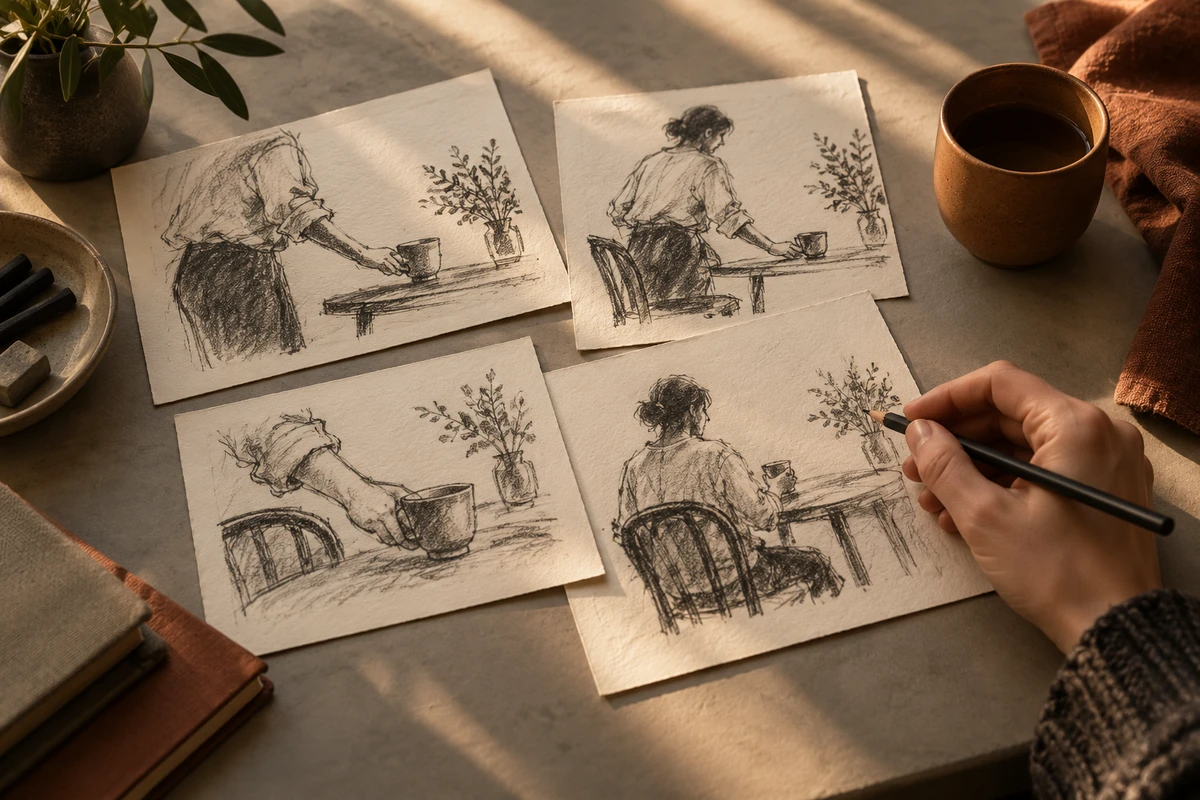
Concentrate the drawing where something changes: noticing the arrival, recognizing the lack of space, choosing to move the cup, and the other person accepting the invitation. These need not be separate shots. Changes of pose within one composition can communicate the relationships. The number of drawings and amount of movement should follow what makes the scene work, not a requirement to animate every shot equally.
The cup’s color and the room’s decoration can remain provisional. The direction of the reach and the space revealed when the cup moves should not vary arbitrarily. The former choices mainly shape the look; the latter shape our understanding of the event. For this scene, the difference before and after the action deserves the clearest treatment.
Add detail where the question needs it
Avoiding polish does not make every detail expendable. If the brand story depends on a handle keeping a hand away from the hot body of the cup, a cylinder without a handle cannot adequately represent that action. A readable hand-and-handle insert may be useful without requiring a fully developed room, wardrobe, and face in every image.
Likewise, a moment of eye contact may not survive the use of placeholder figures with no readable gaze. The useful addition is that exchange, not decoration across the entire sequence to make it resemble the finished film. A preview can have different levels of detail in different places.
Temporary sound can be a scene partner—or an explainer
Boords’ current official Animatics documentation, consulted October 19, 2026, shows how frame durations can be adjusted on a timeline and sound added with a waveform to help align the images. Those controls make timing available for discussion. They do not decide where a pause belongs.
Temporary dialogue should do the work that the intended dialogue will do. In the cup scene, “Sit here” changes the invitation. Speaking explicitly and silently moving the cup for the other person to notice are different scenes. If the finished film is not meant to include the line, adding it to the preview should not be mistaken for making the pictures clearer.
Narration has the same potential to intervene. “He decides to put work aside and enjoy some company” can explain three images immediately while doing a job originally intended for performance. A narrated presentation version can coexist with a playback version using only the planned soundtrack. They serve different purposes; viewers should not be treated as if they understood the sequence under identical conditions.
Music can also give a rough draft the feeling of completion. If an ad’s action is organized around music, a temporary track belongs in the discussion early. For a scene primarily about a relationship, temporarily removing it can reveal whether the exchange is still readable. This is not a rule that every good ad must work silently. It is a way to identify what the team is judging.
Scratch voice recordings need not be deliberately flat. Hesitation, interruption, and silence can be explored through delivery. That voice offers one possibility, though, not a guarantee of the eventual actor’s performance. If a different natural reading removes the support for the entire scene, the script and shots deserve another look together.
Let playback leave a specific question
A useful discussion need not end with approval of the whole film. It might reveal that viewers noticed the cup moving but did not understand that it made room for someone else. The next revision can address the table space, the arriving person’s eyeline, or the moment after the move, rather than asking generally for something warmer or more premium.
Invite a colleague who has not heard the explanation to describe what happened before discussing whether they liked it. This is an internal comprehension check, not consumer research. A colleague familiar with the brand being able to retell the scene does not predict an unfamiliar audience’s willingness to buy. An animatic can expose communication problems without validating campaign effectiveness.
Product depiction calls for a similar distinction. Rough images can help decide when the cup enters the story; they cannot establish that the final glaze, steam, tactile quality, or subtle interaction between actors has been achieved. If those sensations carry the concept, a focused material shoot or performance rehearsal may help more than adding shots to the rough cut. Detailed generated images should also be judged for what they actually show. A finished-looking surface does not establish that the real object or on-set performance has been resolved.
What deserves to reach the shoot is the understanding developed through the preview: why someone acts, which change must be visible, and where actors can still discover something. The animatic need not prohibit creative choices on set, nor become an imitation finished commercial that was never actually filmed.
If you are developing a brand or product ad, bring the script and the scene you are least certain about to a discussion of ONCE’s creative and production solutions. Let rough images tell that scene, then decide where more specific creative work will be useful.
Source note: This article uses the relevant sections of Adobe’s explanation and Boords’ official documentation linked above. The ceramic cup scenario and AI-generated cover are fictional illustrations. No actual animatic was produced, no embedded film was viewed, and no audience or product testing was conducted. The remaining discussion is original creative analysis.