Why can a paperweight travelling the same distance across a desk feel like metal in one version and a flat graphic being dragged in another? The camera may have captured a real surface and clear material details. The difference can still lie in the action: how the object leaves rest, what it encounters and how it finishes moving.
Stop motion product advertising gives an object the freedom to act for itself. It also gives the creator a choice: should this thing seem awkward, brisk, careful or a little stubborn? A sense of weight can contribute to that character. Slowing the whole film is only one intervention; the beginning and ending deserve a closer look.
Separate duration from the distance between frames
Dragonframe's official Introduction to Stop Motion Animation describes moving physical objects between captured frames and playing the images in sequence to create the illusion of movement. The page was consulted on 19 October 2026. Photographing a real object does not automatically preserve its natural movement; the constructed action still needs direction.
In Slow In and Slow Out: The 12 Basic Principles of Animation, published by Animation Mentor on 21 June 2017, Kevin Koch distinguishes when an action happens and how long it takes from its frame-to-frame spacing. He explains that, under the same applied force, a more massive object accelerates more gradually but can still reach a high speed. The text was checked on 19 October 2026; its embedded videos were not viewed.
When asking for more weight, identify what should change. Extending duration changes the overall pace. Redistributing movement within the same duration changes the relationship between the start, middle and finish. An action can begin cautiously, travel briskly and settle firmly without being slow throughout.
This distinction also helps interpret feedback. Asking for a slower version may mean a calmer brand manner, or it may mean that one stop feels too abrupt. Those require different interventions. Stretching every earlier movement may simply make the advertisement longer when the discomfort belongs to its last instant.
Give a paperweight a reason to move
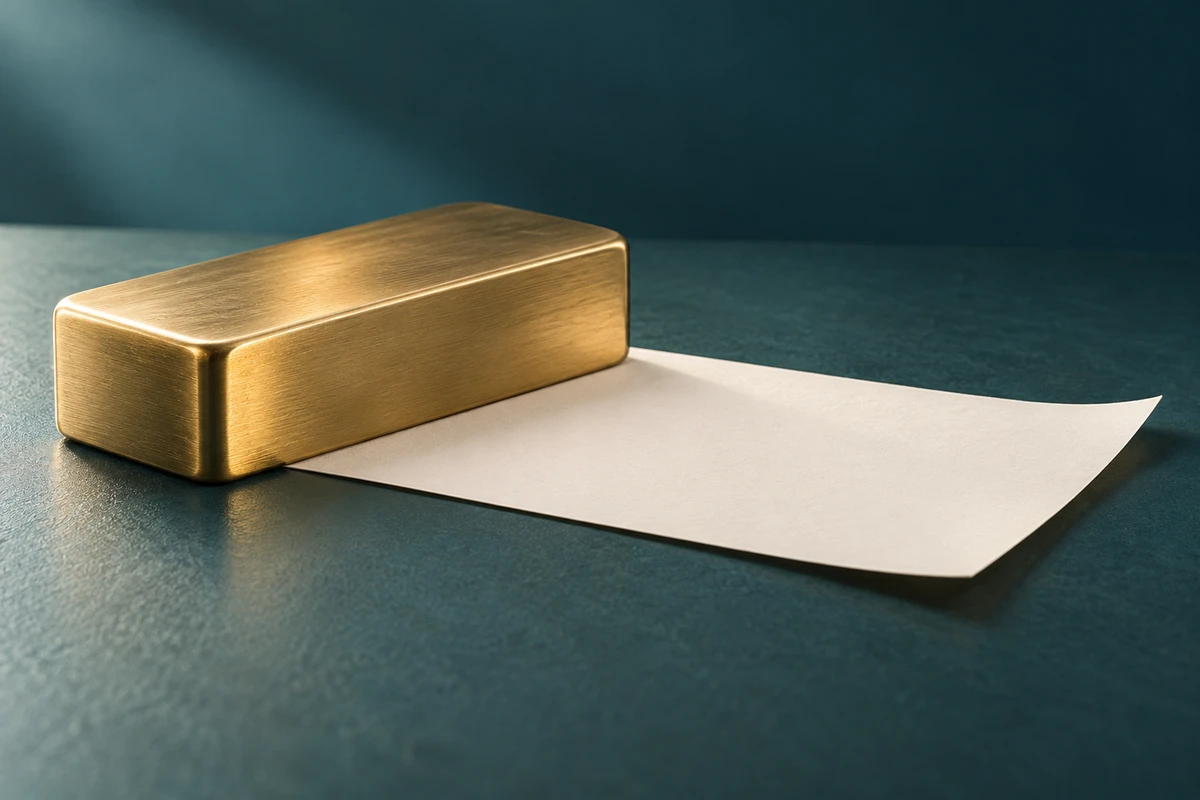
Consider a fictional brass-paperweight advertisement. This is not an ONCE client project, a completed shoot or a weight test. Imagine the paperweight moving onto a note to clear a little desk space. Its independent action is an explicitly animated fantasy, not an automatic product function.
Keep the viewing position, start, destination and total duration fixed while considering how it moves. One version advances by similar distances each time and stops completely on reaching the destination. That can suit a deliberately mechanical, command-driven expression, but may not preserve the physical presence intended for this scene.
Another treatment gives the paperweight a small change of attitude before starting, then gradually opens the spacing. It travels more decisively through the middle, adjusts direction near the note and comes to a clear resting pose. These are ideas for a trial sequence, not prescribed settings. The actual shape, contact and film style may call for different choices.
The performance can mean something different too. An urgent object might shorten its hesitation and travel with greater resolve. A reluctant one might pause, try a small movement and then decide to continue. That can express its thought more precisely than uniformly slowing everything down. Weight becomes part of how the character acts, rather than merely a label saying it is heavy.
Preparation should not become the same little nod assigned to every product. A cylinder, a flat paperweight and an object with a soft base offer different ways to turn or support themselves. If a hard, flat object bounces forward like a rubber ball, the creator should deliberately accept that cartoon rule instead of also presenting it as a naturalistic material demonstration.
Let the desk and paper receive the action
Reference points extend beyond the object. Contact between its lower edge and the desk, the note's edge and the space being cleared can help viewers understand what happened. Choose a view that reveals contact and allows the finished pose to occupy the intended destination clearly.
If the paper is touched, consider its response. Remaining still can be a choice; moving slightly can be another. The relationship should make sense across the sequence. Treating paper as resistance in one shot and then passing through it without explanation changes the scene's rules. This concerns continuity in an animated world, not a measurement of friction.
The camera can remain still while this is resolved. Moving the object, sliding the background and orbiting the camera together makes it harder to identify the source of a floating impression. Establish the action in a simple view before deciding what camera movement the film needs.
A brisk style can preserve the object's identity
A sense of weight does not require an exaggerated bounce after every move. A clear stop, a small settling after a turn or even a deliberate hard stop may suit a particular character. Ask what this ending expresses instead of giving every destination the same recoil.
Pay attention to the shape of a rigid product. Stretching or squashing the paperweight can change the reading of its material even while its metallic surface remains. A brand can choose obvious cartoon deformation. Where contour, ports, capacity or construction also communicate product information, provide an accurate presentation of those features. Fantasy cannot replace the product documentation.
Sound should support that choice. A heavy impact can reinforce a particular arrival without declaring enormous mass in every tiny movement. Watch the starts and stops without sound before adding audio that fits the action. This review supports a creative discussion; it is not a consumer experiment or proof of real mass, durability or tactile feel.
CG or generated imagery used for previsualisation can begin with the same action discussion before the production method is chosen. An object that feels weighty in a concept does not establish the actual product's weight. A stop motion appearance also does not establish that physical objects were photographed frame by frame. Describe the production process accurately.
Locate the change before choosing the revision
When an action does not work, locate the problem: an unclear intention before movement, erratic spacing in transit, no response at contact or continued drifting after the stop. A specific description gives the next trial a clearer purpose than repeated requests for greater realism or premium quality.
Review at the intended playback pace and retain a version for comparison. Keep path and duration fixed when judging the distribution of movement. If the character is changing, preparation and holds may change too. Each comparison should have a purpose so the team can identify what improved. There is no need to describe these trials as technical certification or audience validation.
Some imperfection can remain. Handmade character can emerge from deliberate rhythm, poses and surface detail. Repeated changes in contact do not necessarily become convincing simply because the film uses stop motion. The small action should reveal what kind of life the brand wants to give the object.
If you are developing a stop motion or hybrid product advertisement, bring the object and a short intended action to ONCE for a discussion of product imagery and production. Give the start and stop a clear character, then develop that character into the complete film.
Sources consulted on 19 October 2026. This article uses public text from Dragonframe and Animation Mentor; the remaining discussion is creative analysis. The paperweight scenario and original AI-generated cover are fictional illustrations, without weighing, physical simulation or advertising-performance tests.