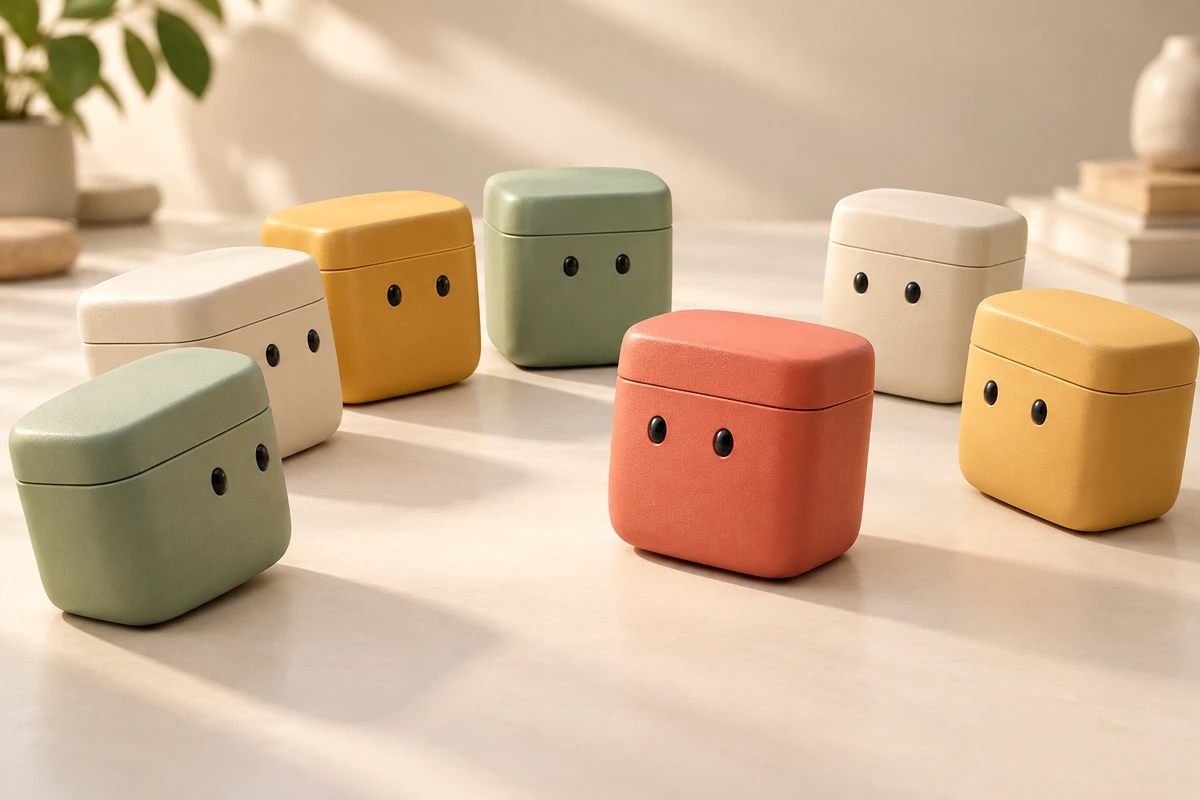
Imagine an original, fictional launch film for desktop storage boxes. Six boxes in existing colors already form a line. A seventh, in coral, arrives at the edge of the desk. If every box jumps, turns and waves its lid at once, the scene will be lively. The newcomer may also be the one nobody notices.
This is an anthropomorphic animation concept, not an automatic product feature or an ONCE client project. It poses a specific creative question: can the welcome in a brand animation ensemble happen between characters, rather than simply on the musical beat?
A group’s personality lives in its responses
In Aardman’s Behind the Craft: Jet-Puffed Marshmallows, published August 21, 2020, director Will Studd discusses expressing the characters’ communal personality through shared, cooperative activity. The account also describes an animatic, CG previs and subsequent performance development. This article draws on that written account, not a complete viewing or evidence of advertising effectiveness. Consulted October 16, 2026.
The useful possibility is not that more characters automatically create more appeal. It is that collective behavior can be the starting point for action design. Characters absorbed in separate activities make a collection. When one character’s action changes another’s choice, a relationship emerges. That is our creative interpretation, not a rule measured in that project.
Return to the fictional boxes. The one nearest the new arrival notices it and stops. Its neighbor follows its orientation, looks over and shifts aside. A box at the back has not understood, peeks out and then makes room. The welcome needs neither narration nor identical smiles. It happens through the relay of “I noticed, and now you have noticed too.”
Unequal activity can make individual characters clearer
The difficult question is often not “Who has stopped moving?” but “Who should we be watching now?” Choose an initiator whose action is clearest. Keep responses smaller and let distant characters hold their poses. The background need not freeze, but a box doing a somersault in the corner could compete with the newcomer’s entrance.
Variation is not merely delaying identical actions by random frame offsets. The nearest character notices first because it is close. The one behind responds later because its view is obstructed. Another hesitates because it occupied the space being offered. Timing can follow circumstances rather than turn a copied action into a staggered loop.
Orientation and space deserve attention before facial detail. Even without eyes, the boxes’ turns, the gap in the line and the distances between them should suggest who has noticed whom. If every body faces the camera while eyes look in conflicting directions, elaborate expressions may not repair the relationship.
Follow the relay instead of introducing everyone
A wider view can retain the first observer, the newcomer and the space about to open, allowing their relationship to unfold together. Cutting to a close-up whenever anyone moves may require viewers to keep reconstructing the layout. Reserve a close-up for a change that matters: the initially reluctant box finally making that small amount of room.
The camera need not move throughout. It could settle while the group prepares to respond and wait for the newcomer to enter. Once attention has transferred, decide whether to move closer. There is no universally correct camera position or pause duration. Rough shapes and simple camera tests can help judge the relationship before detailed facial performances are added.
Synchronization expresses something different
When a film needs to present a unified color range, lids opening together or boxes holding the same pose may be stronger than a relay. Synchronization emphasizes “we belong together.” Differentiated responses can express “this is how we relate.” Both can belong in one film without being asked to do everything simultaneously.
The six boxes might first line up together, establishing a familiar order. The newcomer’s arrival breaks that arrangement and prompts individual responses. A group forms again at the end. Its final order now reflects the arrival of another member, rather than merely repeating a dance.
But if the new color is the launch’s priority, let its companions stop and give it a moment alone. Keep lid seams, proportions and color faithful to the real product as the anthropomorphic performance recedes. The ensemble welcomes it into view; it should not keep burying it. Movements beyond the product’s actual capabilities need to read as fantasy, not drift into an operating demonstration.
A shorter version can keep one relationship
For a cutdown, speeding up all seven performances is an obvious temptation. But when noticing, responding and making room become indistinguishable, what remains is simply a lot of moving objects.
Rewrite it as a pair: one existing box notices the newcomer, turns to make room, and the new box enters before the product shot. The scale is smaller, but the welcome survives. A version retaining only the synchronized dance can instead communicate range and atmosphere. It should not also be expected to tell the original encounter story.
An ensemble earns its complexity not by keeping every background character busy, but by giving an action someone to respond to. Establish why these characters gather and who changes whose behavior before deciding how many characters or shots are needed. Commercial animation can be exuberant. It should still leave a relationship worth remembering and a product viewers can see clearly.
Developing a brand character or product animation? Bring the relationship you want viewers to feel and discuss the animation and production approach with ONCE. Start with a short exchange between characters, then turn the idea into specific shots.