A newly built hallway has smooth walls, an untouched door handle and furniture that seems to have arrived from the same shop. Add some old books and a coat, and it may still feel ready for someone to move in—not like someone already lives there. What is missing may not be another object, but a history.
Commercial set aging addresses that question of time. It is not a uniform desaturation or a layer of dirt across every surface. For a product film seeking a lived-in setting, give traces a reason: who touches this spot, what happens repeatedly, and how is the home maintained? Decide separately what condition the new product should retain.
Not everything in a room is the same age
In her Directors Notes interview, consulted October 16, 2026, production designer Julija Fricsone-Gavriss distinguishes existing locations from newly built sets. The former often bring lived-in texture; the latter require deliberate aging when realism is the goal. She discusses paint layers on doors and scratches motivated by contact. This is a practitioner’s account, not an aesthetic rule for every commercial.
A room’s signs of age need not belong to one period. The door may be old, the mat recently replaced, the cabinet regularly cleaned and the bag placed down minutes ago. Giving them identical dust, scratches and fading flattens those different histories.
Separate the clues by their source in time. This is an editorial design method, not a technical way to determine material age.
| Source in time | Its role in the picture |
|---|---|
| Long-term use | Suggests repeated contact or maintenance, such as a localized mark by a door. It does not vanish because someone has just left. |
| A recent action | Shows the current sequence, such as a displaced shoe or an emptied hook. It should change with the story. |
| The product’s intended condition | Establishes a new item, an item in use or a sample with a documented history. Artificial aging cannot substitute for durability evidence. |
An empty position can sometimes say more than a stain. The space left by an umbrella just removed can connect to the next action; a worn door edge can suggest a longer-standing habit. Viewers need not consciously identify every clue. The clues should simply avoid telling conflicting accounts of time.
Place marks through contact and maintenance
Uniform dirt readily becomes a pattern. If every edge has the same scratches and every corner the same dust, the image may say only “old set,” not that a particular person has used it.
Work outward from actions: where a hand steadies a door, where a bag rests, how a chair is pulled out. Then consider what gets cleaned, protected or repaired. A much-used, carefully maintained home need not be damaged everywhere. Replaced hardware, a local repaint or retained furniture can also express a past.
These are design possibilities, not proof that a particular mark must come from a particular behavior. When using real places as references, learn their use context rather than collecting attractive photographs of old walls. Surface traces should not become shortcuts for assigning class, personality or competence to a character.
Also separate what has been designed from what the camera sees. Small surface variations may be prominent under one lighting direction and recede from another viewpoint. View the proposed treatment through the intended camera and lighting before deciding its strength. Do not keep intensifying it until age and dirt become the only story.
Obtain permission before altering a real location, choose appropriately reversible methods and consult the relevant professionals. This article addresses visual reasoning, not sanding, spraying or chemical recipes, and does not recommend damaging furniture, samples or building surfaces.
A new product in an established hallway
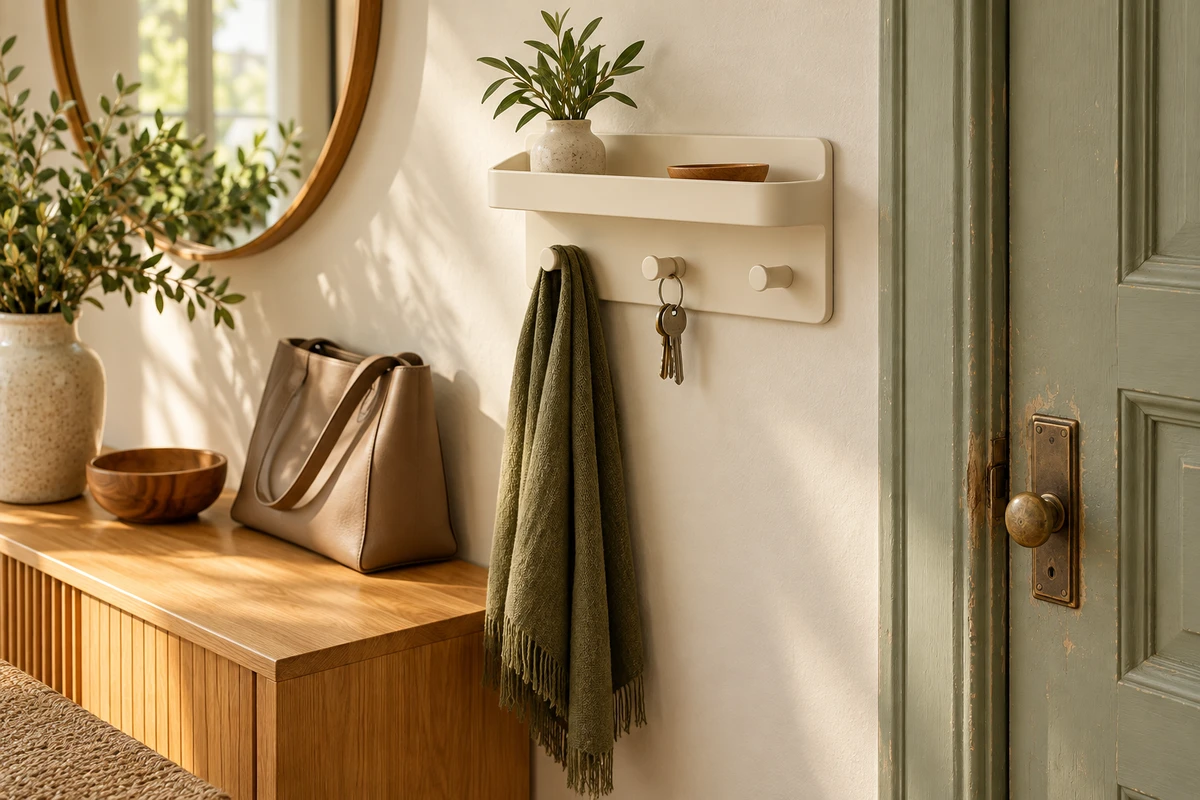
Consider an original fictional commercial for a new wall-mounted organizer in a hallway that has been occupied for some time. It is not an ONCE client project or a real model. The idea is that a new object joins existing habits—not that the entire room has been renewed overnight.
Retain a slight trace beside the door associated with everyday passage while keeping the cabinet visibly cared for. The mat need not be distressed, nor the shoes arranged into an exaggerated heap. Keep the organizer in its intended new condition, with its color and structure clearly recognizable.
Someone returns, places personal belongings on the organizer and takes down a coat already hanging there. A hook becomes empty: that belongs to the present action. The mark beside the door remains: that belongs to the room’s longer past. Check loading, installation and handling against the actual sample; the concept cannot invent capabilities.
Scuffing the new organizer to add “life” could suggest that viewers are seeing a product used for years. If the ad needs to depict long-term use, establish the basis for the sample’s history and the claim first. A scenic treatment cannot demonstrate abrasion resistance, durability or a service life.
The point is not a dramatic old-versus-new contrast. It is a reason for the two to coexist. The product need not rescue a home made implausibly unlivable for the opening. It can add one arrangement to an everyday routine already in progress.
Time cannot restart with every camera angle
If the coat returns to its original hook after a cut, the action expressed by the empty space has been undone. If a mark switches sides, the room may seem to have changed. Record persistent traces and recent states separately: one maintains the environment’s identity; the other advances with the character’s actions.
The purpose is not to return every object to a universal starting position. A pickup should return to the state at that moment in the story, not the beginning of the whole film. When the film skips forward in time, decide which traces persist and which belongings have been cleared away.
Clean and credible can coexist
Not every commercial needs aging. A newly opened venue, a recently completed room, an abstract brand world or an appearance-focused product shot may call for clean, complete or deliberately non-everyday styling. The question is which world the film has chosen and whether it remains consistent.
A lived-in feeling need not rely on old objects either. Keeping something within easy reach or leaving a working surface empty can express habit. Art direction need not explain a character’s entire past. Select the clues relevant to this story and let the rest remain quiet.
AI reference images can support a discussion of the same space as “just moved in,” “occupied but carefully maintained,” or “someone has just left.” That is a proposal method, not a guarantee about any generation tool. A mark or arrangement deserves a place in the final design only when its location, associated action and product condition make sense.
Set aging ultimately concerns time, not the concentration of dirt. Viewers may not remember a small mark beside the door. They may nevertheless feel that the person entering the shot had a life before it began.
If you are developing a lifestyle or product commercial, bring the sample, intended situation and key shots to discuss commercial art direction and practical set design with ONCE. Decide which parts of the past belong in frame and which changes should happen through the action now.