A table can fit a dining room and still be the wrong table for it. Extend the top, pull out the chairs, or open the adjacent cabinet, and the apparently generous space changes. That is a hypothetical example—not an ONCE project—but it exposes a useful commissioning question: which version of “fit” is your content actually showing?
For overseas teams sourcing furniture from China, the answer often sits across product engineering, packaging and local delivery operations. A styled film can connect those teams’ information. It cannot replace it.
Fit confidence needs more than a beautiful room
In its May 19, 2026 article, Furniture & Home Decor Quantitative UX: 3 High-Level Takeaways from 30+ Charts, Baymard reports a survey of 1,598 US online shoppers. Its findings support providing both concrete measurements and visual context for evaluating spatial fit. This is survey evidence, not an experiment proving that video reduces returns, and it should not be generalized to every national market.
ONCE’s production inference is narrower: choose the medium according to the uncertainty. A dimension image helps someone inspect exact endpoints. A continuous demonstration explains changing geometry. A delivery guide helps collect information about the route into a particular home. Buying another lifestyle film is not automatically the best response to a missing dimension drawing.
The durable opportunity is to separate reusable product footage from information that changes with the shipping configuration or destination market.
ONCE’s three-footprint storyboard
We propose commissioning furniture content around three distinct footprints. This is an editorial production method, not an engineering standard or a delivery-clearance calculator.
| Footprint | What the content should establish | What it cannot establish |
|---|---|---|
| Placed | Assembled shape in a named configuration, supported by clearly defined measurements | That a wide-angle room resembles the shopper’s available space |
| Shipped | The actual sales packaging, package count and confirmed package dimensions for that version | That the item will negotiate an entire delivery route |
| In use | The space involved in extending, reclining, opening or pulling out, with surrounding objects visible | That every household can use it in the same arrangement |
Keep measurement names precise. Overall table width, distance between the legs and clear space under the top answer different questions. Do not estimate any of them from a photograph. Ask the product owner to confirm the values, endpoints, units and configuration before creating overlays.
For shipping, film or document what the customer actually receives. A conveniently unwrapped sample should not stand in for a package that normally remains intact during delivery. Whether parts travel separately must come from the brand’s approved packing information, not assumptions about flat-pack furniture.
For use, preserve the surroundings through the action. Moving a chair out of shot or shifting the table before a cut can make the mechanism look easier to accommodate than the demonstration really shows.
A practical sequence for an extendable dining table
Consider a hypothetical product being prepared for a regional launch. No dimensions or performance results are assumed here; the brand must approve the actual operating sequence.
Establish the closed arrangement
Begin with a stable view that includes the table, nearby cabinet and chairs. Pair it with a readable still identifying the closed dimensions. A dramatic low angle may sell the finish, but it should not be the only view used to understand scale.
Show what has to move
Demonstrate the real extension process. Detail shots can explain the mechanism, then return to the same wide framing to show the changed relationship to the cabinet. If chairs must be moved before operating the table, include that preparation instead of hiding it in the edit.
Finish with people using the arrangement
Show a chair in a demonstrated seating position and the movement involved in getting in or out. Avoid presenting an invented universal clearance number: chair design, users and room layouts differ. Any published recommended space needs a brand-approved or appropriately qualified basis and clear conditions.
The sequence succeeds when it tells a shopper what else to measure. It fails if the final impression is an unsupported promise that their home will work the same way.
Do not turn delivery footage into a guarantee
IKEA’s US Shipping and Delivery Terms & Conditions, effective August 31, 2026, provide a useful distinction. For its specified Scheduled In-Home and Express In-Home services, access to the chosen room still depends on fit and safe delivery; the terms ask customers to consider the route through hallways, stairs and elevators. These are that company’s US conditions, not a rule for all furniture retailers.
A brand should therefore identify whether “delivery into the dining room” footage is an illustrative scene, a locally available service, or a record of one delivery. Place its own measurement guidance and support route beside the content. A supplier’s generic product film cannot certify the route through an individual building. Nor should a crew attempt a risky carry to obtain a reassuring shot.
Scope the work by what changes
Before commissioning, request a model-level information pack from the manufacturer: assembled dimensions by configuration, shipping packages, approved operation and the destination market’s units. Flag unresolved values rather than turning them into confident captions.
Discuss the production scope in three parts: shared styling and room footage; demonstrations that need separate treatment for different mechanisms; and updates to packaging information, dimension graphics and market versions. A new finish may share an action sequence. A structural change may not. A packaging revision can require new delivery information even when the assembled product looks identical.
This is not a claim that the arrangement will always be cheaper. It makes reuse and unavoidable work visible before the purchase order. For an overseas marketing team, it also separates what the factory must confirm from what the local retailer or delivery partner must explain.
Use ONCE’s production solutions as a starting point for defining that brief. Begin with one model that attracts recurring fit questions. Ask whether a shopper can find separate answers about placement, arrival and operation before scaling the content across the range.
Keep the aspirational film. Just do not ask it to impersonate a measurement guide.
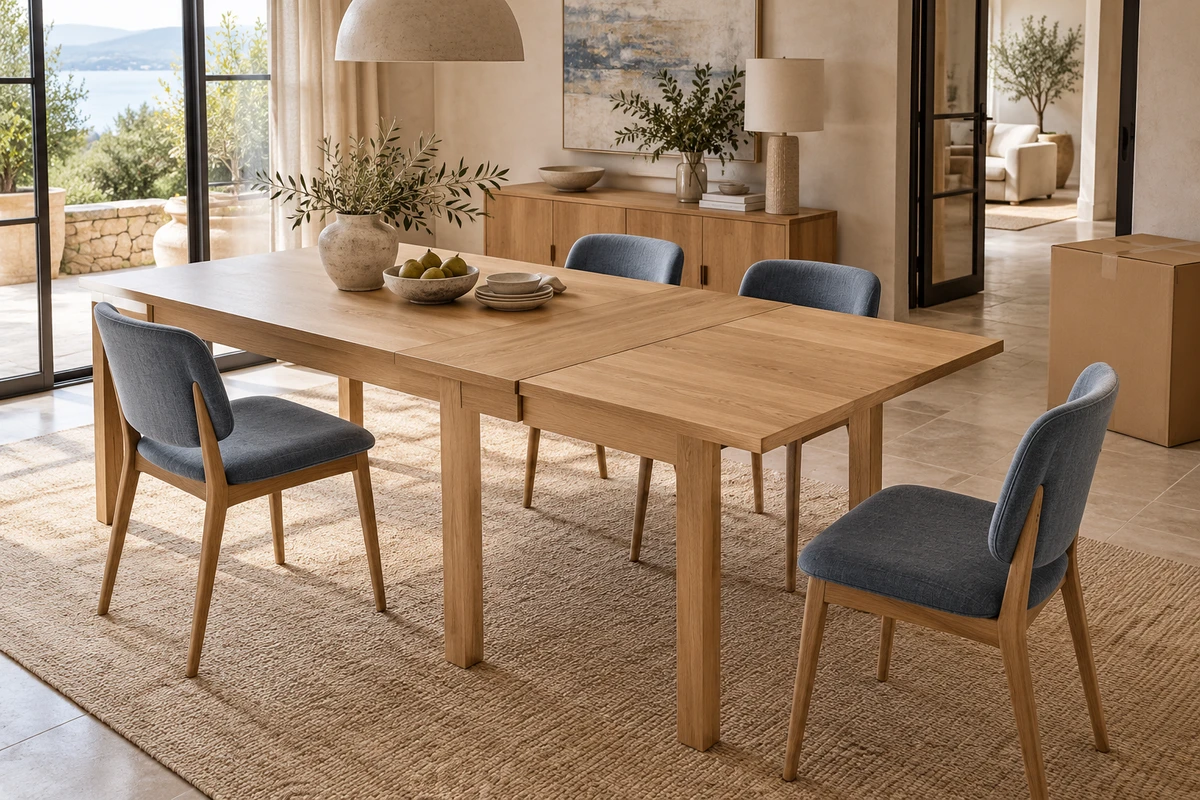
Sources checked October 15, 2026. The original AI-generated cover illustrates a hypothetical dining room; it is not a dimensional drawing, a depiction of a verified product, or proof of delivery clearance.