A brand character can look convincing in a presentation and still be unproven for the commercial. Picking up a cup, placing it beside a real machine and meeting an actor's eyeline are performance tasks, not simply design approvals.
For international brands arranging production around a Chinese product sample, those tasks offer a practical way to choose a route. Before committing to a practical puppet, CGI or an AI-led treatment, commission the interaction that matters most to the idea. Then ask what can actually be retained when the next product arrives.
A current campaign shows why the choice remains open
In its October 6, 2026 announcement, Plymouth Rock confirms that McKinney's new Owl and Bear commercials used practical effects, including a seven-foot animatronic bear. The rollout began October 5 in Massachusetts and New Jersey.
McKinney's accompanying LBB project account also describes purpose-made social videos alongside the hero spots. These are written project descriptions. ONCE has not watched the films or behind-the-scenes footage for this article and has no access to the production budget, performance results or asset-reuse records.
The useful signal is that a physical performance was chosen for a contemporary brand campaign. It does not establish that puppets outperform CGI, that practical production is cheaper, or that the industry is reversing its use of digital tools. The right question for another brand is what its own character must do.
Audition a relationship, not an attractive pose
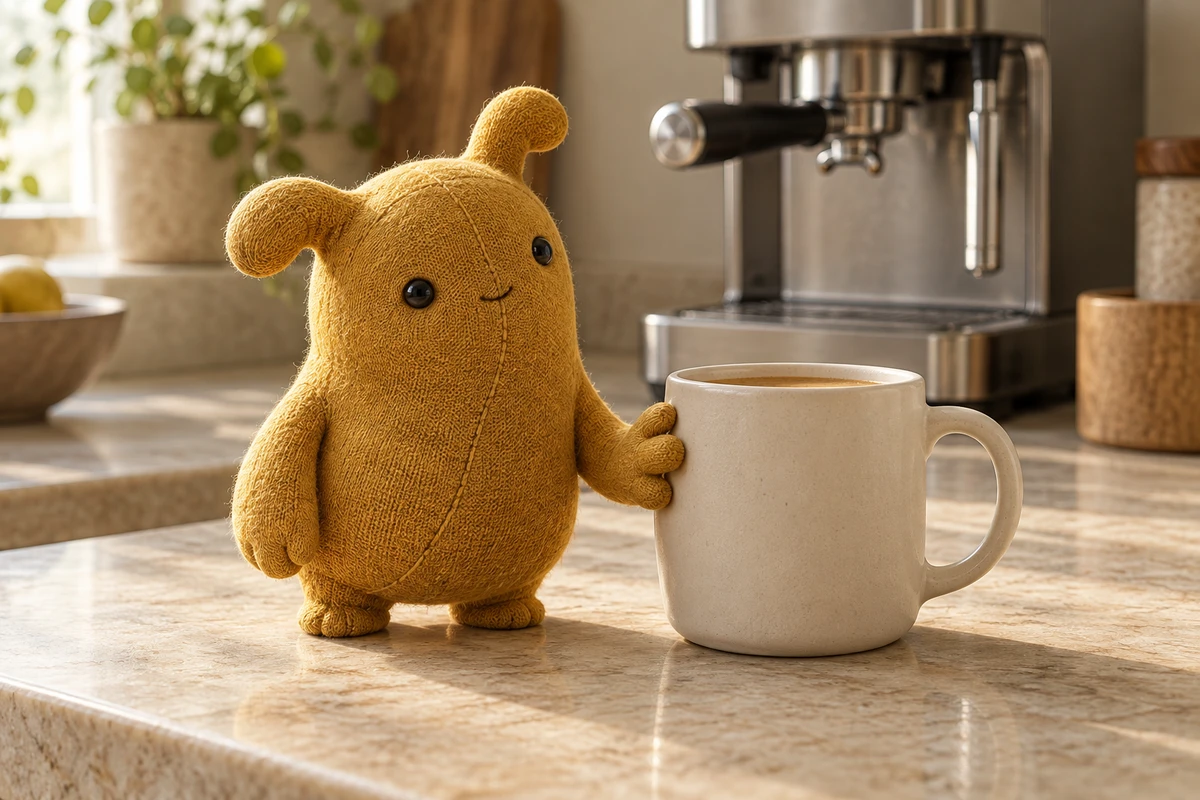
Consider an invented coffee-machine commercial. An original soft creature picks up a cup, places it in front of the machine and looks toward a person. The person notices the cup is in the wrong position, pauses, and moves it. Their exchange supplies the joke. This is a hypothetical creative exercise, not an ONCE client project.
ONCE proposes a contact audition built around three events:
| Event | What the trial should reveal |
|---|---|
| Pick up the cup | The complete transition from contact to separation from the counter, including the grip and a stable hold. |
| Put it down | Where the base lands, when the hand releases, and whether the cup keeps a coherent position and shape. |
| Look at the actor | Whether the eyeline and timing make both performances responses to the same event. |
Use an empty cup and an unpowered machine for the initial rehearsal. The trial does not need a finished kitchen or a polished render. It needs the difficult relationship in the intended framing. A waving character on a clean background does not answer the same question.
State the invariants too: the cup's scale, the real product's controls and the operation the audience must understand. If the character makes a comic mistake, the film should distinguish that behavior from a recommended way to use the appliance.
Ask each route to demonstrate its actual control
A practical-puppet proposal should show the intended physical range. Can the hand grip that handle? Where can the operator and supports sit relative to the camera? Can the performance repeat at the required pace with the actor? A half-body construction can be a good creative choice when the film never needs feet; it is not a solution if walking carries the idea.
Physical presence alone does not prove usable contact. A convincing design may need a different hand construction for the cup. Have the specialist team assess manipulation, support and set safety, including any stand-ins, concealed supports or cleanup. Practical does not mean post-production disappears.
For CGI, ask for a timed rough animation rather than only a finished turntable. Review the grip, arm movement, apparent weight and actor's eyeline together. Ask which approved controls would remain available if the brief later changes the cup, expression or length of the reaction. Separate existing capability from additional work.
Evaluate an AI-led route through its proposed output and revision process, not through a general model claim. With authorized character references and approved product information, try the actual passage. Check action continuity and product accuracy, then request a defined change while retaining the approved elements. One successful generation is not a demonstration of repeatable revision. Include regeneration, repainting and compositing in the scope where needed; this article claims no model success rate.
If contact fails, the team can change the shot or the route. Decide which is appropriate by returning to the idea. Separate shots may be sufficient when picking up the cup is incidental. If the joke depends on an awkward handoff with the person, removing the interaction to preserve a preferred technology removes the creative reason for the shot.
A hybrid needs a plan for the meeting point
One film need not use one method throughout. A physical hand might handle the cup while a digital element supplies part of the expression. Alternatively, the product and person may be photographed with the character added later. Treat either as a proposal to test, not an automatic economy.
At each of the three events, identify what will be photographed, what will be made later and who will reconcile the two. Include the awkward moments: fingers obscuring the handle, the character crossing the machine and the actor passing in front. A trial that avoids every overlap leaves the real question unanswered.
Then ask: if the brand substitutes a different cup, how much of the approved performance can remain? A useful answer identifies affected shots and tasks. “We can fix it in post” is not enough to compare routes or commission the next round.
Price the next performance as well as the first character
For planning, separate initial character creation, this round's actions and shots, performance and production support, and storage, maintenance or future adaptation. Use actual proposals for the amounts. A model fee, puppet fabrication charge or generation price cannot stand in for the complete film.
Compare the same shot list, versions, revision scope and supplied materials. Then request two future scenarios: new dialogue and an ending, versus handling a new product with different dimensions. These are different forms of reuse. A physical hand may need alteration; a digital route may need a new action or contact treatment. The proposed team should explain the consequences rather than promising permanent savings.
Keep approved design, scale, demonstrated actions and known limitations together. For physical work, agree custody, maintenance, operator support and arrangements for another shoot. For digital work, agree usable files, dependencies and a workable revision process. Owning an object or retaining a file does not establish that another performance can be produced on demand.
For an ongoing brand program, these records can become a useful memory of how the character behaves with real products. They do not guarantee declining costs or justify a financial valuation of the character asset. Their immediate value is making the next creative decision less speculative.
When discussing a character-led campaign through ONCE's video production solutions, bring the approved character, accurate product dimensions, the essential contact shot and plausible next-round actions. Start with the moment the character picks up the cup. Choose the route once that performance works, can be revised, and has an explicit path to further use.
Sources checked October 15, 2026: Plymouth Rock's October 6 announcement and McKinney's LBB project account, dated 06/10/2026 in alignment with that announcement. The coffee-machine sequence and original AI cover are concepts, not client work or measured technical results.