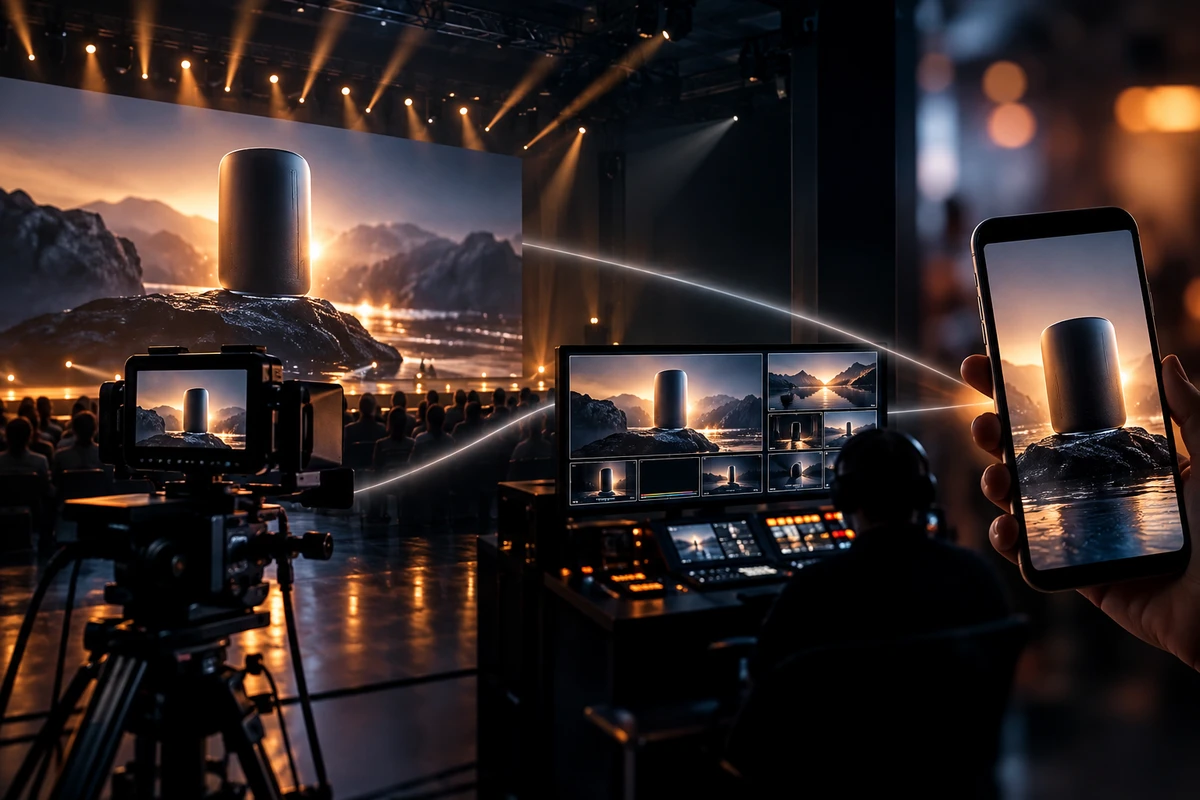
For an overseas brand producing a launch film with a team in China, the dangerous phrase is often “we just need one 16:9 master.” That may describe the first review file, but it rarely describes the launch. The same footage may need to fill an LED wall, enter a live control room and become the first wave of post-event content. Those environments do not merely request different exports. They impose different viewing distances, timing rules, audio relationships and failure modes.
The efficient answer is not three shoots. It is one source production planned around three playback jobs: a stage master, a live-stream master and a post-event master. The footage library can be shared. The edit decisions cannot always be.
Start with three technical sheets, not one 16:9 estimate
Before the director locks the storyboard, the brand should collect inputs from the venue or AV supplier, the streaming team and the post-event content owners. If those inputs arrive after picture lock, versioning becomes emergency repair rather than planned production.
Stage and LED sheet
Ask for the actual LED pixel map, display ratio, accepted codec and container, frame rate, playback-server requirements, audio route, black-level behaviour and the cue sheet for lighting, lifts, presenters or a product reveal. A launch screen may be ultra-wide, segmented or irregular. A conventional “centre safe” assumption is not enough; important product details and type need to be previewed against the real canvas.
Live control-room sheet
Confirm the destination platform, control-room input format, frame rate, colour space, audio sampling, latency target and backup route. The current YouTube Live encoder guidance recommends testing with audio and motion similar to the event, monitoring stream health during the broadcast, using Rec.709 for SDR and a two-second keyframe interval. LinkedIn Live’s current encoder guidance specifies 16:9, 30 fps, H.264 video, AAC audio and two-second keyframes for the recommended setup.
These are platform-specific facts, not proof of one universal broadcast standard. Their procurement implication is simpler: the master must be tested through the actual ingest and encoding chain, not approved only on an editor’s monitor.
Post-event distribution sheet
List the destinations before filming: brand site, media launch, YouTube, LinkedIn, paid media, retailer pages and sales presentations. Then define whether each needs the complete film, a 30-second recap, a 15-second opener, a clean master, portrait and square versions, captions or separated audio.
Current Google Ads video specifications support horizontal, vertical and square video and warn that overlays and calls to action can cover edge content. LinkedIn’s current video-ad specifications list 16:9, 1:1, 4:5 and 9:16 formats. Those specifications can change, so the release team should recheck them near delivery. What should not change is the production habit: do not expect a locked landscape film to survive every crop.
Use the Three-Master Brief
ONCE’s practical decision tool is a one-page Three-Master Brief. For every script beat, record four things:
- the product fact or emotional job the beat must communicate;
- the playback environment that owns the beat;
- the technical dependency, such as an LED cue, a clean switch point or a portrait crop;
- the acceptance test for that environment.
This separates what can be shared from what must be purpose-built. Product actions, material close-ups, function demonstrations and the visual world are usually strong shared assets. Supers, pauses, presenter cues and end cards are often version-specific.
The brief also changes how a production quote is evaluated. “Three versions included” is too vague. A useful scope names three timelines, their aspect ratios, audio requirements, caption assets, owners and approval moments. The procurement question becomes “which playback jobs are resolved?” rather than “how many files are delivered?”
Shoot for switching room, not for a mythical universal crop
A launch shoot still needs hero images, but it also needs edit space. Hold critical actions cleanly before and after the main movement. Those extra seconds let a stage master wait for a cue, give the director a safe point to enter or leave the film, and create usable in and out points for cutdowns.
Protect crop options without flattening every composition
Do not solve multi-format delivery by pushing every subject into the middle. Classify shots instead:
- stable product views that can work across several aspect ratios;
- moving compositions that need a new edit or reframing;
- portrait-specific close-ups that should be captured separately.
The production plan can share assets while preserving a different visual hierarchy for each format. ONCE’s guide to event and social versions for overseas product launches explains why an event cut and a social cut should share core material without inheriting the same narrative structure.
Separate audio so each environment can mix responsibly
The stage may play a full mix through the venue system. The stream must coexist with presenter microphones, room sound and broadcast graphics. Post-event versions need to work on phones, often with captions. Delivery should therefore include a manageable full mix plus separated music, voice-over and sound-effects stems. If a section depends on a live presenter, the post-event plan needs an alternative voice-over or caption treatment that can stand on its own.
Capture the context the room already knows
An audience in the venue may understand that a reveal is about to happen. A viewer discovering a 15-second cut later does not. Add clean product identification, whole-product views, functional proof and brand cues so the post-event master can introduce the story without relying on the host or the room.
Three masters mean three timelines
The stage master follows the pixel map, show flow and cue sheet. It may hold an establishing image, black frame or end frame longer so lighting, lifts and presenters can stay in sync. It should also have an approved emergency still and a backup file.
The live-stream master follows control-room switching and encoder stability. Each segment needs recognisable entry and exit points. Fine text cannot rely on the physical scale of the LED wall. Audio must coexist with microphones and the event feed. The edit can remove stage waiting time, but it cannot remove the frames the director needs to switch safely.
The post-event master follows continued use. It needs a faster statement of the product, independent captions, protected safe areas and footage that can support shorter and vertical edits. It is not a decorated recording of the room. It is a publishable brand asset with its own opening, evidence and ending.
Assign four approvals before the deadline becomes the decision-maker
“Everyone saw it” is not an approval structure. Assign four explicit sign-offs:
- the brand owner approves claims, product status and embargo timing;
- the venue or AV owner approves the pixel map, playback format and cues;
- the streaming owner approves ingest, encoding, audio and the backup route;
- the content owner approves channels, formats, captions, cutdowns and archive assets.
The final handover should identify each master and its specifications, subtitle files, audio stems, emergency stills, cutdown list, checksum or file-verification record, and relevant licences. The aim is not paperwork for its own sake. It is to prevent a late technical decision from silently changing a creative promise.
Rehearse failure modes, not just the perfect playthrough
A useful rehearsal does more than play the film from beginning to end. Test at least four situations: a clean start from the actual playback server; a presenter arriving early or late; the director entering and leaving at different points; and the backup still or file taking over when the primary asset fails.
This is where the three-master plan earns its value. Rehearsal should validate decisions already designed into the timelines, not invent a new edit while the audience is arriving.
When one master is enough
Three masters are not a mandatory package. One tested master may be sufficient for a small internal launch with no public stream, a standard 16:9 screen, one complete post-event use and no portrait or paid-media requirement.
The three-master structure becomes valuable when the same launch must create ceremony in the room, remain technically controllable on a live feed and continue working after the event. In that case, a single shoot can support all three outcomes without pretending that every environment wants the same film.
For a broader channel plan, ONCE’s global product-launch delivery map works backward from the launch date across the hero film, ecommerce, paid media and social output. Bring the launch date, venue screen information, streaming platform and post-event channel list; the first useful deliverable is the three technical sheets and the Three-Master Brief—not a generic duration estimate.