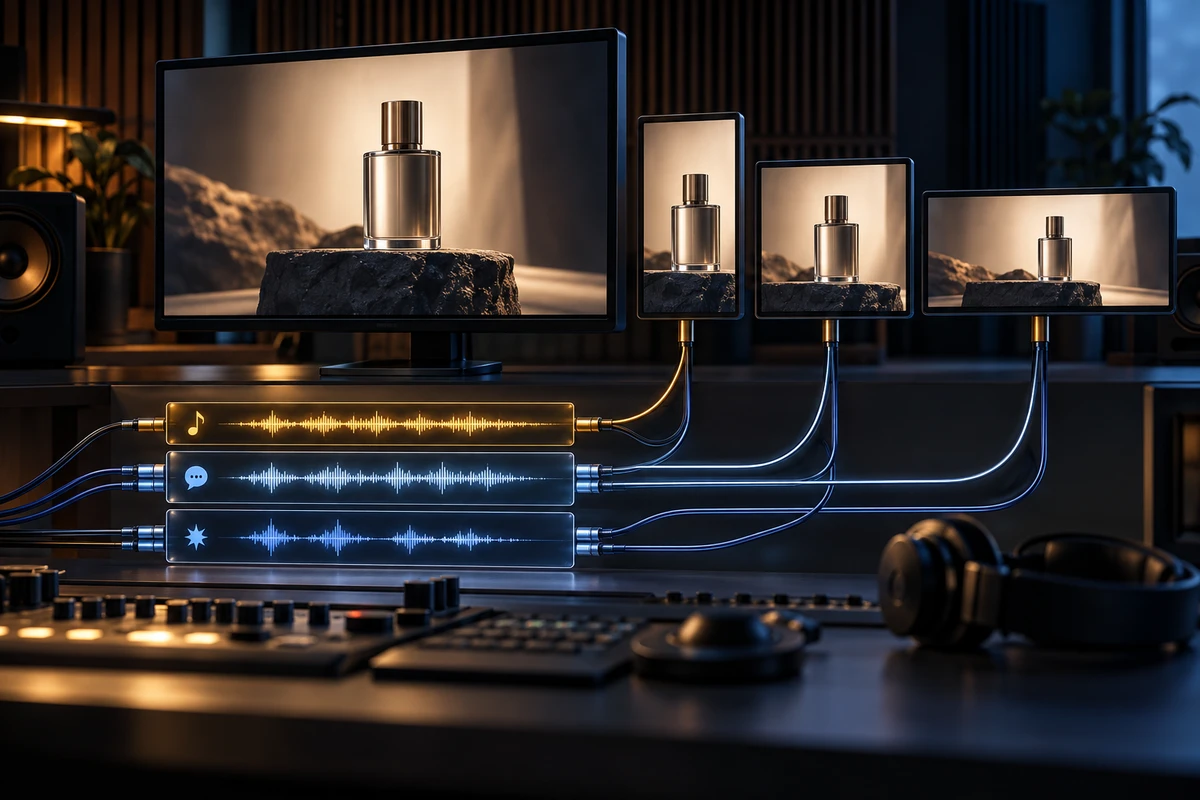
A campaign can leave the edit suite with a landscape master, a vertical cut and a square version, yet still fail the multi-platform test. The image travels. The music track does not.
For brands connected to Chinese supply chains, this is more than a copyright housekeeping issue. A track chosen for a creator post may later appear in paid media, on a product page, in a distributor presentation and across several markets. Each new destination can change the permission the brand needs. The production decision, therefore, is not simply which track feels right. It is which music route matches the content's intended life.
In-platform availability is not a universal licence
Platform music tools make selection fast because they solve a defined publishing problem inside a defined environment. They do not automatically give the brand an all-media, worldwide, perpetual right to carry the finished video elsewhere.
TikTok makes that boundary unusually explicit. Its October 2026 guidance for creator collaborations says that Commercial Sounds are intended for commercial use on TikTok, warns against downloading them for reposting on other platforms, and notes that availability can vary by track, region, account or campaign. Its July 2026 Commercial Music Library instructions also ask businesses to select campaign regions and usable placements before choosing music. (TikTok, October 2026; TikTok CML, July 2026)
Meta's Instagram Help Center separates the licensed music library, described for personal and non-commercial use, from Sound Collection, which it describes as usable for commercial purposes such as ads. YouTube makes a different, equally important distinction: music from its Audio Library is known to YouTube as copyright-safe, but YouTube does not offer guidance for off-platform use. (Instagram Help Center; YouTube Audio Library)
The catalog itself can change as well. YouTube stopped new purchases of Creator Music paid licences on August 10, 2026; licences already applied to videos remain valid only through their own terms. (YouTube Creator Music) The confirmed fact is that platforms define and revise their own usage systems. The ONCE inference is that a brand should treat each platform library as a publishing lane, not as permanent ownership of a soundtrack asset.
There is another reason not to reduce this to a download receipt. The U.S. Copyright Office explains that one musical recording embodies two separately copyrightable works: the underlying composition and the particular sound recording. It also states that combining music with visual content requires a synchronization licence. (U.S. Copyright Office) A file in a folder is not, by itself, proof that every relevant right has been cleared.
This article is a production and procurement framework, not legal advice. A recognisable song, a complex creator collaboration or ambiguous licence language should be reviewed by the rights holder or qualified counsel.
Choose the music route before choosing the track
There are three practical routes for brand video. None is universally superior; each optimises a different job.
Platform-native music
This route fits short-lived content that will be published only on one platform and needs to feel native to that environment. Selection is fast and platform review may be simpler. Portability is low. The track should be treated as the music layer for that platform version, not as the soundtrack of the universal master.
A commercial library or custom score with explicit multi-channel coverage
This route fits assets expected to live on a website, several social platforms, paid media, sales tools or distributor channels. The word “royalty-free” is not enough. The written licence needs to cover the intended brand or client, production partners, paid advertising, territories and term. A custom score also needs a clear agreement on the composition, recording, adaptations and files the client may receive.
Direct clearance of a known song or recording
This route can be justified when the music itself carries the campaign's cultural signal or memory value. The budget must account for the composition and master sides, negotiation time, approval conditions and version limits. If the campaign would mean the same thing with a well-chosen production cue, direct clearance may be an expensive way to solve the wrong problem.
The order matters: define destinations, publishers, paid use and lifespan first; choose the route second; choose the track third. Reversing that order often turns an emotional attachment to a temp track into a channel restriction.
The six-field music rights card
ONCE recommends a six-field card for every cue that enters a working edit. It does not replace a licence or legal review. It gives marketing, production and procurement one shared record.
- Track identity: title, version, recording source, licensor and the exact file used in the timeline.
- Usage lane: website, TikTok, Instagram, YouTube, CTV, retail or live use, plus organic, paid, branded-content or client-posted status.
- Territory: worldwide, named countries or one defined market.
- Term: perpetual, a fixed period, a campaign window or coverage dependent on an active subscription.
- Authorised users: the brand, production company, agency, creator account and client account that may upload or advertise the video.
- Proof and maintenance: where the licence, order or project ID lives; when it must be checked again; and who handles a Content ID claim or platform rejection.
An empty field does not automatically mean the music is unusable. It means the cue cannot enter every version. The dangerous move is converting “not checked” into “cleared everywhere” in a filename or handoff note.
Build two audio lanes around one picture system
A scalable campaign should separate picture portability from music portability.
The first lane is a portable master. It uses music with the required scope, or keeps a music-free picture master. Dialogue, voice-over, ambience, effects and music are managed separately so that a cue can be replaced without rebuilding the entire mix. Where the agreement allows, the delivery can include a full mix, a music-free version, permitted stems and editable versions for planned durations.
The second lane is a platform-native version. Picture, captions and product claims still come from the same approved content system, but the music is selected and published within the destination platform. The filename and rights record should say “TikTok only” or “Meta only” so that a future operator does not mistake it for a universal asset.
This method extends ONCE's multi-platform delivery matrix. That framework addresses framing, openings, captions and deliverables. The two-lane audio system answers a different question: can the soundtrack legally and economically travel with the picture?
Price the scope gap, not only the licence
A cheap track can create expensive version debt. A useful procurement equation is:
Total music cost = licence or composition + first edit and mix + rights verification and archive + expected scope-gap cost.
The last term can be estimated as:
Probability of a scope gap × (re-edit and remix + re-approval + lost media window + re-upload and version maintenance).
No industry average is needed. A brand can use its own channel plan, approval chain and launch timing. For a two-week TikTok test, platform-native music may be the rational choice. For a video already committed to a website, Meta ads, YouTube and distributor presentations, broader commercial coverage or custom music may cost more upfront and less in total.
This model also protects production-company margin. Music should be a scoped line item, not a vague inclusion. A change from organic posting to paid media, from one territory to global use, or from a brand account to creator amplification is a change in usage, not a free export.
The audio handoff should contain more than an MP4
At minimum, a production handoff should include:
- the portable master and each platform version, named by permitted lane;
- separated dialogue or voice-over, effects, ambience and music files to the extent the agreement permits;
- the six-field rights card, licence or purchasing evidence, and a record of where the cue appears in the timeline;
- an owner for expiry, renewal, account change, Content ID or platform-review issues.
If a supplier can only say that a cue “came from a library” but cannot identify the account, plan, channels or term, the handoff is incomplete. The reverse is also true: the brand should not add paid media, new countries or creator distribution after delivery and assume the original scope expands automatically.
A practical reuse rule
Reuse is safe to approve only when the record covers the new platform, territory, term, paid or organic status, and publishing party—and when the underlying proof is still retrievable.
Keep platform-library tracks inside their intended platform lane unless the licence says otherwise. Let broader library or custom music travel only within the written scope. For recognisable songs or complex rights chains, recheck any new medium, territory or term.
The operational sign of a scalable content system is not the number of aspect ratios in the export folder. It is whether the team knows why every version may be used, where it may run and when its music must change. Move that decision from the end of the edit to the start of the brief, and one production can become a real multi-platform asset instead of a collection of visually compatible files.