When a washing machine, vacuum or phone develops a fault six months after launch, the best production conditions are usually gone. The engineering sample has moved on, the industrial design may have changed, the specialist tools are no longer on set, and the people who can validate each step are working on the next generation.
That is why a repair video commissioned after problems appear can cost far more than its runtime suggests. The real bill includes rebuilding access to the correct unit, recreating the workstation, confirming component revisions, and reopening technical, legal and localization approvals.
The EU’s right-to-repair rules make this a current procurement question. They do not require every brand to publish every disassembly procedure. They do, however, make repair information, service access and product longevity a more visible part of the customer experience. For relevant products sold in Europe, the video brief should now ask a longer-term question: can today’s shoot support launch, use, diagnosis, repair and updates over the product’s service life?
What the EU rules do—and do not—cover
The European Commission says Directive (EU) 2024/1799 was adopted on 13 June 2024 and had to be transposed and applied by Member States from 31 July 2026. Among its measures, consumers can request repair from manufacturers for products that are technically repairable under EU law; repair must be completed within a reasonable time and at a reasonable price; manufacturers must make information about repair services easily accessible; and consumers who choose repair rather than replacement during the legal guarantee period receive at least one additional year of guarantee coverage.
The scope matters. The repair obligation does not automatically extend to every consumer product. It applies to products covered by EU repairability requirements and listed in Annex II, with product-specific rules determining the extent of the obligation. The list evolves as new repairability requirements are adopted. The Commission’s 31 July 2026 consumer announcement cites categories such as washing machines, vacuum cleaners, mobile phones and tablets.
Legal, product-compliance and service teams still need to determine whether a particular model is covered in each market. The production implication is an ONCE analysis: when support information must be easier to access and products remain in service longer, the unit of procurement should expand beyond a launch film to a versioned, updateable service-content asset.
Why “we can film it later” is often the expensive option
At launch, four scarce resources are in one place: the correct product revision, the engineers who understand it, the tools and fixtures needed to open it, and the cross-functional team that can approve the facts. A conventional hero shoot uses those conditions once and then lets them disperse.
Returning later can require the brand to:
- source a unit that matches the installed customer base rather than the latest revision;
- rebuild macro lighting and product-color references;
- check whether fasteners, adhesives, connectors or part numbers changed;
- bring engineering, service, legal and local-market reviewers back together;
- recreate narration, captions and safety language for multiple markets;
- identify which steps in an old film are still valid.
The real comparison is therefore not an extra half-day now versus one tutorial later. It is the cost of capturing modular evidence while the production conditions exist versus the cost of reconstructing those conditions repeatedly.
The five-stage service-life content map
ONCE recommends mapping the support journey into five stages before the shot list is approved. Each stage has a different audience, purpose and factual owner.
Launch: why the product deserves attention
Keep the hero photography, use cases, benefit demonstrations and brand world. This layer earns attention, but editing should not hide a maintenance condition or turn a variable process into a fixed performance claim.
Use: how to keep it working correctly
Capture installation, pairing, consumable replacement, cleaning, software updates and common setup mistakes. Many support contacts are state, permission, connectivity or maintenance problems rather than failed hardware. The use layer should help customers complete low-risk checks first.
Diagnose: where the problem may be
Record error codes, indicator patterns, unusual sounds, connector states, visible wear and basic tests. A diagnostic clip should not claim to identify an internal fault that the image cannot show. Its job is to collect enough information for support to choose remote resolution, depot repair or a field visit.
Repair: who may perform which operation
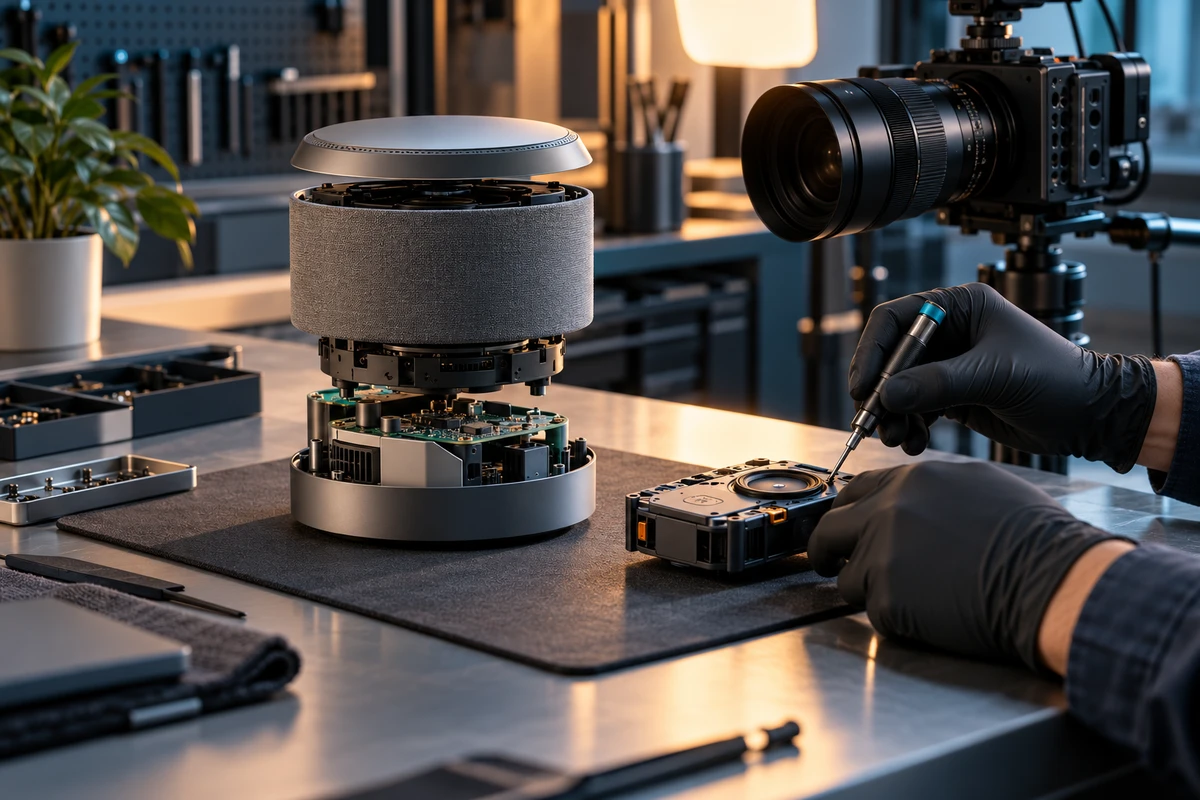
Film disassembly order, fastener locations, tool specifications, wear parts, power states, ESD controls, resealing, reset and calibration as separate modules. Not every module should be public. High-voltage, battery, data-security, sealing and specialist-calibration procedures may belong only in authorized-service channels.
Update: what happens when the product changes
Attach model, hardware revision, firmware version, part number, market, date and approver to every usable sequence. When a latch, supplier component or menu changes, the team can replace the affected module instead of remaking a long master.
The point is not to commission five finished videos. It is to let one accurate action do several jobs: two seconds in a launch film, twenty seconds on a support page, and a complete sequence in technician training.
Use three access levels, not one public library
More accessible repair information is not the same as publishing every technical procedure to a consumer channel. The brief should assign every module to one of three access levels:
- Public customer content: safe operation, cleaning, reset, error capture, low-risk consumables and user-replaceable parts.
- Authorized service content: full disassembly, diagnostic paths, parts identification, calibration and post-repair testing.
- Internal engineering content: unreleased construction, high-risk procedures, security credentials, production tooling and root-cause material.
Each module needs an audience, risk class, applicable revision and destination. This makes information easier to find without turning “transparency” into a safety, warranty or cybersecurity problem.
What to add to the production day
Repair content should not be an hour-long camera record beside an engineer. It has to be editable, localizable and replaceable. Add a controlled capture list:
- neutral orientation shots covering all sides and interfaces;
- isolated macro shots of tools, fasteners and replaceable components;
- continuous relationships between the before state, critical intermediate state and completed state;
- clean product coverage separate from hand performance;
- original recordings of error codes, indicator lights, sounds and screen states;
- power-down, discharge, ESD and resealing procedures;
- reset, calibration and functional confirmation after repair;
- textless masters, separated audio, caption files and a controlled terminology list;
- metadata for model, part number, hardware revision and firmware.
For products with dynamic software or AI features, pair this with a verifiable demonstration method: preserve the original interaction, the version conditions and any compositing as separate layers. A finished image can look seamless while the production record remains auditable.
Compare cost per valid model-month
A brand does not need a repair-content library for every SKU. It does need a denominator that reflects useful life rather than file count:
Cost per valid model-month = (planning + capture + technical validation + localization + version maintenance) ÷ Σ(models covered × valid support months)
This is not an industry benchmark or a promise of savings. It is a planning model. A modular capture package that supports four related models for three years should not be compared with a launch film using the same “cost per video” denominator.
Use six screening questions. If three or more are true, service-life capture usually deserves a place in the launch shoot:
- the category is already, or is likely to become, subject to EU repairability requirements;
- support teams repeatedly handle the same setup, error or component issue;
- a later shoot would require engineering samples, specialist fixtures or scarce engineers;
- several models share a chassis, component or maintenance step;
- the product will be sold in several languages and supported for more than two years;
- repair and maintenance experience materially affect trust or repeat purchase.
When most answers are no, capture clean structural, interface and disassembly footage without immediately producing a full consumer tutorial. Preserving irreplaceable source material is often the right minimum.
Approval has to follow the fact chain
Service-life content adds factual owners that a normal campaign may not include. Marketing can approve the communication goal, but it cannot approve a repair sequence alone. Before the call sheet is locked, assign responsibility to product engineering for structure and revision; service for problem paths; safety and legal for disclosure level; local markets for terminology; and production for modular coverage and metadata.
Review should go beyond whether the film looks polished. Sample whether the unit matches the stated model, safety states are present, picture and instruction agree, clean masters can be localized, obsolete revisions can be found quickly, and public content contains no authorized-only procedure.
This is also why AI-generated instructional footage requires restraint. Synthetic imagery can help with layouts, storyboards or non-critical explanatory graphics, but it should not invent tool placement, component geometry or safety-critical hand actions. Repair content is useful only when product reality remains the source of truth.
The procurement decision
The right-to-repair shift does not turn a launch campaign into technician training. It changes the time horizon of the production decision. Launch is no longer the end of the content job; it is the earliest and often cheapest moment to capture the product knowledge that later support will need.
For maintainable products with a meaningful EU service life, the practical move is not to commission a large library immediately. Capture the actions that will be expensive to reconstruct while the correct sample, engineers and tools are present. Then govern those modules by version, audience and risk.
That approach can reduce repeated production setup and gives a production partner such as ONCE a more valuable role: not just delivering a campaign file, but maintaining a product-content system that can be updated as models, parts and markets change.
The legal facts in this article are based on the European Commission’s Directive on repair of goods page, its 31 July 2026 announcement Right to repair: New consumer rights for easy and attractive repairs, and the official text of Directive (EU) 2024/1799. This article is not legal advice. Product scope and national implementation should be confirmed by qualified teams. The five-stage map, access levels and valid model-month cost model are ONCE production and procurement analysis.