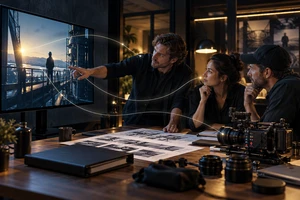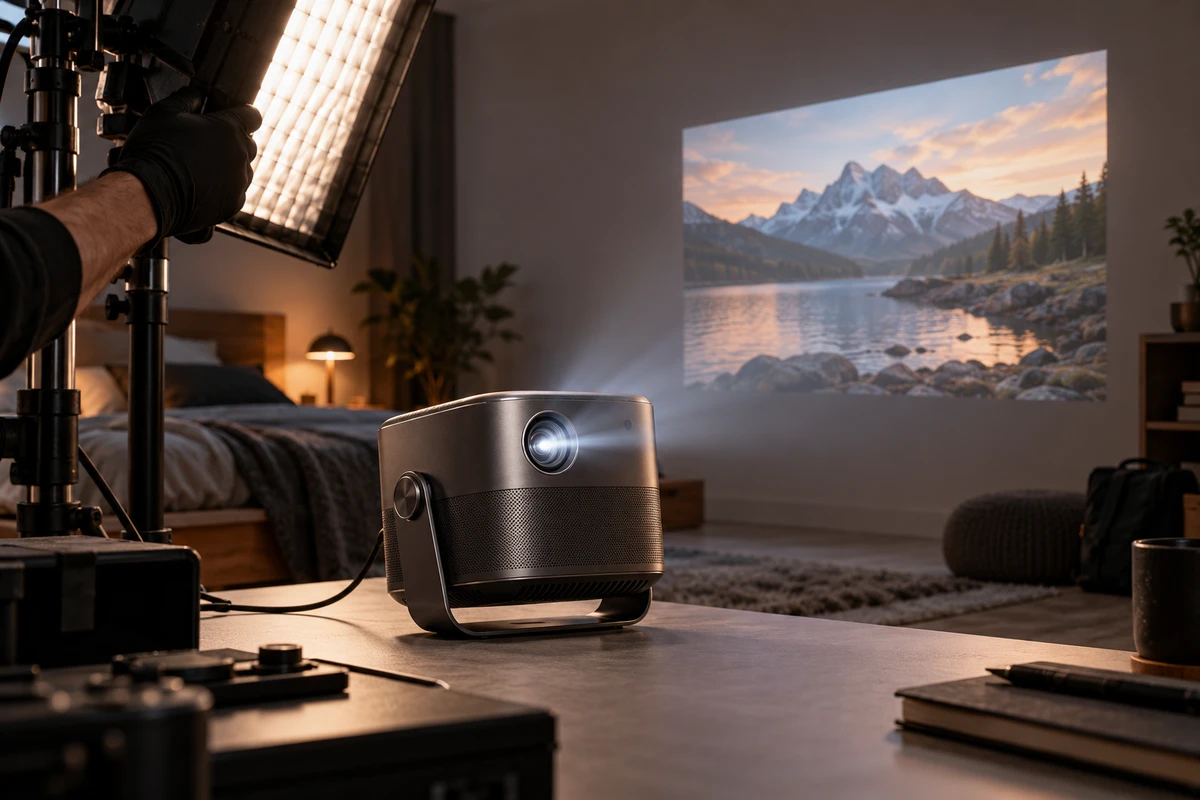
Imagine a compact smart projector approaching launch. It has a finely anodised metal ring, automatic focus and keystone correction, while the brand also wants to communicate brightness, quiet operation and portability. The product information may be complete, yet a 3C product film can still turn all four ideas into one undifferentiated sequence of “tech” imagery: the metal looks beautiful, the functions are explained in captions, brightness is created in the grade, and the lifestyle scene amounts to a smiling actor.
The problem is not a shortage of shots. It is a shortage of responsibility. Design shots help viewers understand why the product looks and feels the way it does. Function shots let them follow an operation. Performance shots communicate claims that must be supported and precisely framed. Lifestyle scenes answer where and why the product is useful. All four can belong in one film, but they should not be approved by the same test.
Start by writing what each shot must let the viewer confirm
Before drawing the storyboard, turn each selling point into something observable. Replace “premium,” “powerful” and “smarter” with a statement a reviewer can test by pausing the frame or following an action.
- Design: the viewer can read the relationship between the lens ring, ventilation openings and the body curve.
- Function: the viewer can follow the complete auto-correction process, including its starting and finishing states.
- Performance: any statement about brightness, noise or battery life matches the test conditions and language approved by the brand.
- Context: the viewer understands why the compact body, port layout or fast correction matters in this particular task.
These are shot responsibilities. They give product, marketing, directing, cinematography and post-production a shared standard, and they can be turned directly into final-review questions.
Design shots make materials and structure legible
The projector's metal frame, matte body, glass lens and ventilation pattern need different reflection behaviour. Product lighting should not simply illuminate every surface. It should create controlled differences: a continuous highlight along the metal edge, retained micro-texture on the matte body, glass that does not clip, and openings that keep depth without disappearing into shadow.
One useful design shot could travel from a rear three-quarter angle, carry a highlight across the body and settle where the lens ring meets the ventilation structure. The camera movement reveals construction instead of merely displaying motion-control polish. If the finish, colour or assembly gap has not been locked, however, the shot is a visual test—not a representation of the production unit.
Reviewers should move beyond “Does it feel premium?” Ask whether the main materials can be distinguished, whether coloured lighting has distorted the approved finish, whether ports and markings match the approved sample, and whether the highlight has made a matte surface look glossy.
Function shots preserve trigger, action and feedback
Autofocus is not a flare animation. It is a time-based chain. Begin with a slightly soft image, show the product or interface being triggered, preserve the focusing change, and finish on the clear result. Automatic keystone correction similarly needs a distorted starting state, the correction itself and an identifiable end state.
On set, capture one uninterrupted operation first, then add close views of the hand, the product response and the projected result. The complete take provides continuity; the close-ups provide pace and information density. If a function depends on a particular network, firmware, companion phone or room condition, put that dependency in the shot plan. A single finger press cannot recreate missing cause and effect in post.
The review question should be equally concrete: with the sound muted, can a viewer still understand who triggered what, what the product did and where the result appeared? If the narration has to supply a missing step, the visual evidence is probably incomplete.
Performance shots begin with the claim, not the image
Brightness, noise, battery life and connection speed can influence a purchase decision. Images can help explain them, but a polished image is not a test result. Darkening a room and lifting the projected area in the grade can create the feeling of brightness. Removing every operating sound can imply silence. Compressing a connection sequence can make waiting disappear.
For advertising aimed at the United States, the FTC's current guidance looks at both express and implied claims conveyed through words and images, and says objective claims need a reasonable basis before they are disseminated. The production implication is practical: the brand first supplies the approved claim, test conditions and limitations; the creative team then decides whether to use demonstration, copy, CGI or a controlled comparison. The order should not be reversed by creating a strong visual conclusion and searching for support later. See the FTC's Advertising FAQs for small business for the source guidance.
Take operating noise. If the brand has approved “quiet operation” but not a decibel figure or measurement distance, the film may show use in a calm interior, retain an honest amount of operating sound and use reviewed qualitative copy. It should not invent a number or use total silence to suggest the device makes no sound. A performance sequence is complete when picture, copy, sound and the approved claim all point to the same conclusion.
Lifestyle scenes explain value without impersonating a lab
Putting a portable projector in a bedroom, tent or business suitcase does not automatically create a useful context. A scene needs a task: the device is moved to a wall that is not perfectly square and corrects the image; it comes out of luggage and the stand and port layout shorten setup; it occupies little space on a small bedside surface.
Context answers why a feature is useful. It should not quietly carry a performance claim. A bright image inside a tent is not a daylight-brightness test. A relaxed conversation does not prove a noise rating. Cropping out the power cable and accessories should not imply that they are unnecessary. Props, wardrobe and performance should make the task easier to understand, not hide the operating conditions.
If the shoot needs controlled product close-ups and domestic actions in one location, review U-STUDIO's white cyclorama and home interiors before deciding whether the spaces suit the sample reflections, talent blocking and real operating conditions. The public studio page supports planning; set changes, equipment and availability still need project confirmation.
A hypothetical 36-second sequence
This is an illustrative storyboard, not an ONCE client case.
0–6 seconds: reveal the design. A narrow highlight emerges from black and travels along the metal edge towards the lens ring. The product turns by roughly a quarter, while the matte body and glass lens retain visibly different textures. The job is recognition, not performance.
6–16 seconds: show the function chain. The projector is placed slightly off-axis. The wall image begins soft and distorted; the user powers the device, and the shot preserves the focusing and keystone correction until the rectangle settles. The viewer can follow both operation and feedback.
16–24 seconds: communicate performance. The sequence moves to conditions approved by the brand: throw distance, ambient light and source content remain consistent. Copy uses only reviewed language for brightness, noise or battery life. If adequate support is not available, replace this passage with design or function detail instead of using mood to stand in for a number.
24–36 seconds: place the value in context. The user moves the projector from a work surface to a low bedroom cabinet and quickly corrects the image again. The action gives portability and setup speed a concrete task. The final shot returns to the product and brand information; the context supports understanding and memory without pretending to be a test.
This order is not mandatory. A design-led brand may expand the first passage. If efficient operation is the main buying reason, the second passage should arrive sooner. What matters is that each passage owns one primary responsibility, so one selling point does not depend on four vague pieces of imagery.
Protect product truth through three handoffs
Script handoff: product and marketing approve what can be said
Production inputs should include the approved production appearance, functional path, publishable specifications, necessary operating conditions, prohibited information and one named approver for each area. This is where claims are separated from creative adjectives.
Set handoff: directing turns claims into repeatable actions
Each critical shot should record sample state, starting position, user action, product feedback, sound and reset method. Reflective products also need the camera angle, product angle and major flag positions noted. Screen-based products need the firmware, language, brightness and notification state locked. If another angle or pickup is required, the crew can reproduce the fact rather than merely approximate the composition.
Post handoff: approve a fact pass before the mood pass
The first rough-cut review should check product accuracy, complete actions and supported claims. After colour, effects and sound are added, reviewers check whether style has changed the meaning of the product. AIGC can support previs or extend an environment that carries no product fact. If generated imagery changes ports, proportions, projection results or operating conditions, return to the source material and reassess the shot.
Content provenance can help with traceability. The current C2PA specification covers standards for recording media provenance, and Adobe describes Content Credentials as metadata that can show whether content was captured, generated or edited. That history does not by itself clear usage rights or substantiate a product claim; those decisions still belong to the brand and production approval process.
Approve the film with three different viewings
First, watch with the sound muted: are functional triggers and results still clear? Second, stop on product frames: do finish, ports, indicators, interfaces and accessories match the approved version? Third, isolate the performance passage: can every number, comparative word and strong visual implication be traced to approved support and conditions?
Then place the asset in its real destination. Google's current official video ad specifications cover landscape, vertical and square assets, while formats differ in duration and placement. A landscape master passing review does not automatically make a vertical cutdown usable. Critical actions still need to remain legible in the crop, with safe space for captions and interface elements.
If the sample is unstable, a performance claim is not approved, or a scene hides a necessary operating condition, the responsible choice is to reduce that passage to a visual test, postpone it, or redesign it as a brand-mood shot that makes no factual promise.
ONCE connects product strategy, filming and multi-version delivery around what buyers need to understand. Explore our ecommerce and product-video production approach, then share the production status, approved claims, intended use cases, launch timing and budget range to receive a practical technology-product video plan.