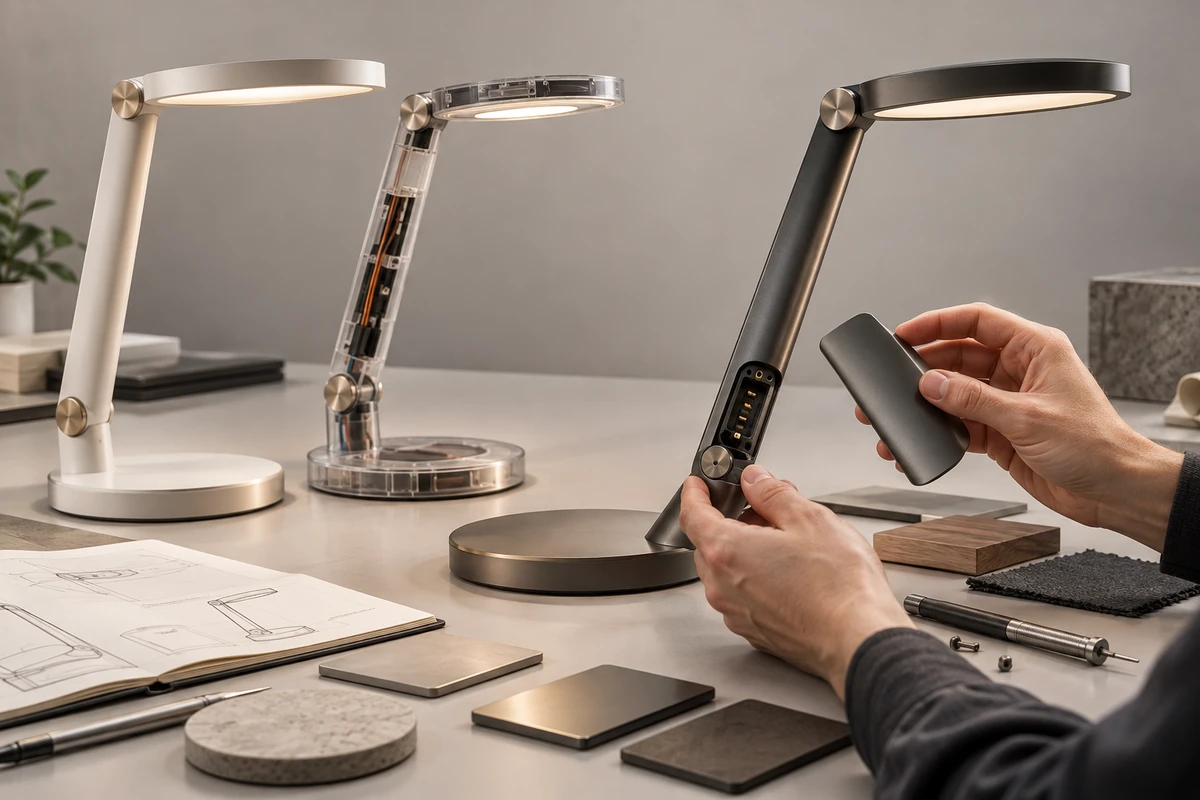
The shoot date is approaching, but the table holds three incomplete versions of the product. One has the best-looking shell but cannot power on. One performs the key function but uses a temporary port. The third is close to production, although its finish and packaging have not been approved. The most dangerous answer is not “we cannot shoot.” It is “let’s shoot everything now and fix it later.”
A more useful rule is this: film stable product facts now, use unsettled facts only for tests or placeholders, and wait whenever an image could make viewers believe that an unverified capability is already real and repeatable. Shooting early should preserve footage that can survive product iteration. It should not turn an engineering state into a launch claim.
The example below uses a hypothetical smart desk lamp. It is not an ONCE client project and does not represent the specifications of a real product.
Work backwards from the final deliverables
Do not begin by asking which sample looks best. Split the film’s information into four kinds of product truth.
- Appearance: silhouette, proportions, colour, finish, port locations and assembly gaps.
- Operation: touch controls, hinges, app connection, light changes and the complete user action.
- Outcome: illumination, responsiveness, runtime, heat and other performance that may affect a buying decision.
- In-box delivery: packaging language, certification marks, accessories, instructions and the final model name.
These facts rarely lock at the same time. Having a sample therefore does not mean the whole film is ready to shoot. Autodesk describes a high-fidelity prototype as a later-stage representation designed to approach the final product in appearance, materials and function. The production implication is straightforward: earlier prototypes are useful for composition and action testing; samples closer to production are better suited to final material, performance and in-box evidence.
If the roles of the hero film, product-page video and cutdowns are still being defined, review ONCE’s ecommerce product video production approach and assign the product facts required by each deliverable before building the shot list.
Four samples of the same lamp cannot do the same job
Appearance model: show the form, not the function
Assume the first lamp has the intended silhouette and a close approximation of the target colour, but no production light board. It can support powered-off hero shots, silhouettes, scale in relation to a desk and tests of how light travels across a reflective edge.
It should not demonstrate dimming, touch feedback or sustained operation. Even if post-production can make the light surface glow, that image must not be treated as functional evidence. If texture, port position or base height may still change, macro and precise scale shots remain internal style tests.
Functional prototype: test the action without hiding temporary construction
The second sample can perform touch dimming and hinge movement, but the shell is an engineering material and the cable exits through a temporary opening. It is useful for learning how long a complete action takes, where a hand should land, whether the lamp head obscures the view and whether the function can be repeated across takes.
A repeatable action can become test footage. Public use requires a separate check that unsettled construction is not visible and that the shot does not imply more than the current sample can do. One successful attempt is not the same as a stable product capability.
Approved or production sample: carry the final close-ups
Once colour, material, ports, assembly and the core operation have been approved, the sample can carry higher-risk shots: surface macros, connector details, continuous operation, interaction with the approved app interface and demonstrations that directly affect a purchase decision.
Objective claims still need support beyond the shoot. For advertising aimed at the United States, the FTC’s advertising substantiation policy says advertisers need a reasonable basis for express and implied objective claims before dissemination. Other markets require their own legal or compliance review. A single successful take on set does not replace product testing or regulatory evidence.
Final packaging: shoot it last, but plan it early
Packaging, model names, barcodes, certification marks, accessories and manuals often lock after the product form. Unboxing, pack rotations, accessory flat lays and “what is in the box” sequences must wait for the final list. A temporary box can test composition, but it should never enter a publishable master.
Sample state and shot-risk table
| Sample state | Shoot now / wait |
|---|---|
| Appearance model | Shoot silhouette, powered-off hero frames, scale and lighting tests; wait for approval before material macros, ports and functional outcomes |
| Functional prototype | Test action timing, camera position and internal demonstrations; public footage requires repeatability and no misleading temporary construction |
| Approved or production sample | Shoot final materials, assembly, core operation and product close-ups; performance, durability and safety claims still require separate support |
| Final packaging and accessories | Shoot unboxing, copy, accessory lists and end frames; provisional versions are layout placeholders only |
The practical statuses are not simply “shot” and “not shot.” Use three: publishable, internal test only, and pending replacement. A shot may be captured early as a style test, but the filename, review page and edit timeline should all say so. That prevents a placeholder from quietly becoming a final asset.
Placeholders can solve layout, not missing product truth
Useful placeholders answer questions about composition and pace without inventing a product fact.
- A neutral card can reserve space for unapproved packaging copy and test subtitle scale.
- A proxy app screen can test hand movement and screen exposure, but it must be replaced with the approved interface before delivery.
- A real product photograph can be composited into a non-functional seasonal environment to explore art direction; the product structure, accessories and functional outcome still require approved source imagery.
- Visual effects should not make an unfinished function appear complete and rely on fine print to repair the impression.
- Certification marks, runtime, brightness, included accessories and final packaging language should never be guessed.
For Kickstarter campaigns, the platform’s current rules for Design and Technology projects state that prototype demonstrations should reflect the product’s current state and should not use CGI or special effects to demonstrate functionality that does not yet exist. That policy does not govern every channel, but it illustrates why an attractive placeholder cannot replace product status. Adobe’s guidance on AI-generated product backgrounds describes a narrower use: combining a photographed product with a generated setting. The team still has to verify the product itself, the light relationship, usage rights and channel requirements.
Turn the pickup shoot into a planned replacement
An early shoot can match a later pickup only if the first unit records enough information. For every shot, keep at least six fields:
- shot ID and intended use;
- sample ID and sample state;
- product facts approved at the time;
- camera position, focal length, lighting and product-position reference;
- the condition that triggers replacement;
- whether the version may be published and on which channels.
The lamp’s powered-off hero shot might read: “Appearance sample A, composition approval only; replace macro after final colour sign-off.” The touch demonstration might read: “Functional sample B, action timing approved; reshoot outcome after the production light board passes repeatability review.” The pickup is then a defined replacement task, not a new debate about the entire film.
Version control should also mean more than adding v2, final and final2 to filenames. Frame.io’s V4 comparison viewer offers one useful model: keep related asset versions comparable and attach comments to the correct version. The specific tool can vary, but the team should always be able to answer which sample, approval and review note produced the current shot.
Three review questions are better than “it looks final”
For each shot, ask:
- What product fact will a viewer infer from this image?
- Does the current sample genuinely and repeatedly support that fact?
- If the next product version changes, will the shot survive, require a local replacement or need a complete reshoot?
Waiting is usually the better decision when the product silhouette may change, the main benefit depends on an unstable function, safety or performance claims lead the communication, only one irreplaceable engineering sample exists, or nobody owns approval of packaging and in-box contents.
If the form, target market and communication task are already locked, the team can often proceed with composition tests, powered-off product shots, action rehearsals and environment plates while functional development continues. The essential distinction is between ready to film and ready to publish.
To plan the production, send ONCE the product information, target market, channels, launch date, sample states, approved and unsettled product facts, and indicative budget through the project enquiry page. We will first separate the shots that can start, need testing or must wait, then define the complete production scope.
Sources reviewed on 10 October 2026. Platform policies and product compliance requirements should be checked again by the responsible project owner before publication.