Hiring Video Production in China 06/10
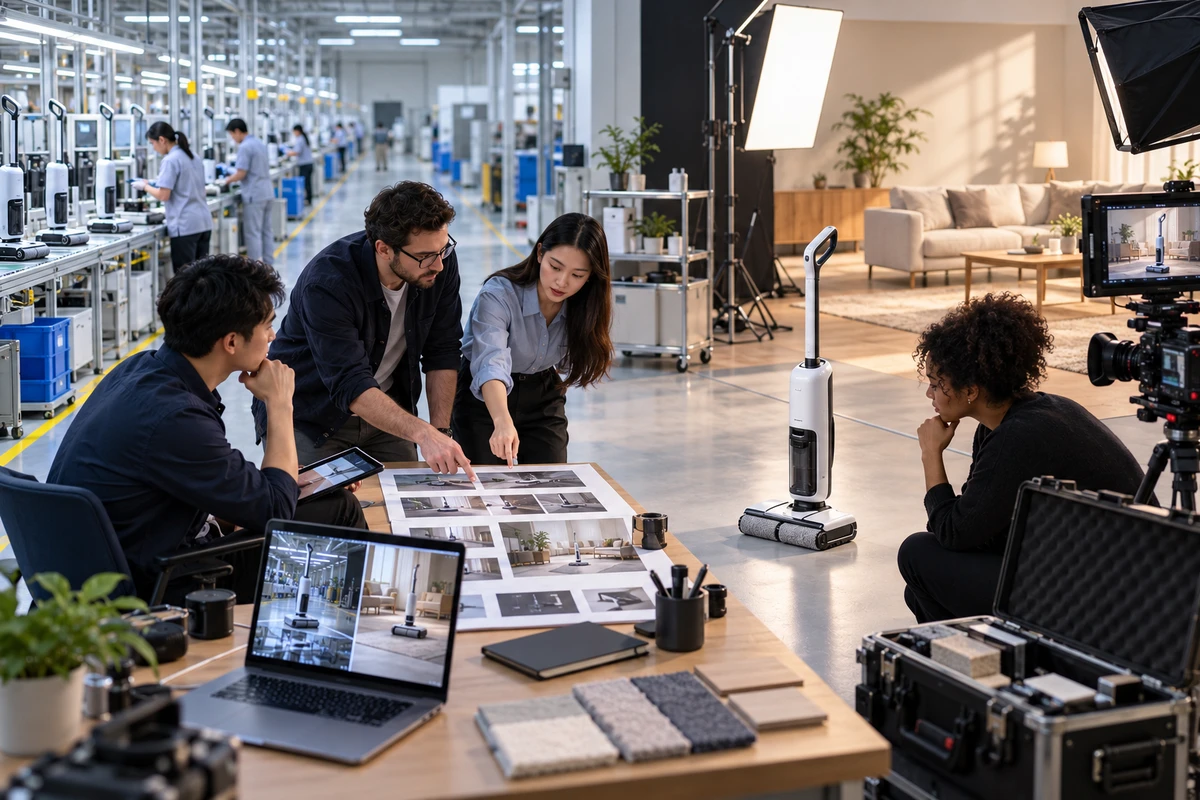
Consider a hypothetical overseas home-appliance brand preparing a launch film for a smart floor cleaner made in Dongguan. Its marketing team wants assembly, testing and packing footage. It also needs international talent to demonstrate wet-mess pickup, edge cleaning, tank handling and storage in a kitchen, living room and pet-home setting. The production supplier is based in Shenzhen. The factory asks a reasonable question: if the product is already here, why not film everything on the same day?
The decision should not begin with “Is Shenzhen, Dongguan, Guangzhou or Shanghai better for production?” A city name gives you geography, not a shot plan. A more useful rule is: identify the facts that cannot move, then move the other resources.
A real line, a particular manufacturing step, the engineering team and the production state on the day cannot be transported into a studio. Samples, talent, furniture, lighting and consumer settings usually can be moved or rebuilt. Factory footage should answer how the product is made, checked or prepared for delivery. Studio footage should answer how an overseas buyer will use, understand and compare it. If a location does not own a distinct buyer question, adding it usually creates more logistics than value.
Make every shot explain why its location is irreplaceable
The smallest unit of location planning is not the whole film or the whole shoot day. It is a shot task. For each group of shots, complete this sentence:
This must be filmed here because only this location can truthfully show ______.
“It feels more industrial,” “it looks like an international home,” or “the supplier is nearby” are not yet strong reasons. A procurement-ready answer should point to an observable dependency:
- only the current factory has the approved line making the target model;
- only that test station can show the process the brand is allowed to disclose;
- only the engineer and product together can reset a technical demonstration;
- only a controlled studio can preserve the floor, spill quantity, light and camera position across comparable takes;
- only a particular location set has the access, dimensions and layout required by the action; or
- only a quiet, repeatable space can capture product sound or multilingual dialogue cleanly.
This test exposes false dependencies. A normal office table does not become more authentic because it sits inside a factory. An empty line that is not running the launch product does not become manufacturing proof because it contains many machines. Conversely, a studio can create a credible use context, but a set cannot prove real production, capacity or quality.
Choose the factory when manufacturing is part of the reason to buy
Send the production team to the factory when the buyer needs to understand something that depends on the actual site. That might include the target model moving through an approved assembly sequence, a specific inspection action, engineering collaboration, packing or the relationship between the product and equipment that cannot reasonably be moved.
The advantage is not automatically lower cost. It is the fact that the claim and the place are connected. The line, equipment, people, materials and product can appear in one real operational relationship.
That relationship still needs conditions. The client confirms the model and the claims that may be communicated. The factory confirms the production window, zones, people, safety and confidentiality. The production company turns those conditions into shots, positions and fallbacks. Episode 01 explains the three-party appointment between the client, production supplier and factory. Without that appointment, a crew may reach the site but find that it can film only generic exteriors, idle equipment or a production state unrelated to the launch product.
A factory is not a free studio. Typical constraints include:
- the line follows production rhythm, not the director’s preferred number of takes;
- noise, flicker, mixed colour temperatures and limited space affect picture and sound;
- stands, track, cables and crew cannot interfere with routes or machinery;
- other customers’ orders, screens, labels and processes can enter the frame;
- a line stop or changeover affects people beyond the film crew; and
- if the production state changes, the planned shot may no longer support the intended fact.
The completion test for a factory sequence should therefore be more specific than “capture plenty of industrial footage.” Each manufacturing statement should have a permitted, genuine and recognisable action. Third-party and confidential information should not be carried into the asset by accident. Site safety and production authority should remain with the factory’s authorised people. Any missing process needs an agreed substitute or an explicit decision to omit it.
Choose a studio when control and repeatability matter more than the address
When the job is to show product design, materials, operation, household use, talent relationships or multiple market versions, sending the sample to a professional studio is often the stronger choice.
For the floor-cleaner example, a wet-mess demonstration depends on floor material, spill type and quantity, product start point, travel speed, light reflection and the reset between takes. Talent and animals may need rehearsal. Horizontal and vertical openings may need the same outcome repeated. These facts do not become more credible in a factory; a live industrial environment may make them harder to control.
The value of a studio is not that the result is automatically more premium. It is control:
- camera, light, sound and background can stay consistent across takes and versions;
- the same product action can support a hero film, feature cutdowns, stills and multiple aspect ratios;
- talent, wardrobe, props and art direction can be organised for the intended market;
- if a sample, interface or script changes, the setup is easier to restore; and
- home, technology and white-stage environments can serve the script without forcing factory space to impersonate consumer life.
ONCE’s ecommerce product video production solution places samples, use scenes, platform versions and remote approvals in one production scope. U-STUDIO in Shenzhen publishes its own studio layouts and equipment context, while the Pearl River Delta location-studio directory describes independently operated venues that can be shortlisted and recced for a brief. These pages show available production approaches; they do not mean every project automatically includes the same sets, equipment, people or deliverables.
A studio also has prerequisites. The sample must travel safely, survive repeated operation and have access to replacement parts. Door width, loading, power, water, drainage, sound conditions and the product path need checking. International talent, special props, animals, vehicles, cooking, water effects or exterior action may introduce their own production and permission requirements. A beautiful set that cannot accommodate the complete action is still the wrong location.
Use two locations only when each answers a question you cannot remove
A factory-and-studio plan can make sense when the film needs both manufacturing trust and consumer understanding. It should not repeat the same hero shots in two places simply to make the treatment look larger.
| Location | Buyer question it uniquely owns | Typical coverage | What it should not pretend to do |
|---|---|---|---|
| Factory | How is this product actually made, checked or prepared for delivery? | Target-model line, approved processes, inspection actions, engineering collaboration, packing | Imitate lifestyle scenes, stage a false process, or replace an audit or certification |
| Studio or location set | How will the intended customer use, compare and understand it? | Hero shots, material detail, repeatable demonstrations, talent use, household tasks, format variants | Imitate a real line or use art direction as proof of capacity or quality |
| Shared across both | How does the same product identity and message remain continuous? | Model, finish, accessories, interface, action, copy and approved claims | Use editing to conceal differences between samples or versions |
In the hypothetical floor-cleaner project, the factory covers only the assembly, testing and packing actions that genuinely depend on the site. The studio handles wet-mess performance, edge access, storage, talent, pet interactions, hero photography and platform variants. The factory sequence does not need to build a complete lifestyle story, and the studio should not dress a table to look like a manufacturing line. Each location solves one distinct problem; the edit connects them through product identity, action and information order.
Two locations add recce, transport, loading, venue, crew time, sample management and continuity work. They earn that cost only when removing either location would leave an important buyer question unanswered.
Do not compare only drive time; compare which dependencies must move
A supplier close to the factory is not automatically the lowest-cost option. A studio close to the sample is not automatically simpler. A useful comparison lists the objects and people that would move.
Can the product move?
Record dimensions, weight, packaging, loading, insurance, spares, charging or consumables, post-transport testing and return arrangements. A battery-powered sample cannot always be treated as ordinary courier freight. As checked on October 7, 2026, China’s MH/T 1052-2025 air-transport testing standard and IATA’s 2026 guidance for lithium and sodium-ion batteries address classification, test summaries, packaging, marking, documentation and state-of-charge conditions in specific air-transport scenarios.
Those documents do not apply identically to every product, route or transport method. The manufacturer, shipper, operator, carrier or a qualified logistics provider should confirm the actual shipment. A video supplier should not make a dangerous-goods determination on their behalf.
Can the people and environment move?
Talent, factory engineers, product managers, animals, vehicles, furniture and large props have different movement costs. If the demonstration needs a factory engineer to reset an engineering sample repeatedly, moving the product far from technical support may create more risk than it removes. If the project needs several performers, makeup, art direction and several household sets, moving that entire unit into the factory can be inefficient.
Can equipment and usable time move?
The camera is only one part of the load. Lighting, flags, rigging, track, motion control, sound, monitoring, data backup, power and safety equipment take vehicle capacity, load-in and setup time. Six hours of venue access does not mean six hours of exposure time. Security, induction, clearance, build, tests, resets and wrap all consume the window.
Can a reshoot be restored?
Distance often becomes expensive not on the first shoot but when the team must restore it. A changed production plan may make the same line, materials and employees hard to reproduce. A location studio may change furniture or be unavailable. Quotes should state which resources a pickup requires rather than hiding the question under “travel at cost.”
The AICP’s current official resources still publish its National Guidelines for Live Action Production, revised in 2019. They emphasise precise client specifications and a bid proposal that works as an execution roadmap. These are US industry guidelines, not Chinese law and not a price rule for China. The transferable procurement point is narrower: compare suppliers against the same shot-dependency brief, not only duration and city.
Lock three records before a two-location shoot
The shot-dependency map
For each shot, record the buyer question, the non-movable fact, sample state, people, set, equipment, sound, approver and fallback. This map assigns the shot to the factory, the studio or a genuine either-location option.
The sample and continuity record
Give every unit an identifier. Record finish, firmware or app version, accessories, damage, interface, packaging and transport state. If the factory and studio use different units, state which shots may cut together and which cannot form a continuous causal sequence because the model, colour, port layout or functional state differs. Episode 05’s shot-by-shot release method for prototypes and product interfaces can feed directly into this record.
The location handover
List the objects and files passing from one location to the next: units, accessories, spares, wardrobe, props, product settings, reference stills, colour and lighting records, completed and missing shots, media-verification status and any new restrictions. Test product appearance and function before it leaves the factory, then check again on arrival. Do not wait for the critical take to fail before investigating transport.
The final rule: every location must earn its place
Before approving the production plan, ask four questions:
- If the factory sequence is removed, do we lose a manufacturing or engineering fact that cannot truthfully exist elsewhere?
- If the studio sequence is removed, do we lose target-market use, performance or repeatable product demonstration?
- Is moving the product safer, more controllable and easier to restore than moving the full group of people, equipment and settings?
- If both locations remain, can the model, state, action and claim be reconciled in one continuity record?
If the first answer is no, the factory may not be necessary. If the second answer is no, the studio may not be necessary. If the fourth answer is no, a two-location edit may simply conceal incompatible footage. The city is not the answer; the dependency is.
If you are planning a product shoot between a China factory and a studio, send ONCE the product and factory location, target markets and placements, launch timing, sample dimensions and state, manufacturing facts that must appear, talent and setting needs, and any existing script or shot list. We can first assign shots to the factory, studio or either-location options, then check relevant production resources in Shenzhen and the Pearl River Delta and define a comparable scope. ONCE provides video production and coordination; it does not replace dangerous-goods logistics advice, factory safety management, supplier auditing, certification or legal advice.
Source note: this article was checked on October 7, 2026 against the AICP National Guidelines for Live Action Production, China’s MH/T 1052-2025, IATA’s Guidance Document for Lithium Batteries and Sodium ion Batteries – 2026, and ONCE’s published U-STUDIO, Pearl River Delta location, ecommerce-production and prior production-guide pages. Each source is used only within its stated production or transport context.