A one-shoot, multi-version brand film becomes difficult not when the team exports more files, but when too much of the original picture can no longer be translated.
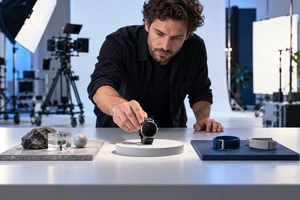
Consider a hypothetical smart-wearable launch film. A presenter faces the camera and states the main benefit while tapping an English interface. Product claims appear beside the device, and the composition is built for 16:9. After the English master is approved, the team asks for German dubbing, Japanese subtitles and a 9:16 cut. Every translation may be accurate, yet the German line does not fit the mouth movement and action, the Japanese subtitles cover the hand demonstration, and the vertical crop removes the claim. The failure is not the translator’s. Production never identified the visual relationships that could not be repaired through language replacement.
This article is not another argument for collecting more footage. ONCE’s earlier shot asset map addresses that question. The decision here is what must be designed in the storyboard and on set when a brand genuinely needs multiple languages and formats, and what can safely remain for translation, dubbing and post-production.
Find the four visual relationships that subtitles cannot repair
Multilingual risk is not simply the presence of text in the frame. The hard problems occur when language, sound, performance and product action have become inseparable.
The first relationship is front-facing speech and mouth movement. The actor’s opening, pause, breath, gesture and turn define how long a line can occupy. A target language can express the same meaning with a different sentence structure and natural duration. Speeding up the dub can damage the performance; shortening the translation can remove a qualification.
The second is on-screen language and interface action. If a finger lands on an English button and the interface changes immediately, a subtitle cannot replace that event. A different term, button width or product version can invalidate the fingertip position, occlusion and response timing.
The third is subtitles, supers and platform overlays. Google’s current video-ad specifications recommend 16:9, 9:16 and 1:1 assets and provide universal safe-zone references because CTAs, buttons and interface overlays can appear in different places across inventory and devices. The specifications define asset conditions, not creative effectiveness. Their production implication is narrower: keeping a person inside a crop does not prove that the vertical version still has room for translated information.
The fourth is product action and verbal promise. A voiceover may say “instantly” while fast editing visually implies the same conclusion. Even if a translator narrows the wording, the original performance and edit may continue making a stronger claim. A language review must evaluate image, voice and rhythm together, not only a bilingual spreadsheet.
Decide who must speak inside the frame
Not every brand film needs a person speaking directly to camera. The more important the language versions, the more deliberately the production should choose where speech lives.
- Synchronous direct-to-camera speech is useful when the speaker’s identity and delivery are themselves part of the trust proposition, such as a founder’s point of view, a genuine specialist’s explanation or a promise that needs a visible speaker. It is also the least flexible for another language.
- Voiceover with non-speaking performance suits product action, lifestyle scenes and brand emotion. The person still carries the relationship, while the language can move in a more independent audio layer.
- Short synchronous phrases plus voiceover explanation preserve some immediacy while moving complex parameters, qualifications and market differences outside the mouth-shape constraint.
- Separate target-market performance is appropriate when local language, speaker identity or required wording is itself part of the communication. Reshooting is not a failure when one performance cannot credibly serve every market.
Netflix’s dubbing principles treat a dub as a production in its own right, requiring natural phrasing, performance, lip sync and mixing to work together. Its entertainment standards are not advertising rules, but they reveal a relevant craft constraint: strong dubbing is not the act of forcing a waveform into the same duration. It rebuilds a credible performance in the target language.
Before the script is locked, label every spoken line as “mouth must be visible,” “may move off screen,” “may be adapted,” or “meaning may not change.” A sentence containing fixed terminology or a material qualification should not also carry a rapid action and rigid lip sync. A brand line that must be visible should be read in the target language before the shoot to test whether it needs a longer pause, a second performance or its own shot.
Film the product interface as a replaceable asset
When a device screen, app, web page or package carries text, the easiest on-set approach can become the most expensive localisation problem: recording the current interface permanently inside reflections, shallow depth of field and finger occlusion.
A more adaptable handoff usually includes four elements:
- A clean screen or trackable plate: preserve the frame, reflection and environmental relationship without permanently filming unapproved copy.
- A genuine screen recording: preserve the real interaction state, frame rate and version for compositing and product-team review.
- A finger-action reference: retain tap, swipe and response timing so a localised interface can still connect to the performance.
- A string and terminology sheet: list source text, intended meaning, permitted abbreviation, prohibited translation, target market and approver.
When the screen is part of the story, decide whether viewers need to read it. Environmental texture can be de-emphasised. A step, feature demonstration or purchase promise requires enough time and space for the local language. Netflix’s localisation best practices also warn that when on-screen text and dialogue overlap, the most important information needs priority; teams should not over-truncate subtitles or push reading speed merely to preserve both. The useful transfer here is the information-conflict principle, not the wholesale application of streaming-delivery rules to advertising.
Landscape and vertical are two information layouts
A product remaining visible in both 16:9 and 9:16 does not mean both frames can carry the same multilingual information. In a vertical frame, the person, product, supers, subtitles and CTA compete for a narrower area. Some target languages also change line count and line breaks.
The US government’s Section508.gov caption guide, reviewed in August 2025, recommends planning for captions from the start. It advises avoiding overlapping speakers where possible, notes that fast speech can force a conflict between readable duration and synchronisation, and suggests keeping important on-screen text in the upper two-thirds because many players use the lower third for captions. This is US federal digital-accessibility guidance, not a universal legal dimension for every commercial ad. Its transferable production lesson is to reserve caption space before shooting.
A storyboard review should place three real occupancies in the frame, not only a central safe box:
- two lines in the longest target language;
- likely platform CTA or interface overlays;
- product action, eyeline and brand element that must remain visible.
If they collide, choose before the shoot: reposition the person or product, capture a looser composition, move the claim to an independent end card, or film a dedicated vertical action. Cropping cannot create space that the source frame never contained.
Do not hand over only a Chinese film and an English film
The reusable output of a multilingual project is not a group of finished videos with language burned in. It is three layers that can be recombined.
The first is a clean picture master. It contains no burned-in subtitles, price, date or market-specific copy. Replaceable screens have trackable plates. Synchronous speech is distinguished from replaceable voiceover. Landscape and vertical use suitable shots rather than one automatic centre crop.
The second is a language package. It should include a timecoded source script, meaning and context, terminology and pronunciation, adaptation limits, subtitle files, voice files, separate dialogue and music-effects stems, and a target-language reviewer for each market. A translator needs to know whether a sentence identifies a button, carries a material qualification or exists only for emotion.
The third is a market release package. It records the country or region, platform, aspect ratio, duration, CTA, landing-page language, required notice and final approval. TikTok’s ad-language review guidance, updated in August 2026, says ad text, spoken words, subtitles and the linked landing-page or app-store language should align with the acceptable languages in the targeted country or region; it also says language targeting does not replace using a country’s accepted language. That does not make every market rule identical. It shows why a language version must belong to a real media task.
These layers complement ONCE’s brand film planning for hero films, cutdowns, aspect ratios and clean footage. One structure controls how language changes; the other makes one production leave useful long-term assets.
AI dubbing and lip conversion need a version strategy
Generative video translation can alter voice, language and even mouth movement. That can make “shoot one language and automate the rest” sound like a settled plan. The available evidence does not justify such a broad conclusion.
Wahid, Han, Fauzan and Karjaluoto’s open-access study, “Generative AI for Video Translation: Consumer Evaluation in International Markets,” was published online in November 2025 in the Journal of International Marketing. It reported two between-subjects experiments: 140 participants for English-to-Indonesian translation and 161 for Indonesian-to-English, using one named tool and one marketing-video stimulus in each study. AI-translated versions were rated lower for naturality and accent neutrality in both directions. Comprehension changed by translation direction, while the reported customer-engagement intention did not differ significantly.
The result is not proof that AI dubbing should be rejected. It shows that language direction, outcome measure and stimulus matter. One tool, limited language pairs and a single stimulus in each experiment also constrain generalisation. A brand can use AI dubbing for internal prototypes, low-risk cutdowns or alternative tests, but a target-language reviewer should still assess meaning, naturalness, pronunciation, lip movement, notices and brand voice before release. Where a person’s credibility, a complex claim or a sensitive category depends on the performance, retain the option of human dubbing or reshooting.
Run an untranslatable-shot check before the camera rolls
The checklist can be short, but every answer must point to a real storyboard:
- Which lines need a visible mouth, and which can become voiceover?
- Which words are filmed into a screen, package or prop, and can the production capture a clean plate?
- Does the longest target-language subtitle cover product action or expression?
- Does each ratio have a viable information layout, not merely a viable crop?
- Can music, effects and dialogue be delivered as separate stems?
- Are product terminology, pronunciation, units, qualifications and approvers recorded?
- If AI dubbing or lip conversion fails, can the team return to human dubbing, a re-edit or a pickup?
If any answer is only “post will solve it,” the film has not yet been designed for multiple languages. One shoot can serve many markets, but not because every version looks identical. It works because the shoot preserves the relationships that need to remain selectable.
If your next brand film needs landscape and vertical cuts, short versions and multiple languages, put the target markets, platforms, languages, spoken lines and product interfaces into the brief together. ONCE can identify which shots can be shared, which require clean plates or alternative compositions, and how the hero film and market versions should be scoped.
Sources checked through October 7, 2026. Platform and research statements apply only within their stated scope. This is production-planning guidance, not a substitute for formal review in the target market, category or platform.