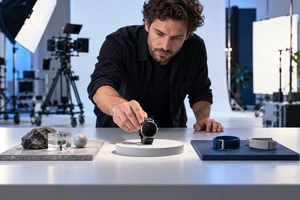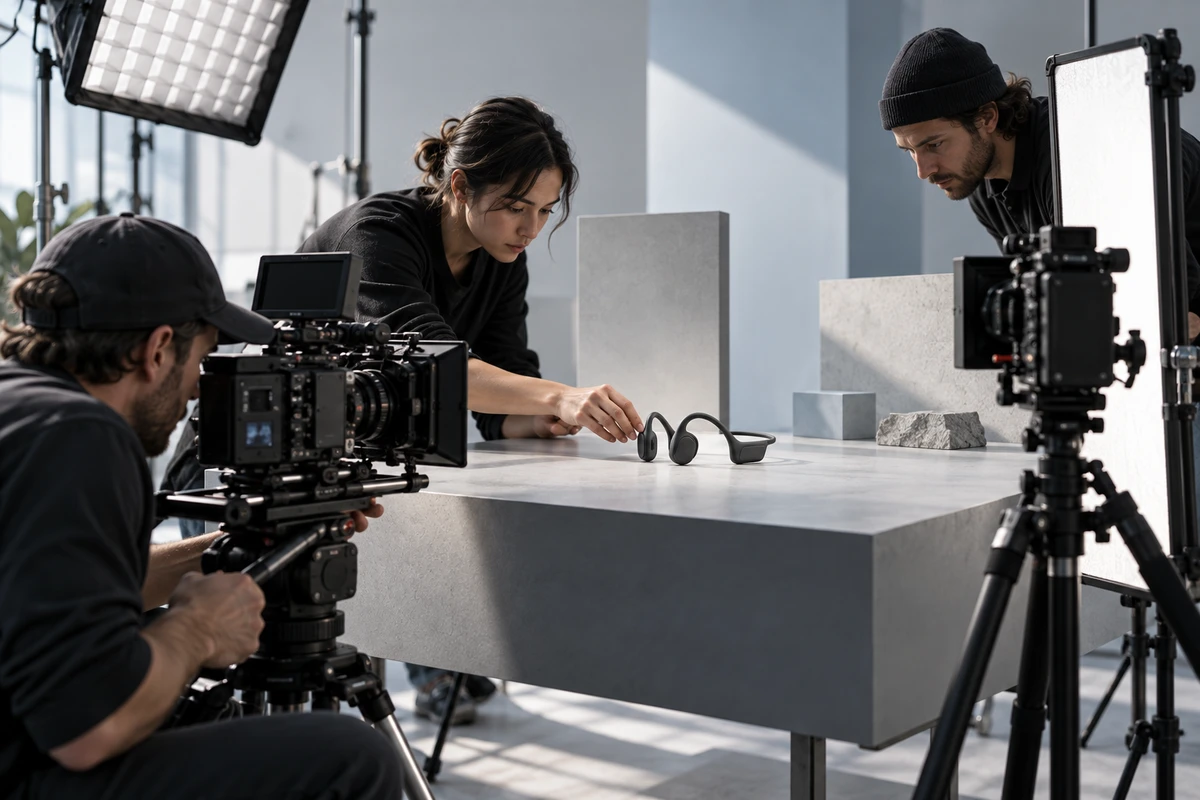
Imagine an open-ear headphone launch. The brand needs a hero film with a complete visual character, an Amazon product-page demonstration, YouTube ads, vertical TikTok cutdowns and multilingual versions. The easiest scope to write is “one 60-second film, two 30-second edits and six 15-second edits.” The quantities are clear, but the production logic is still missing.
When a global product hero film and advertising cutdowns share footage, the real saving does not come from the number of exported files. It comes from avoiding repeated construction of the prototypes, set, lighting, talent and critical product actions. That only works when the team knows in advance which product facts must remain stable across versions and which hooks, human relationships, compositions, captions and calls to action need to vary.
Without that separation, “shared footage” usually creates one of two outcomes: the short edits feel like interrupted pieces of the hero film, or the money apparently saved on set is spent again on reshoots and post-production repair.
Start with one question: what do these versions actually share?
A hero film and performance ads can share a world, prototypes, core product facts, some performers and locations. They do not necessarily share the opening, information order, shot distance, sound conditions or ending.
The hero film may need to explain why the product deserves a place in the brand’s new line. It has room to establish mood, people and a world of use. A cutdown has a narrower job: within one exposure, help a particular audience understand one benefit and one next step. A product-page video serves another role again. It sits inside a buying decision and often needs to make size, operation, feedback and use conditions legible.
Before asking how many 15-second films can be cut from 60 seconds, ask:
- Which brand or product promise must remain consistent in every version?
- Why should viewers believe it, and what visible proof can the image provide?
- Which variables deserve to be replaced or tested in advertising?
- How does each placement change composition, captions, sound and CTA?
Those four questions become the four layers of a shot asset map.
Layer one: the promise is the centre of the footage decision
Compress the hero-film promise into one sentence that filming can test. For an open-ear headphone, suppose the proposition is: “The product enters mobile work and commuting without cutting the wearer off from the surrounding world.” This is a hypothetical example, not a claim about a real product.
If that proposition is valid, the hero film might use a complete situation to establish the relationship: a person moves from a shared workspace into the street, then enters a call or listening state. A short ad does not have to preserve the whole journey. It still needs to retain the centre of the argument—how the product enters the action, how the person remains connected to the environment, and where the result becomes visible.
The promise layer stops a growing version list from looking like unrelated assets made by different suppliers. It also tells the crew which material cannot be sacrificed casually: the first meaningful product appearance, the critical action, recognisable light or sound cues, and the moment the product becomes part of real life.
This does not mean every edit repeats the same sentence. The promise stays stable while the entrance changes; recognition stays stable while the reasons can be reordered by audience. The hero film may begin with the person’s situation. Ad A may begin with the wearing action. Ad B may begin with call feedback. The product-page version may go directly to structure and operation.
Layer two: film product proof as self-contained action units
The most reusable footage is not necessarily the most beautiful three seconds in the hero film. It is product proof that still makes sense in a different context.
A proof unit needs at least four parts: use conditions, the start of the action, product feedback and the outcome. A hand placing a headphone near an ear may look elegant without making fitting, connection or control understandable. If the footage clearly covers taking the product, wearing it, touching the control and seeing the device response, the editor can preserve rhythm in the hero film or recombine the action for a product page and short ad.
The shot list can therefore record more than lens and movement:
- whether the product model, colour and interface state are final;
- whether there is enough time before and after the action for editing;
- whether a clean version without captions, effects or hand obstruction is required;
- whether the same action needs a relational wide shot, a hand close-up and a product detail;
- whether the image remains understandable when narration is muted;
- whether the feature needs live product footage, interface compositing or an explicitly provisional concept demonstration.
This is not an argument for filming a little of everything. Every additional camera position, performance and product reset consumes time. Priorities should come from the version tasks: protect proof that multiple versions need and that would be difficult to reshoot; move decorative coverage with no defined destination lower down the list.
Layer three: hooks, argument order and CTAs are the variables
Advertising cutdowns need variation, but variation is more than replacing one caption. Testable variables can include:
- whether the opening begins with a human problem, a product action, an outcome or a direct question;
- whether a product fact is carried by a creator’s explanation, a scene action or a close demonstration;
- whether portability, connection, fit or listening experience appears first;
- whether the product appears in the first shot or after a brief piece of suspense;
- whether the ending points to a product page, brand site, reservation, crowdfunding page or retailer.
The variable layer needs discipline: keep most conditions interpretable while changing a small number of important elements. If Ad A changes talent, setting, benefit, duration and CTA while Ad B changes everything again, a performance difference will not explain which decision mattered.
TikTok for Business’s June 2025 Creative best practices for performance ads recommends continuous testing and creative refreshes, and suggests maintaining an asset library. It also recommends materially different creative during an ad group’s exploration stage. These are platform recommendations, not a guaranteed performance formula. The useful production implication is that a team should not deliver only a locked “final short film.” When rights and visual continuity allow, openings, product proof, reactions and endings should remain recombinable.
That is also why a production scope should distinguish “replace the opening,” “reorder the argument,” “change the CTA,” “resize only” and “reshoot.” They are different jobs and should not all disappear into the word “cutdown.”
Layer four: format, captions and sound are not last-round technical fixes
Whether an action can be reused is often decided at composition.
Google Ads guidance currently recommends supplying 16:9, 9:16 and 1:1 assets for Video and App campaigns. It explicitly suggests multiple videos across those ratios with different messages, and notes that interface overlays and CTAs can occupy different positions. TikTok’s In-Feed specifications also support vertical, horizontal and square video, while the safe zone changes with dimensions, caption length and additional format elements. Amazon Sponsored Brands video uses 16:9, begins muted by default, requires the featured language to match the marketplace, and warns against placing important information beneath the lower-right overlay.
These requirements were checked on 7 October 2026 and should still be reconfirmed for the actual account, marketplace and ad type before launch. Together, they show that avoiding a destructive crop is only the minimum. The action, caption density and timing of information must still work in the new frame.
On set, divide footage into three categories:
- Truly transferable shots. The subject remains concentrated, the action is complete in horizontal and vertical compositions, and the background leaves room for captions.
- Paired shots. The set and lighting are shared, but horizontal and vertical compositions are recorded separately. A wide relationship shot that places the performer and product at opposite sides may need a second, tighter vertical pass.
- Platform-specific shots. First-person operation, creator-to-camera delivery, phone interfaces or actions that depend on vertical space should not be presented as safe crops from the hero film.
Captions are not merely translation. German, Spanish or Arabic can change line length, reading direction and occupied space. A Chinese or English version whose rhythm depends on on-screen copy may need different sentence lengths, holds or even shot order in another language. Instead of repeatedly moving text around a locked master, retain clean plates, editable graphics, split audio and an approved terminology sheet.
Put the map into the script, schedule and camera report
A shot asset map is not a presentation diagram. It must let strategy, direction, production, camera, post-production and the brand team understand why the same shot exists.
For each shot, record at least:
- a shot ID and the promise it supports;
- the product fact it needs to prove;
- the complete performer or product action;
- the versions it serves and those in which it cannot be used;
- whether horizontal, vertical and square use one take, paired takes or dedicated material;
- whether sync sound, muted comprehension and clean plates are needed;
- prototype, prop, interface, talent and rights dependencies;
- priority, estimated production time and on-set completion status;
- graphics, captions, language and delivery naming required in post.
The script explains how an audience understands. The asset map explains how footage supports multiple versions. The shooting schedule then orders work by real reset cost. Production order usually should not follow the hero-film timeline. Completing every required composition and action while the same light, set, styling and prototype state are available is often more practical than finishing one film before starting another.
Efficiency cannot become the only objective. A shot used in five versions is not automatically more important than a dedicated vertical-ad shot. Priority still comes from the commercial task and the cost of recovery, not the reuse count.
When should the team stop forcing reuse?
Dedicated filming is often more honest when:
- the hero film depends on widescreen blocking, a long take or gradual revelation, while a short ad must reveal the product and outcome immediately;
- a market uses a different model, pack, interface, price or mandatory notice, so the underlying product facts have changed;
- a creator version needs a genuine personal voice and handheld environment that a studio performer imitating UGC would undermine;
- gaze, hands and interface relationships in vertical space cannot remain coherent in the horizontal composition;
- changing sets, talent, rights and resets for a possible future use now costs more than filming the actual need later;
- a prototype function is unstable, making any final-result image liable to present a concept as a production fact.
More reuse is not automatically better. Reuse works only when shared conditions are real, future uses are reasonably clear, rights allow them, and the footage can be found. A drive full of unnamed files without status, language and usage restrictions is not a content asset.
Quote and approve the work without counting only “how many videos”
A clearer estimate separates four kinds of work: shared production conditions, additional shot capture, new editorial decisions, and format or language adaptation.
Shared production conditions include the set, lighting, prototype, talent and core art direction. Additional capture includes a new action, angle, composition or performance. New editorial judgement includes a changed opening, audience, argument order or ending. Adaptation includes reframing, captions, dubbing, graphics and export checks. The buyer can then see why cost changes, and the production team does not have to conceal every new request inside “just cut another one.”
Approval should also look beyond file count. Sample whether each central promise has at least one independently understandable proof unit; whether important actions include useful handles; whether horizontal and vertical versions were separately checked for subject, caption and interface coverage; whether clean plates, split audio, subtitle files, terminology and rights schedules are present; and whether a person who was not at the shoot can find the correct version from its filename.
Our earlier article on the three budgets behind a product launch video addresses which irreversible conditions deserve protection first. The shot asset map in this article answers what those budgets should return as recombinable, traceable and approvable footage. If a hero film, product-page video, advertising cutdowns and language versions need to come from one production, review ONCE’s ecommerce product video approach, then bring the target markets, channels, product status and expected versions to ONCE VISUAL to draw the first shot asset map.
Research note: platform information was checked on 7 October 2026 against Google Ads Help, TikTok for Business and Amazon Ads official pages linked above. Platform recommendations do not guarantee results. Requirements should be verified again for the actual account, market and ad type before publication.