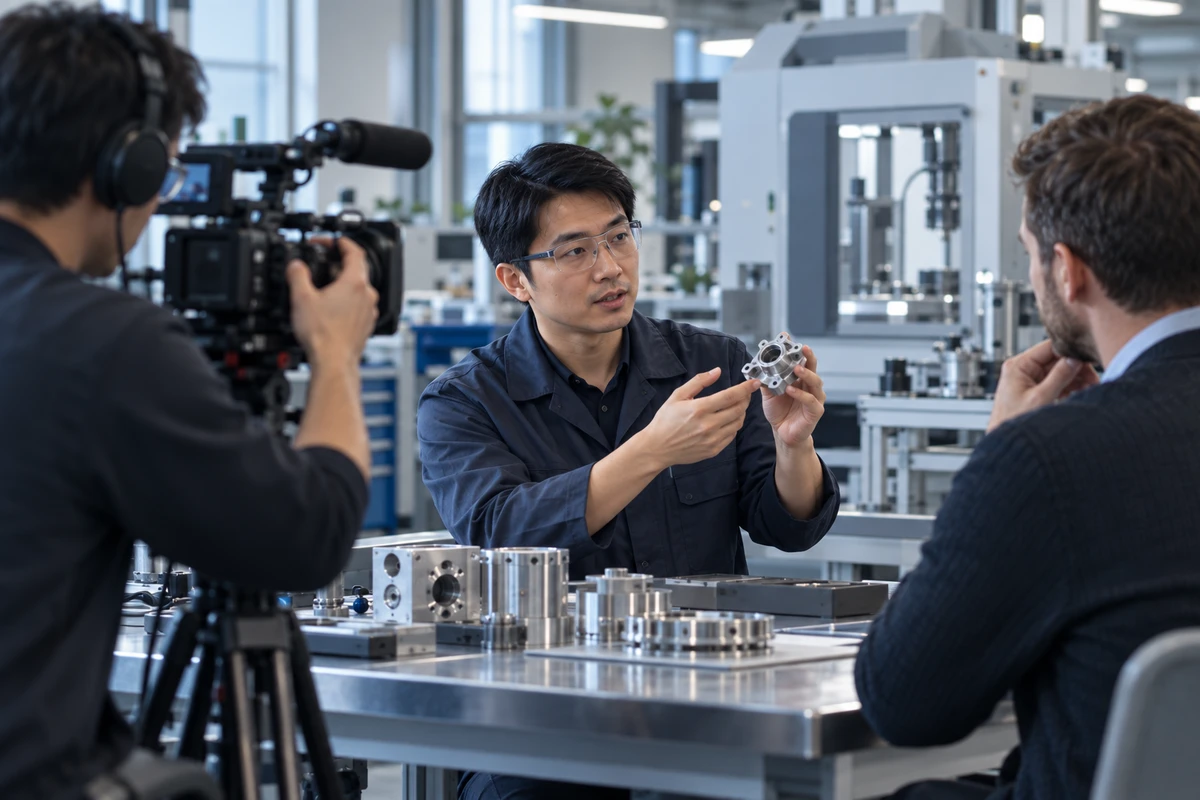
The hardest part of an R and D team interview video is rarely camera anxiety or the number of technical terms an engineer uses. The real tension is structural: marketing wants customers to understand the story, R and D wants the technology represented accurately, and the legal or intellectual-property team needs to decide what must never appear in a public frame.
If those decisions are left until editing, the film usually moves toward one of two extremes. It becomes a sequence of safe but empty claims about innovation, or it becomes specific enough to be useful while exposing a prototype label, a value on a screen, an internal failure mode, or a comparison that nobody approved.
A more dependable process starts with three connected production documents: a buyer-question card, a disclosure matrix, and an evidence shot list. The interview explains a judgment. The images show an approved process. The review record protects both the technical meaning and the confidentiality boundary.
Document one: the buyer-question card defines what the engineer must explain
An engineer does not need to imitate a marketer. Their most valuable contribution is explaining why a customer encounters a problem, what the team looks at before making a technical decision, and under what conditions that decision holds.
Do not begin the interview guide with “Please introduce our R and D capability.” For every question, identify five things first:
- who will watch: procurement, a customer engineer, a channel partner, an investor, or a candidate;
- what decision that person needs to make;
- the conclusion the interviewee is qualified to confirm;
- the conditions, scope, and exceptions attached to that conclusion;
- the image or approved document that lets the audience verify the explanation further.
Instead of asking, “What makes our algorithm superior?” ask, “Under which operating condition is a customer most likely to encounter the problem, what input does the team inspect first, and how does that observation change the next action?” This question naturally produces an object, an action, and a condition. If the answer remains abstract, the interviewer can ask what the engineer actually observes, who makes the decision, and how the result is checked.
The audience does not need a complete engineering education. It should be able to repeat three things accurately: the problem the product addresses, the basis for the team's judgment, and what still needs to be checked. The World Health Organization's plain-language guidance uses a similar communication principle: define the desired outcome and audience need, put important information first, and explain technical terms with simple language. That principle can guide a corporate interview, but it is not permission to remove necessary qualifications.
For example, a team trying to explain “closed-loop control” might structure the answer as “what change the system reads, what correction it makes, and what outcome the user can observe.” That is only a communication structure, not proof of any product's performance. The responsible technical owner must confirm the real input, action, result, and operating range.
Document two: the disclosure matrix decides what may be said, filmed, and retained
China's State Administration for Market Regulation issued the Provisions on the Protection of Trade Secrets, effective June 1, 2026. The provisions include structures, materials, samples, processes, methods, data, algorithms, programs, and code among the types of information that may qualify as technical information. They also explain that disclosure through publications, media, reports, or exhibitions can make information publicly known.
WIPO's trade-secret overview describes the same core logic at an international level: protected information is commercially valuable because it is secret, known only to a limited group, and subject to reasonable protection measures. The exact legal test varies by jurisdiction and facts, so a production checklist is not a substitute for legal advice.
“Many people inside the company already know” does not mean “safe to publish.” A failure explanation, an unreleased structural change, or a threshold visible on a laboratory display may look harmless in isolation while revealing the direction of development when combined.
Teams can begin with three working classifications, but the company's technical, IP, or legal owner must approve them:
- Approved for public use: information already present in current websites, published patents, released manuals, approved exhibition material, or formal announcements.
- Requires rewriting or controlled filming: the business meaning may be discussed, but raw data, customer names, prototype details, thresholds, or interfaces need substitution, masking, restricted framing, or an explanatory animation.
- Must not enter the media library: unreleased designs, source code, complete drawings, customer-confidential material, patent-sensitive improvements, and locations or records that the company restricts.
The matrix needs to cover more than forbidden words. Include shooting areas, monitors and whiteboards, fixture labels, sample versions, filenames, employee badges, customer property, storage location, download permissions, and deletion dates. Post-production blur can only protect risks the team has already noticed; it should not replace a controlled location and a cleared frame.
There is no universal red-yellow-green list for every company. Contractual duties, patent timing, internal policies, and cross-border disclosure rules differ. A production team can make the decision points visible, but the final approval must remain with the company-appointed owner.
Document three: the evidence shot list makes the image accountable
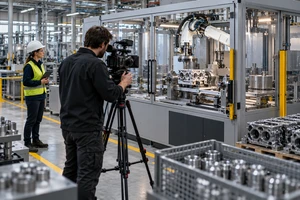
When the interview consists only of a medium shot, the editor has to manufacture momentum with music, subtitles, and generic laboratory footage. Useful B-roll is not an engineer walking down a corridor. It is an approved action tied to a specific statement.
Every evidence shot should identify:
- the claim it is meant to support;
- the object or action the audience can actually see;
- the conditions required before filming;
- the result that may be shown;
- the technical reviewer;
- what needs to be hidden or substituted;
- whether an unavailable shot should become a diagram, an animation, or a deleted claim.
Suppose an engineer says, “We identify anomalies before mass production.” The automatic visual response should not be a dramatic close-up of an instrument. The team needs to decide whether it can show a sample entering a test, the type of approved observation a person reads, and the way an anomaly is marked, or whether only the workflow may be shown while values remain hidden. The image may demonstrate that a step exists and has an owner. Without formal supporting material, it cannot prove a yield, accuracy, or performance improvement.
ONCE's corporate film production solution treats R and D, factory operations, teams, and delivery as observable material. Our recent article on an industrial equipment proof chain separates visible process evidence from specifications, certification, and performance claims. An R and D interview adds another task: aligning each person's statement with disclosure authority and supporting footage before the shoot.
The answer and the B-roll must not contradict one another. An interviewee may say that an outcome was observed with a particular sample under defined test conditions, while the edit implies a universal result across every product. A phrase such as “helps reduce” can also become “eliminates” in a subtitle. Technical review therefore needs to check the subject, causal verb, time range, sample range, and qualifying condition—not only spelling.
Do not script the whole interview: record the judgment, then capture a standalone conclusion
A full teleprompter script makes a technical expert concentrate on the next line. It can also make marketing's wording look like a claim personally endorsed by the engineer. A safer workflow begins with an audio-only or low-pressure pre-interview that establishes the logic and disclosure boundary.
During filming, let the interviewee answer in their own syntax. The interviewer follows up only on missing objects, actions, conditions, and results. After the complete answer is captured, record one conclusion that can stand alone in a short version, a chapter opening, or a sales follow-up. The short version must not remove essential qualifications or change “may,” “supports,” and “under certain conditions” into “will,” “guarantees,” and “in every environment.”
The production log should record more than “good take.” Link the take to the question number, approved conclusion, unverified fact, disclosure level, and planned B-roll. The editor can then compress pauses without deleting a necessary qualifier, and the technical reviewer can trace a sentence back to its original context.
The greatest bilingual risk is polished technical drift, not accent
An international version does not need to rewrite the engineer into a different personality. It needs product names, abbreviations, units, scope words, and causal relationships to stay consistent across speech, subtitles, voice-over, and images.
Create an R and D-approved bilingual glossary before filming. Include official product and component names, unit conventions, patent or standard names, terms that must not be substituted, and verbs that frequently change claim strength. During English review, check whether:
supporthas becomeguarantee;- “reduce risk” has become “eliminate risk”;
- “under test conditions” has disappeared;
- numbers, signs, units, and version numbers still match;
- “the test sample” has expanded into “all products.”
YouTube's official automatic-caption guidance warns that pronunciation, accents, dialects, and background noise may cause captions to misrepresent spoken content, and it tells creators to review and edit the result. Automatic transcription can accelerate logging, but it cannot own final terminology approval for a technical interview. The approved source meaning, translation, timecode, and final subtitle should remain a traceable set of files.
Acceptance needs a non-expert who can repeat it and an expert who can reject it
Use two review rounds. First, show the film to a marketing or sales colleague who does not know the project details. Without giving background material, ask that person to repeat the problem, the basis for the team's judgment, and the operating condition. If the only memory is “the company is innovative,” the film remains too vague. If the viewer repeats a false causal relationship, it has been simplified too far.
Second, let the responsible technical, IP, or legal reviewers inspect each statement together with its background image—not just a subtitle document. They need explicit authority to rewrite, qualify, replace, or delete a passage. The Chinese master, English version, horizontal cut, vertical cut, and short clips should then be checked against the same approved meaning.
An R and D interview does not replace a technical file, test report, contract, or customer due diligence. It also cannot prove sales impact by itself. What it can do is let a potential customer understand a real judgment earlier and know what person and document to consult next.
If you are preparing a corporate film, an R and D series, or international sales content, bring the questions customers repeatedly ask, existing public material, proposed interviewees, and the owner of disclosure approval to ONCE VISUAL. Decide what is worth saying and what can support it before choosing cameras, scripts, and versions.
Sources checked October 6, 2026. Legal and IP references support production and review planning only and do not constitute legal advice. Each company should confirm disclosure authority against its contracts, patent stage, target market, and internal policy.