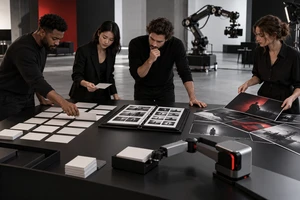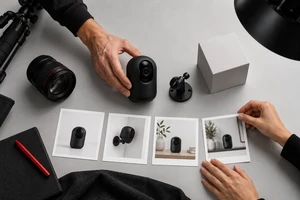
Imagine commissioning a three-minute corporate film. Once it goes live, the website team says the opening is too slow. Sales says prospects only want to see delivery capability, which does not appear until minute two. The trade-show team needs a silent loop. Distributor training needs installation, service and common questions divided into chapters. Every department is asking the same timeline for a different answer.
That does not necessarily mean the editor failed to make shorter cuts, or that the script was poorly written. The deeper conflict is that each setting asks the viewer to complete a different task. A website must help an unfamiliar visitor understand the business. A sales meeting must move a specific decision forward. A trade-show screen must earn attention in a noisy space. Training must be accurate and easy to revisit. A coherent brand film can build an impression, but it is not automatically all four tools.
The most important early procurement decision is therefore not whether a B2B corporate video should run for two or three minutes. It is whether the company is buying one finished film or a set of video assets organized around sales questions.
Separate the four viewing tasks first
A website video often meets someone who has little context. It should establish the business, the relevant capability and a credible reason to continue, then connect naturally to a product page, solution or inquiry. Google's current video SEO guidance distinguishes a dedicated watch page, where an individual video is the main content, from an ordinary page where video is supplementary. Stable thumbnails, accurate titles, descriptions and page context also affect how clearly a video can be discovered and understood. In other words, a website video must be designed with the page, not merely uploaded to it.
A sales-meeting video begins with an active question. A prospect may ask about capacity, deployment, compatibility, quality control or service. The salesperson needs relevant proof immediately, not a request that everyone watch the corporate story from the beginning. Independent modules, clear file names and useful pause points matter more here than one uninterrupted emotional arc.
A trade-show video has to work with movement, noise, silence and viewers entering at any point. It needs fast recognition, a clean loop and visible meaning that does not depend on complete narration. ONCE has addressed trade-show screens, silent viewing and sales explanation separately. The broader procurement question here is how the same shoot can also supply the website, sales and training without forcing them into the trade-show edit.
Distributor or internal training video prioritizes accuracy and updateability. Product configurations, service boundaries, interfaces and regional policies can change. Chapters, captions, screens and dates therefore need replaceable layers. An aggressively cinematic pace can become a liability if one specification change forces a complete re-edit.
The four uses may share the same factory, products and interview day. They should not automatically share the same opening, information density or call to action.
Build a sales-question map before the shot list
Corporate-film outlines often move from company introduction to history, team, products and vision. The structure is coherent, but it does not necessarily match the questions that appear in a live buying process.
A more useful starting point is to list the questions sales and channel teams regularly need to answer. For each question, define five things:
- who asks it, such as procurement, a technical evaluator, management or a distributor;
- who should answer it, such as an executive, engineer, operator or service lead;
- what the camera must prove, such as production workflow, real operation, inspection, interface behavior or a delivery milestone;
- where the answer will be used, such as the website, meeting, email, trade show or training portal;
- what change would make it obsolete, such as a specification update, policy change, interface revision or organizational change.
For example, "Can you deliver reliably?" should not receive only an executive promise. Depending on the business, the answer may need visible production stages, quality-control points, packaging, warehousing and project coordination. Conversely, company age may belong in the brand film without needing to appear in every sales module.
The map connects spoken claims to visible proof. Production knows which footage an interview answer requires, and sales knows which file to retrieve later.
Share source footage, not necessarily edit structure
Material that can often be shared across deliverables includes:
- establishing footage of facilities, offices, laboratories and service environments;
- product appearance, operation, inspection, packaging and delivery processes;
- team activity, work detail and clean location sound;
- interview answers recorded around one question, with usable handles before and after the statement;
- graphic and end-card foundations without prices, dates or channel information permanently embedded.
The following elements usually need scenario-specific design:
- Opening: a website can begin with business value, a trade-show loop needs a recognizable visual action, and a sales module should begin with the question already being discussed.
- Order of proof: a brand film may delay the reveal; a sales tool often needs evidence before background.
- Sound: a silent booth loop cannot depend on voice-over, while training may require detailed narration and operating cues.
- Composition: a website landscape frame, vertical feed, meeting display and custom LED canvas cannot all be solved by cropping.
- Call to action: a website sends viewers to an inquiry, a sales meeting moves to the next confirmation, and training may only need a clear chapter and accountable owner.
LinkedIn currently accepts a wide range of video-ad lengths, but its official video advertising specifications recommend 15-30 seconds to qualify for all possible placements across the LinkedIn Feed and Audience Network. That is not a universal corporate-video length rule. It does show why a professional-feed version needs its own entry point at capture and edit, rather than a random excerpt from the middle of a three-minute film.
Schedule the shoot by proof unit, not master-film order
If the project is meant to produce an asset kit, the call sheet must reflect that choice.
Interview subjects do not need to repeat company history, current services and future vision in one long answer. Record complete answers around sales questions, with clear beginnings and endings. Brand vision, technical explanation, operating instruction and service policy also deserve different performances; one sentence should not be forced to carry all four roles.
B-roll can be organized as proof units: how a process starts, how a product is operated, where inspection results appear, and how a handoff is completed. Each unit needs an establishing image, the critical action and a visible result so it can survive outside the master film. Where interfaces or specifications must remain synchronized, record the software version, sample state and capture date so future editors can judge whether the material is still valid.
Composition should be planned against the landscape master, vertical safe area and actual trade-show pixel canvas. If a shot cannot serve more than one, capture the necessary alternative on set instead of hiding the problem later with enlargement, repositioning or a blurred background.
Do not write only one master and several short cuts in the contract
"Several short versions" sounds flexible but creates ambiguity at acceptance. A clearer scope can define five deliverable classes:
- Brand master: one complete narrative for a core website page, brand introduction or important meeting;
- Sales-question modules: named after the approved questions, each understandable on its own and easy to join to live explanation;
- Silent trade-show loop: built for the actual screen and playback chain, with a clean loop and visible meaning without sound;
- Training chapters: divided by task or responsibility, with replaceable captions, interfaces and version dates;
- Asset map and clean masters: file names, contents, suitable channels, languages, aspect ratios, validity conditions and replacement triggers.
Acceptance should follow the job each deliverable must do, not only resolution and duration. Can the website version explain the business quickly? Can sales find a relevant module after a prospect asks a question? Does the trade-show version still make sense on mute? Can training locate an exact step? When information changes, can one layer be replaced without rebuilding every film?
If a production agreement promises only a number of finished files, the result may still be a folder of similar crops. A reusable asset kit must first be findable, understandable and explicit about when each item remains safe to use.
When one linear film is still the better answer
Not every project needs a content system. An anniversary film, major event opener, founder story, emotionally continuous brand short or internal film with one known playback setting may derive its value from the complete narrative. Breaking it into modules for the sake of version count can weaken rhythm and feeling.
The test is straightforward. If several teams want to play the same story in the same kind of setting, one master may be enough. If they need to answer different questions in different environments, the work should branch at the source-footage and call-sheet level.
When preparing a corporate-video brief, bring ONCE your key website pages, recurring sales questions, trade-show screen specifications, training audiences and the information likely to change during the next year. Through our corporate and B2B video production planning, we can define the sales-question map, proof units and five deliverable classes before deciding how long the master film should be. You can also review ONCE's video production approach and submit the project goal for a scoped production recommendation.
Sources reviewed: LinkedIn Help, Video ads advertising specifications, accessed October 3, 2026; Google Search Central, Video SEO best practices and Video structured data, accessed October 3, 2026. Platform requirements can change, so confirm the current rules for the target account and page environment before release. The procurement framework in this article is a production judgment, not a fixed package or performance guarantee for every company.