An automotive camera video can contain individually impressive shots and still fail the final review. The night road looks bright, license plates remain readable, and detection boxes appear stable, yet nobody can say whether the improvement came from the sensor, the lens, the ISP, or a visualization added later.
The answer is not another layer of polish. Before production, give every proof shot a three-layer contract. Layer one records the installation and capture conditions. Layer two separates raw or neutrally decoded sensor data from the ISP output. Layer three presents algorithm visualization on its own and states what that visualization does not prove. All three can live in one film, but they should never share an ambiguous label such as “direct camera output.”
Work backward from the delivered shot
The automotive imaging chain is long. Light passes through the lens to the sensor. Raw data then enters an image signal processor for operations that may include demosaicing, noise reduction, HDR, and color processing before the result reaches detection, segmentation, stitching, or sensor-fusion modules. onsemi describes this sequence in its official ISP overview. A buyer-facing video does not need to teach the entire engineering stack, but each comparison shot should support only one conclusion.
| Layer | Display and labeling rule |
|---|---|
| Installation and optics | Show where the camera is mounted and where it points. Record the prototype, lens, mounting height, optical axis, visible occlusion, and calibration state. A beauty shot cannot replace the real installation relationship. |
| Sensor and ISP | For a same-route comparison, lock the lens, firmware, exposure strategy, speed, and recording path. If raw data needs a neutral decode to become viewable, label it “neutrally decoded raw data” instead of calling it raw direct output. |
| Algorithm visualization | Identify the algorithm version, input source, synchronization method, and whether boxes, paths, segmentation, or a bird's-eye view are live, replayed, or reconstructed. The overlay can explain what the system perceived. It does not automatically prove what the vehicle did. |
This contract gives the director, product manager, and algorithm team the same vocabulary. When a product manager says that the film must prove night detection, the director can ask a useful follow-up: are we proving low-light image quality first, or the detector output? Those claims usually require two independently verifiable assets, not one split-screen packed with labels.
Installation is evidence, not behind-the-scenes detail
Field of view, distortion, occlusion, and the useful detection area all depend on camera position and orientation. NVIDIA's DRIVE OS calibration overview describes camera intrinsics as the geometric relationship between pixels and optical rays, while extrinsics describe the sensor's position and orientation in the vehicle rig. Mapping image observations into vehicle coordinates depends on those relationships being calibrated correctly.
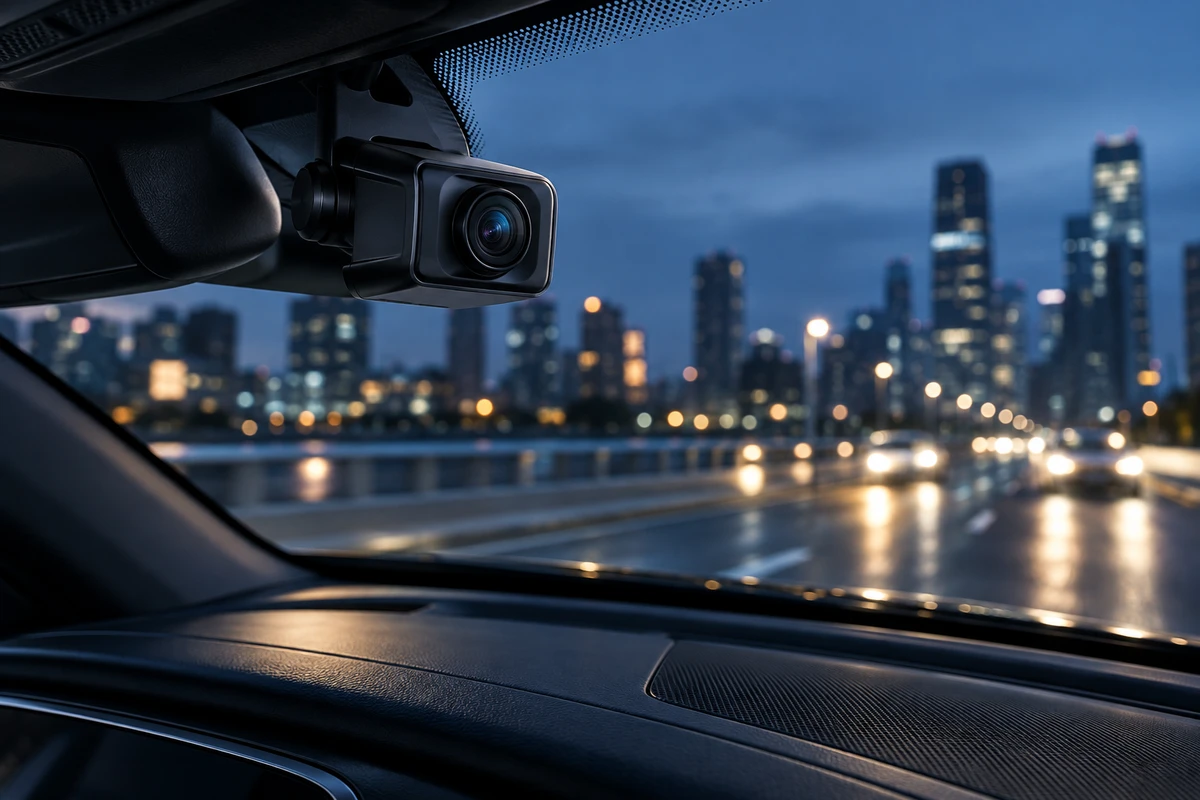
For a product film, that means a road clip without installation context cannot independently establish which vehicle position or system configuration it represents. The opening does not have to show only a camera floating against a black background. A short relationship sequence is more useful: is the camera behind the windshield, in the grille, at the rear, or on the side; how is its optical axis oriented relative to the road and body; do the wiper, interior trim, or body structure enter the useful image area?
If a test bracket or non-production mounting position is used, label it as a test installation. Do not let viewers infer that it is the final packaging. Consumer dash-camera documentation also treats installation adjustment and ADAS calibration as separate steps. That example is not a substitute for an automotive-grade calibration specification, but it demonstrates the same communication principle: when performance depends on mounting, the installation and calibration state cannot disappear in the edit.
If the project also needs product beauty shots and a clear use relationship, see ONCE's article on showing product features clearly in ecommerce video. The product category is different, but the division of labor remains useful: close-ups explain what the product is, while relationship shots explain why it is there.
A night comparison needs comparable conditions
A montage of one road by day and another road at night can create atmosphere, but it cannot compare imaging performance. To show field of view, low-light response, HDR, or LED flicker mitigation, keep spatial anchors that viewers can recognize: a curb, road sign, tunnel entrance, opposing headlights, or a pedestrian and vehicle near the frame edge.
A wider field of view does not automatically mean the camera sees farther. A brighter night image does not automatically contain more usable detail. The film should let viewers assess edge coverage, motion smear, noise, highlights, and shadows together.
Sony Semiconductor Solutions uses tunnel entrances and exits as examples of the high-contrast conditions addressed by automotive HDR. Its official explanation of LED flicker mitigation notes that LED light sources switch rapidly: a short exposure may miss the illuminated state, while a longer exposure can introduce saturation. These official examples do not validate a particular prototype. They show why different claims need different test scenes and exposure conditions instead of one generic “enhanced night vision” title.
For a reviewable same-route comparison, record the following:
- vehicle speed, route, time window, weather, and road lighting;
- prototype ID, sensor, lens, firmware, and ISP configuration;
- automatic or manual exposure strategy, frame rate, gain, and recording format;
- the on or off state of stabilization, noise reduction, HDR, and distortion correction;
- when A/B footage cannot be captured during the same run, which lighting and traffic differences must not be presented as product differences.
The main film does not need to fill the screen with parameters. It can retain the essential conditions such as same route, same camera position, and same speed, while the complete capture record is delivered to sales, media, or technical reviewers. Without that record, the cleaner the short film becomes, the harder it is to answer a serious follow-up question.
Detection boxes show perception, not vehicle action
Algorithm visualization can make an abstract capability legible. ZF's Visual software page, for example, describes real-time and playback views of sensor, reference, and ADAS or automated-driving system data for analysis and assessment. In a marketing film, however, boxes, paths, and segmentation colors may also come from offline processing, postproduction redraws, or timelines that use different clocks. Unless their origin is disclosed, viewers cannot know whether they are product output, an engineering tool, or a communication device.
The safer approach is to make the algorithm layer a distinct group of visualization shots and answer four questions in the script and delivery sheet: which video stream is the input; which algorithm version is running; is the visualization live, replayed, or reconstructed; and does the output actually enter the vehicle-control chain?
If the available evidence stops at perception, the copy should stop at “detected a pedestrian, lane, or vehicle.” It should not jump to “the vehicle automatically avoided the hazard” or “the system guarantees safety.” Those statements require a complete system definition, operating conditions, and approved functional evidence.
A bird's-eye view follows the same rule. Corrected and stitched multi-camera footage can explain surround coverage, but it does not prove that obstacle detection, ranging, or automated parking is active. Separating the layers makes the real capability more credible.
AIGC can build atmosphere, not a performance sample
AIGC can support moodboards, storyboard previews, abstract light-path explanations, and conceptual transitions that are difficult to shoot. It can help a team decide whether a journey through a rainy city at night deserves production. It should not generate the raw sample, ISP comparison, detection stability, or extreme-condition performance evidence. Once a shot carries a product claim, it must return to the locked prototype, recording path, and algorithm output.
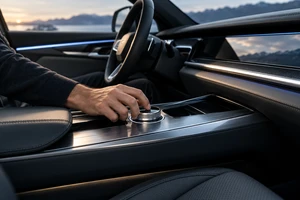
CGI can accurately explain lens construction, optical paths, processors, and mounting locations. It should not be edited to look like road-test footage. The same source discipline applies to cockpit content. ONCE's guide to synchronizing hands, interface responses, and vehicle states explains why separate timelines must be planned rather than made to look synchronized afterward. An automotive camera project should add sensor and algorithm timelines to that same production discipline.
Lock five versions before the shoot
The most expensive correction is rarely a subtitle. It is a prototype, firmware, or algorithm change after capture that removes the common baseline from every comparison. Before production, product, algorithm, creative, and compliance owners should approve five version groups:
- Prototype and installation: unit ID, production or engineering state, bracket, position, occlusion, and calibration record.
- Optics: sensor, lens, filter, target field of view, and acceptable distortion.
- Imaging: firmware, ISP configuration, exposure and HDR strategy, and recording format.
- Algorithm: model or software version, input resolution, runtime hardware, output fields, and visualization method.
- Communication: approved feature name, operating conditions, prohibited wording, subtitle language, and channel crops.
Final review should follow the same three layers. First verify the installation and capture conditions. Then verify the source of the raw or ISP image. Finally verify the algorithm visualization and copy boundary. Only after all three pass should the film move into final color, sound, and localized versions.
The night road can still look cinematic, but atmosphere will not replace evidence. Detection graphics can still have impact, but they will not overstate the product's actual capability.
If you are preparing launch content for an automotive camera, smart cockpit, or ADAS-related product, share the target vehicle, installation drawing, prototype and firmware versions, three capabilities the film must prove, and the algorithm outputs that may be shown publicly with ONCE. We will define the three-layer shot contract and same-route comparison conditions first, then decide which shots should be captured, explained with CGI, or limited to concept previs.