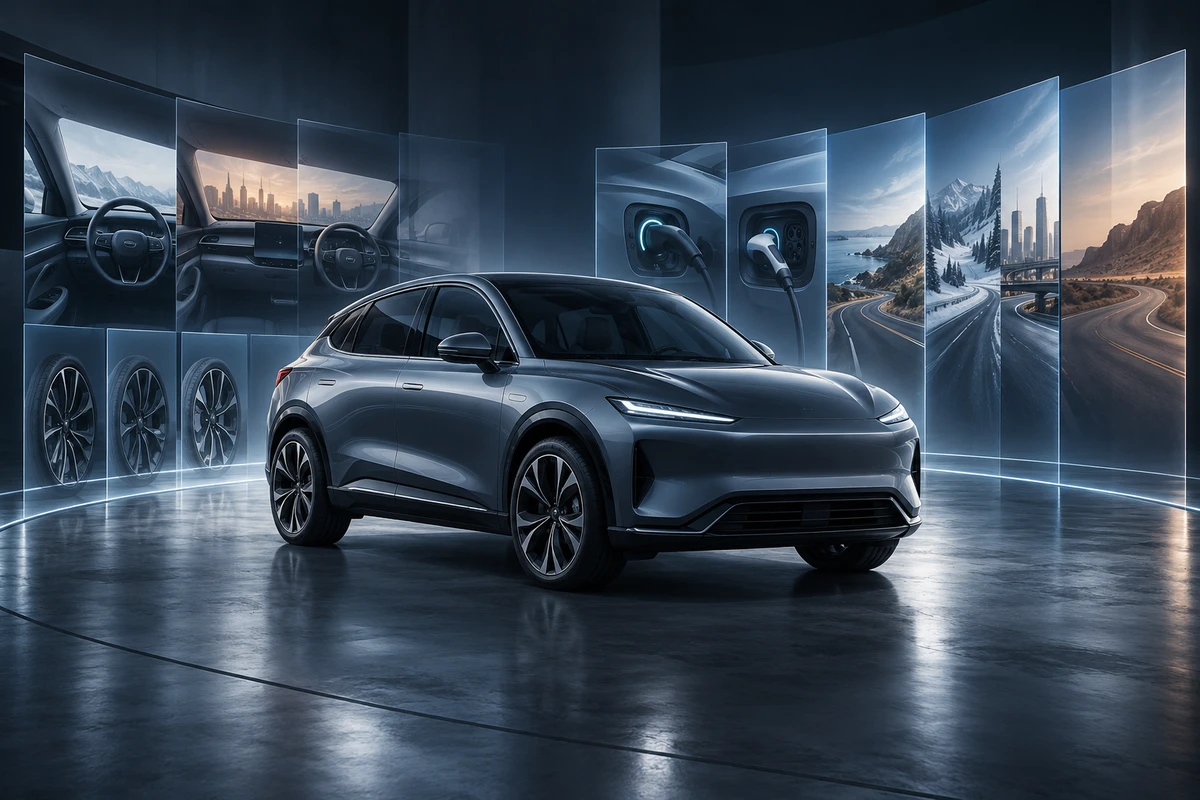
A launch is six weeks away. The team has one top-trim show car built for China, but Germany, Thailand, and the Middle East all need a hero film, event-screen content, dealer cutdowns, and test-drive ads. The common mistake is to treat “the same model” as “the same footage with new subtitles.”
That is rarely true. The first decision should not be how many edits to order. It should be which shots represent the vehicle’s shared design, which remain valid only under specific trim conditions, and which must be produced for a particular market. With those layers defined, one show car can become a useful asset instead of the source of a late-stage dispute.
A beautiful shot can still show the wrong car
Trims may share the same body shape while differing in wheels, lamps, sensors, upholstery, speakers, badges, and charging-port details. The cockpit is even more sensitive: steering position, instrument themes, interface language, maps, feature menus, and software builds can all determine whether a shot is usable.
Public automotive data structures make the same distinction. Google’s vehicle-listing specification records VIN, make, model, trim, color, options, drivetrain, and battery information as separate fields. The US National Highway Traffic Safety Administration also starts a vehicle lookup with a specific VIN and notes that the displayed information is reported by the manufacturer. A film production does not need to copy those schemas, but it needs the same discipline: identify exactly which vehicle, trim, and operating state appears in every shot.
Give the show car an identity card before the shot list
The card can be short, but “SUV, top trim” is not enough. Record at least:
- show-car ID or VIN, model year, trim, powertrain, and battery version;
- paint, interior, wheels, lamps, sensors, and option packages;
- left- or right-hand drive, charge-port location, plates, and market identifiers;
- software build, interface language, maps, and connectivity state;
- enabled functions versus engineering-sample limitations; and
- approved markets, channels, release dates, and required disclosures.
A VIN can help verify the physical vehicle, but it does not replace the brand’s configuration sheet, software log, or approved reference images. A practical footage record should carry the show-car ID, shoot date, software version, and permitted markets. Editors should not have to reconstruct those facts from memory.
Use three asset layers, not one global master
Layer one: reusable vehicle-core footage
This layer establishes design identity. It can include overall proportions, signature lighting, approved exterior details, neutral driving footage, studio beauty shots, and text-free CGI, provided those elements are identical across target trims.
Keep clean picture, split audio, and text-free versions. Launch captions, prices, offers, and booking buttons should never be burned into the only master.
Layer two: conditionally reusable footage
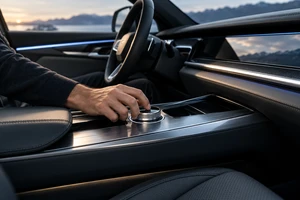
Charging, parking assistance, luggage space, seat controls, infotainment, and phone integration belong here. They look like generic feature demonstrations, but validity depends on hardware, software, account permissions, and local services.
Replacing a screen in post does not automatically make the hand interaction valid. A charging-gun close-up may be reusable while the port location, connector, and on-screen charging animation are not. The shot list needs a “reusable when” condition, not just the label “feature shot.”
Layer three: market-specific footage
Steering position, local roads, charging infrastructure, license plates, interface language, maps, regulatory copy, pricing, finance offers, dealer information, and calls to action usually belong in the market-specific layer. Local buyers notice these details immediately. One obvious mismatch can make the whole film feel translated rather than made for them.
Technical claims travel with their test conditions
“Longer range,” “faster charging,” and “safer” cannot move between versions as free-floating voice-over lines. Each technical claim should be tied to four things: the relevant configuration, a visible action, the test or use conditions, and approved wording.
The US EPA’s EV range-testing explanation shows that the combined label value follows defined laboratory tests, adjustments, and city/highway weighting. European-market claims use procedures including WLTP. The production lesson is not that a director should interpret regulation. It is that a number approved for one configuration and market should not be placed over another car or measurement framework. Shoot a clean plate and add the number only after local approval.
Feature demonstrations need the same restraint. For automated parking, driver assistance, vehicle-to-load, fast charging, or cockpit automation, record the vehicle state, trigger steps, and what the camera actually proves. If the shot only shows activation, the narration should not promise the full outcome.
One location, two locations, or a CGI-AIGC hybrid
When body and cockpit specifications are shared and the differences are mainly language, voice-over, and CTA, a centralized shoot is usually efficient. Capture clean masters, replaceable screens, horizontal and vertical protection, and versions without talent.
When steering position, charging infrastructure, road rules, landscapes, or actual use differ materially, centralize product-detail work at one production base and add driving, talent, and environmental footage in the target market. Two-location production costs more to coordinate, but it avoids faking local relevance with visibly wrong details.
CGI and AIGC can support pre-launch visualization, controlled exterior hero shots, seasonal or city extensions, and transitions that would be difficult to capture. They should not be asked to infer the opposite-side charge port, a specific wheel design, or the cockpit from one reference image. ONCE has discussed this in its Chinese guide to automotive reference images and model-consistency review. Accurate feature triggers, human-vehicle contact, and trim-identifying details are still better handled through live action or engineering-verified CGI.
Deliverables should keep growing by market
A scalable package contains more than one 16:9 final film. It should include a clean master, replaceable interface plates, voice and music stems, subtitle files, horizontal and vertical safe framing, an approved-copy sheet, and a shot register carrying vehicle identity.
YouTube’s multi-language features can attach additional audio tracks to one video and support localized thumbnails for long-form content; translated titles and descriptions can also be published separately. This makes language layers easier to manage, but only when the vehicle shown is valid for every language market. Localization tools cannot repair the wrong steering wheel, connector, or trim.
Eight questions to answer before production
- Which exact trim and show-car state will appear?
- Which markets change the hardware, steering position, connector, or interface?
- Which technical figures have been approved market by market?
- Which shots can become text-free, market-neutral vehicle-core assets?
- Which feature shots are valid only for a named software build?
- Which local roads, people, and charging scenes require a local shoot?
- Which identity details must CGI or AIGC preserve?
- Who approves the permitted markets for each shot?
When these questions are answered before the estimate, the budget shifts from “more cutdowns” to building durable launch assets. If you are planning a multi-market launch for an EV, automotive component, or cockpit product, send the configuration matrix, target markets, and first-wave channels to ONCE VISUAL. We will separate reusable, conditional, and market-specific shots before recommending live action, CGI-AIGC, and version deliverables.