The costliest mistake in new energy product video production is often not a missing shot. It is choosing the location that looks most advanced and asking it to prove everything about the product.
A spotless laboratory can signal control, but it cannot stand in for deployment. A busy charging site can show real use, but it cannot reveal manufacturing discipline. A factory can show how equipment is assembled, but it cannot prove how the product behaves with a vehicle, a network and a user in the field. These are not three visual styles. They answer three different buyer questions.
Why one location cannot carry every claim
The value of new energy equipment usually spans three layers: how the product is made, the conditions under which a performance statement is valid, and the way the deployed system interacts with power, connectivity, vehicles and people. When every scene is forced into one location to save a move, the production loses conditions before it loses polish.
For example, inserting a connector into a demo unit and showing an indicator light proves only that a demonstration occurred. It does not automatically prove rated power, long-term reliability, cross-vehicle compatibility or certification. In the opposite direction, a laboratory sequence cannot replace the practical realities of parking circulation, cable reach, weather protection, lighting and user access.
The US Department of Energy's Alternative Fuels Data Center infrastructure guide lists proximity to electricity, wireless connectivity, weather, future expansion, permits, inspections, signage and security among site-selection and procurement considerations. The useful production lesson is that the field site is part of the product story. The checklist itself is US guidance, not a universal approval standard.
Factory: show how a deliverable unit is made
The factory sequence is best used for incoming parts, assembly, critical processes, in-process checks, traceability information and preparation for shipment. The aim is not to make the building look large. It is to let the viewer see how a product fact moves through people, tooling and records to become a deliverable unit.
Avoid the “walk-through montage”: machines move, lamps flash and employees cross frame, but no shot explains what the process changes. Before filming, ask the manufacturing owner to complete one sentence for each process shot: what enters, what action happens, and what state exits. This keeps the sequence factual without exposing information the company cannot publish.
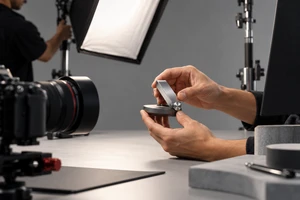
Laboratory: show the condition around performance
A laboratory should not be treated as a cleaner background for a hero shot. Its value is the condition. The instrument, sample version, environmental setting, test action and result reading should connect. Confidential data can remain off camera, but a vague gauge and fast edit should never imply that a certification has been passed.
For charging equipment, communication is also part of performance. The Open Charge Alliance describes OCPP as a standardised communication method between charge points and central systems. ISO 15118-20:2022 specifies messages and sequences between an electric vehicle and electric vehicle supply equipment. In a video, this means a single “success” icon is weak evidence. A clearer sequence shows the vehicle or simulator connecting, equipment recognition, a backend state change, charging or stopping, and an engineer confirming which software version and test condition the demonstration represents.
Laboratory footage may document a test process; it does not replace a test report. Script and captions must distinguish among “testing is in progress,” “the sample completed this demonstration under stated conditions,” and “the product holds this certification.” Those are three different claims.
Field site: show what the product works with
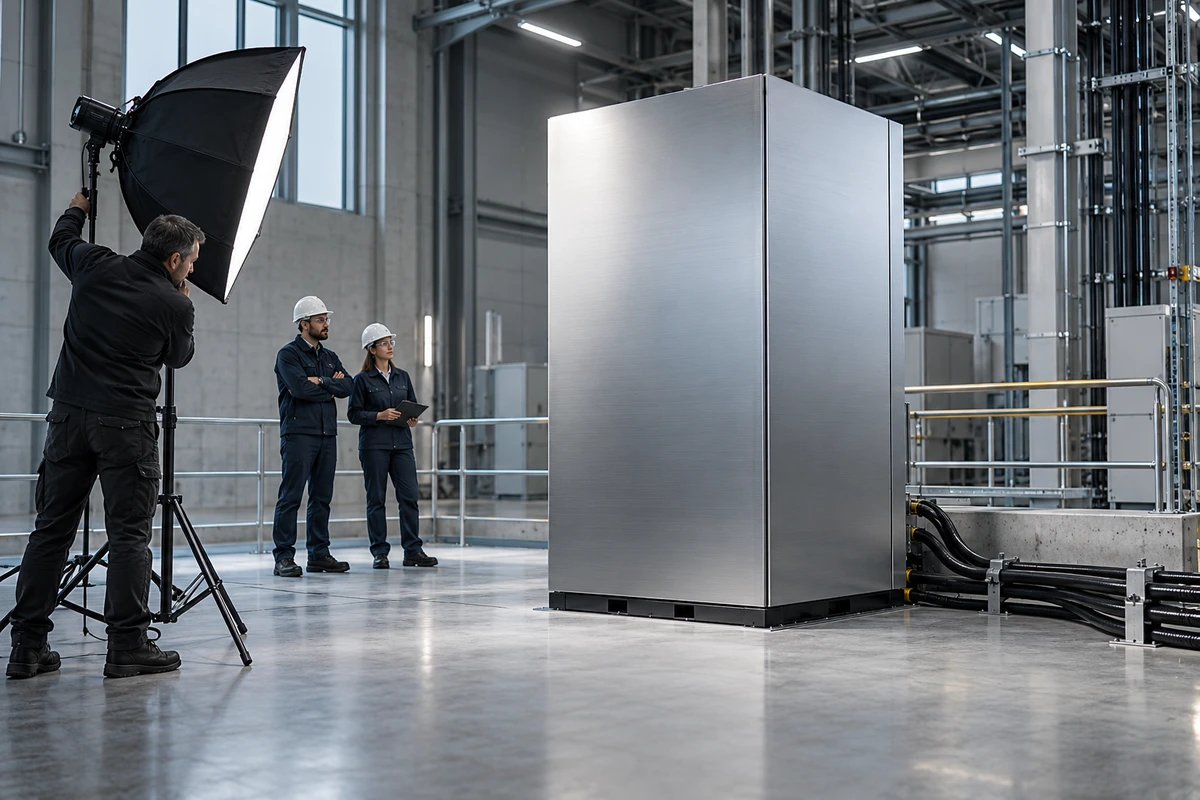
At a deployed site, the most valuable images are often around the equipment rather than on its front panel: vehicle approach, bay geometry, connector reach, lighting, obstruction, weather exposure, the user's path from parking to completion, and coordination with a network or site operator.
During the scout, walk one real route: arrival, parking, identification, connection, confirmation, charging, completion and departure. At every step ask two questions. What must the viewer see to avoid a false assumption? What permission and safety condition must the crew have to get close? The resulting shot list is more useful than simply requesting a wide, medium and close-up of every action.
ONCE's recent article on showing four operating states in a BESS video focuses on making equipment state visible. The location method here addresses where, and under which conditions, those states should be filmed. The two methods can work together, but a visually attractive site cannot substitute for all three kinds of evidence.
Put the safety brief before the shot list
New energy shoots may involve energised samples, storage units, moving vehicles, test instruments, construction zones or an operating site. A production crew cannot decide that equipment “looks off” and is therefore safe to approach. It should never remove a guard, shift a barrier or ask an unqualified person to operate equipment for a better shot.
In the United States, OSHA 1910.333 requires safety-related work practices around equipment that is or may be energised. De-energised equipment that has not been locked or tagged according to procedure is treated as energised, and only qualified people may work on equipment that remains live. The rule applies to relevant US workplaces; the broader production principle is to follow the site's EHS system and let the equipment owner decide the energy state, authorised operators and access zones.
A new energy production brief should therefore add six fields: equipment state, energy-isolation method, authorised operator, crew exclusion distance, vehicle or equipment movement window, and stop-work command. If filming temporarily changes the normal operating process, the site owner should approve the restoration procedure before the cameras roll.
Safety conditions also change cinematography. When the crew cannot approach, use a long lens, locked camera or safely pre-positioned compact camera. If internal high-voltage parts cannot be shown live, film a controlled de-energised structure sample and clearly identify it as an explanation. CGI or generative imagery can explain invisible energy flow and communication, but it should not masquerade as test footage. C2PA's 2026 Content Credentials implementation guidance provides one current framework for recording whether an asset was generated, captured or edited with AI.
If the budget allows only one location
Choose the location that answers the hardest-to-replace question. If the product is still a prototype and buyers need to understand technical limits, prioritise the laboratory. If procurement teams need confidence in manufacturing and delivery consistency, prioritise the factory. If the product is deployed and buyers are most concerned about installation, connection and user flow, prioritise the field site.
A practical alternative is to place the main production day at the least replaceable location and collect lightweight evidence from the other two. The factory can supply authorised process inserts; the lab can provide condition-labelled test records; the field site can use half a day to capture the real operating path and environmental relationships. The goal is not to give all three locations equal screen time. It is to stop any location from answering a question it is not qualified to answer.
In the quotation and pre-production meeting, add four fields after every planned shot: location, buyer question, validity condition and approver. If one field is empty, the shot is not yet an acceptably defined production task.
ONCE VISUAL plans product videos across factories, laboratories and deployed sites. If you are comparing locations and budget, review our video production solutions and contact ONCE VISUAL with the product stage, target market, available locations and the three facts the video must establish. We can then define a new energy and automotive product-video approach around the evidence that matters.
Sources checked: US Department of Energy Alternative Fuels Data Center, “Procurement and Installation for Electric Vehicle Charging Infrastructure”; UL Solutions, “You've Got the Power — An Essential Guide to EV Charging”; Open Charge Alliance, “OCPP protocols”; ISO 15118-20:2022; US OSHA 1910.333. International standards and US regulations are cited to clarify differences in site, communication and safety conditions. Each production must follow the target market's rules and the site's own EHS procedures.