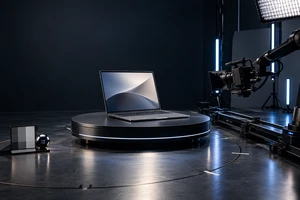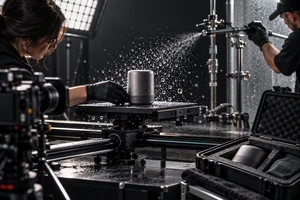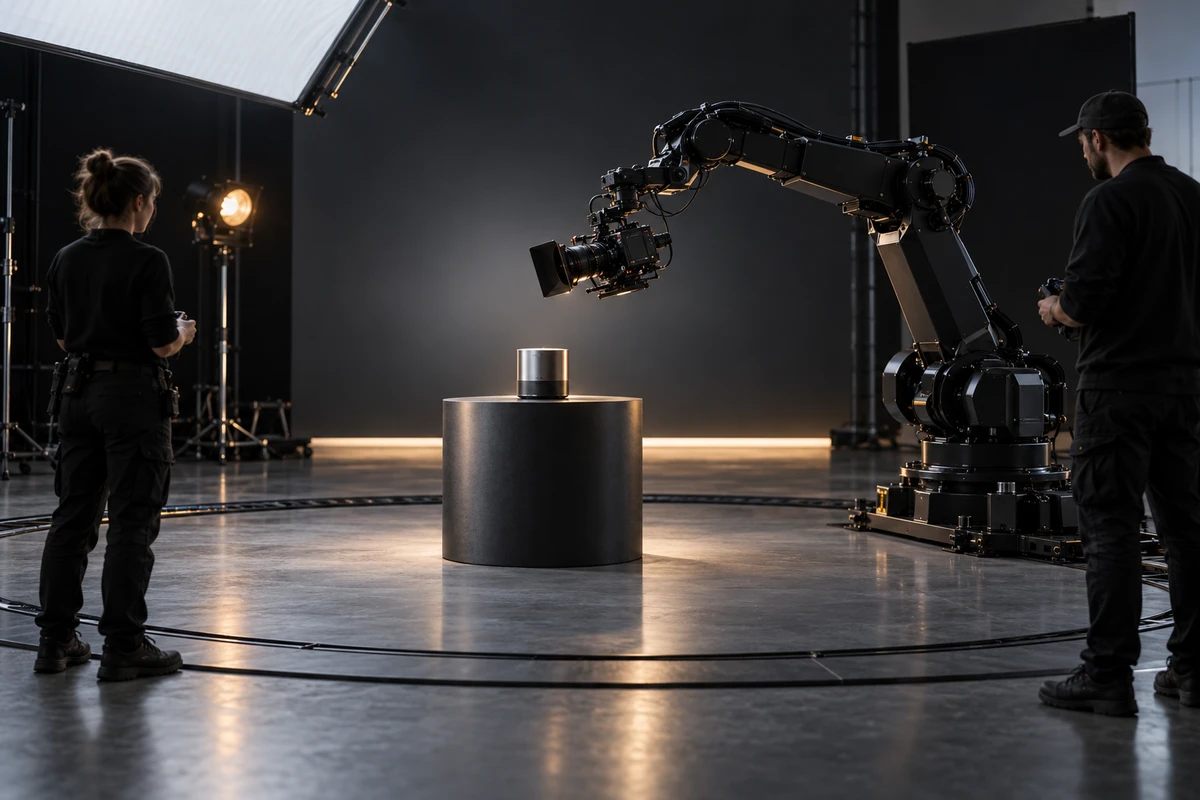
Imagine a brand sharing a six-second reference shot. The camera dives from above the product, skims a metal edge, stops exactly as a button lights up, and then reveals a ring of light crossing the body in slow motion. The brief says only: “We want that sense of speed.”
The first missing item is usually not an equipment day rate. It is the information needed to decide whether the shot can be executed at all. How large is the product? How reflective is its surface? What does the complete camera package weigh? What frame rate will be used? Where must the move start and finish? Does a performer or turntable move at the same time? Until those inputs are known, a robot's speed specification is only an impressive number.
Before booking a camera robot studio, the brand should prepare a path previs package. It does not have to be an expensive finished animation. It needs to let the director, motion-control operator, cinematographer, lighting team, and post-production team judge the same movement: why it must move this way, whether the space can contain it, how many times it must repeat, and what counts as complete.
First ask why an ordinary camera mover cannot deliver the shot
The real purchase is not “premium production value.” It is the ability to repeat a complex move. Current product information for the MRMC Bolt X describes repeatable motion, target tracking, lens control, and external equipment triggering as core capabilities. The Milo workflow can also previsualize a move, transfer it to the rig for execution, and export the camera motion for post-production. Those capabilities matter only when the final image actually depends on them.
Three types of task are more likely to justify a cinema robot:
- Multiple passes must land on the same path. The production may record the product, a moving light, and a clean plate separately, then combine those passes. It may also repeat a performance and composite several versions of the talent into one frame.
- A high-speed move must stop on an exact frame. The camera can travel quickly, but the final composition still needs to land on a logo, connector, or material detail with deliberate focus.
- The camera must synchronize with other motion. A turntable, model mover, opening mechanism, performer, or lighting cue may need to hit the same timing on every take.
If the requirement is a smooth straight push, a slow parallax move, or a camera that must react freely to a performer, a motorized slider, jib, gimbal, or handheld operator may be more natural. They can also leave more time for performance and lighting. Our article on choosing camera movement for a product video offers a broader comparison.
The path previs package should answer eight questions
An executable path is more than a reference clip. Before requesting a quote or entering technical preparation, place these eight inputs on one shot card:
- Opening and closing frames. Use two sketches or frame grabs to show where the shot begins and the exact image on which it must finish.
- Physical product information. Provide dimensions, weight, fragile areas, moving components, power requirements, and whether a non-hero sample is available for testing.
- Complete camera payload. Count the body, lens, focus motors, battery, wireless video, and mounting hardware as one camera package. Camera body weight alone is not enough.
- Lens and minimum focus distance. A wide lens can amplify speed, but it can also reveal the robot, track, ceiling, or lighting. Macro work makes focus errors more visible.
- Move duration and speed curve. Specify whether the camera travels at a constant speed, accelerates, or stops when the product action occurs. “Make it faster” is not a usable curve.
- Capture frame rate and playback speed. High-speed capture changes exposure, action timing, and the amount of lighting testing required.
- Synchronized events. Identify every turntable, spray, liquid action, mechanism, performance, lighting cue, or model move, who triggers it, and how the setup resets after a failed take.
- Delivery aspect ratios. Decide whether landscape, vertical, and square versions can share the move, or whether the subject exits the vertical safe area during a fast pass.
These inputs do not freeze the creative. The curve can still be refined during programming. They turn “make it look like this” into conditions the production can test, so the team is not using paid studio time to discover basic spatial constraints.
Previs must solve the room, not merely sell an animation
MRMC's public case studies show what previs is for in practice. In one project, a move was built in a 3D environment before being transferred to the motion-control system. In another, previs helped the crew evaluate focal distance, path limits, visible track, and reflections in a very tight location. A Burberry clone project depended on more than twenty repeatable passes that could later be layered together.
For a product shoot, previs should result in at least a floor plan and a low-speed rehearsal. Mark the robot base or track, product table, background, key lighting positions, operator zone, and exclusion zone. A low-speed run should confirm that the camera does not cross the product, strike the set, or reveal equipment that should remain hidden. KUKA's official material on robot planning and simulation similarly places reachability testing, risk identification, and a safety concept before operation. A cinema robot serves a different industry, but the planning principle is useful: validate the space before increasing speed.
Reflective metal, glass, and glossy plastic add another path to plan—the path of the reflection. As the lens rises, the product may reveal the floor, operator, negative fill, or ceiling. A route that is collision-free can still be unusable on camera. The team may need to move a light or flag with the camera, or preserve a separate clean plate for post-production.
Lighting and safety cannot be added after the path is locked
The faster the robot travels and the closer it comes to a product or performer, the less room there is to treat lighting and safety as final adjustments. The crew must define emergency-stop authority, communication commands, exclusion zones, cable routes, and who clears the set before every high-speed run. Passing a low-speed rehearsal does not mean a performer can stand in the same place at full speed. The equipment provider's safety rules and the responsible on-set operator remain decisive.
Lighting should be tested at the intended frame rate as well. The brand does not need to select fixtures, but the brief should state the target frame rate, product material, and desired lighting behavior. The lighting team can then record a test at the intended frame rate, shutter, and dimming level, leaving time to adjust output or replace a fixture if required.
If the project also needs a specific lens package, high-speed camera, or lighting kit, review the Shenzhen camera and lighting rental reference alongside the shot plan. The goal is not to maximize the equipment list. It is to ensure that every item supports the same path.
Compare quotes by shot task, not by the robot day rate alone
The cost of a motion-control setup is not confined to the hours when the camera is recording. To compare proposals fairly, ask whether each quote includes:
- previs, path programming, and a defined number of reprogramming rounds;
- the robot, track, turntable, model mover, and operator team;
- camera, lens, focus, and high-speed capture requirements;
- load-in, setup, low-speed rehearsal, safety checks, and strike time;
- the planned hero passes, clean plates, lighting passes, and reset procedure;
- path data, lens metadata, or post-production references when needed;
- the boundary between included path refinement and a new scope after the product, set, or creative changes.
A film rarely needs every shot to use the camera robot. A more disciplined plan reserves it for the two or three hero shots that genuinely depend on repeatability, synchronization, or extreme speed. Sliders, turntables, macro setups, and gimbals can handle the remaining information shots. This keeps the robot's unique visual contribution without making the entire production wait on one system.
Completion is not simply seeing the robot move
A camera robot shot is ready for principal photography when five conditions are met: the opening and closing frames are approved; the low-speed path is collision-free; product, performer, and lighting synchronization is confirmed; exposure and flicker tests pass at the target frame rate; and every required pass, reset procedure, and post-production purpose has an identifier.
Return to the six-second reference clip. What deserves to be reproduced is not merely its speed. It is the way the lens, product, light, and timing have been organized into a move that can be executed again. The robot is the performer; the path previs package is where the shot becomes producible.
If you are evaluating camera-robot hero shots for consumer electronics, smart hardware, appliances, or automotive accessories, send the product dimensions, reference clip, target formats, and launch date through U-STUDIO Shenzhen. The team can first assess the studio space, motion path, and equipment combination, then help you check a suitable viewing or production date.