The most expensive mistake in TikTok Shop LIVE production may happen before the camera rolls: coupons, flash sales, giveaways, and countdowns are stacked together before the team knows what is blocking the purchase. GMV can look impressive while the brand loses both margin and a clear explanation of why people bought.
A September 2026 TikTok Shop U.S. brand-LIVE playbook makes a useful distinction. Build interest and confidence through demonstration first, then choose a mechanism for the actual barrier—price, urgency, basket value, shipping cost, or trust. If a non-price tool can solve the problem, discounting first leaves margin on the table.
That changes the production brief. A TikTok Shop LIVE scope should not be only a host, a studio, and a number of broadcast hours. Product proof, promotional mechanics, permissions, traffic, and stop-loss rules belong in the same operating plan.
What the latest platform signals do—and do not—prove
In its October 2026 U.S. holiday update, TikTok said Shop sales exceeded $500 million during the four-day 2025 Black Friday and Cyber Monday weekend. Sellers hosting livestreams saw 84% year-over-year sales growth across more than 760,000 sessions and 1.6 billion views. TikTok also said U.S. LIVE Shopping sales more than doubled year over year in the first half of 2026.
Those figures show that TikTok is investing in LIVE as a shopping surface. They are platform-level figures, not proof that a particular brand will produce positive contribution margin after seller-funded discounts, returns, fulfillment, affiliate commission, media, and production costs.
The operating rules are more actionable. TikTok Shop Academy’s September 2026 quality requirements call for dynamic, face-visible, real-time interaction and product demonstrations from multiple angles. The visible background and staging must match the products actually being sold. Still or animated content covering more than half the screen, product-detail-page screenshots, and AI-generated or prerecorded audio used in place of real-time interaction may be non-compliant.
Why promotional mechanics belong inside production
Each mechanic changes what the host must prove
If trust is the barrier, the host may need to unbox, compare, assemble, clean, test, or answer objections live. If choice complexity is the problem, the frame must hold the relevant bundle and make differences visible. Only when price is the real objection should the offer become the main answer. The mechanism changes the script, camera plan, product quantity, and control-room cues.
Stacking incentives destroys diagnostic value
When a coupon, gift, countdown, and free-shipping offer all run at once, the brand cannot tell which intervention mattered. Repeating the entire stack in the next session converts a temporary event into a permanent margin burden. TikTok’s playbook recommends one hero mechanic for the real barrier, with support added only when it has a defined job.
The room must change with the product
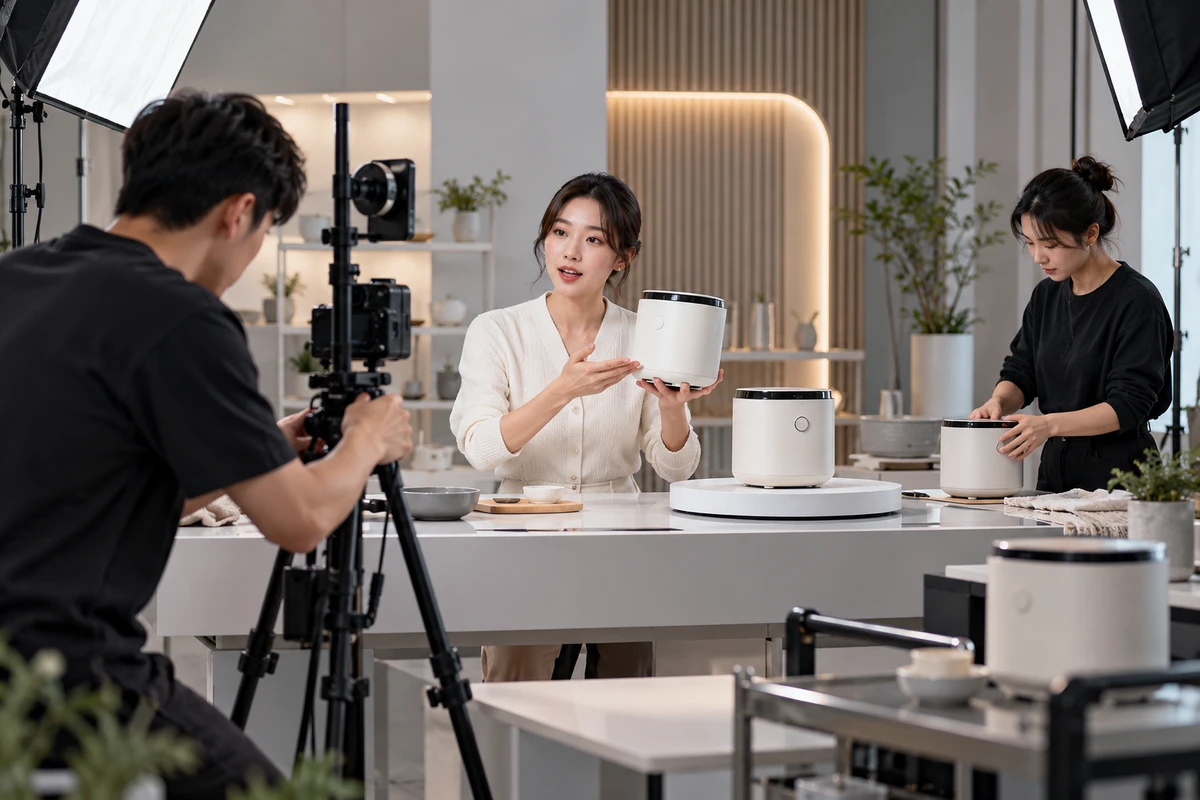
TikTok’s U.S. requirements say the LIVE background and staging should remain consistent with the item being sold. For a multi-SKU session, this creates real production work: product-change choreography, prop order, close-up coverage, inventory confirmation, and cues for the host. Every priority product needs a visible proof action rather than another spoken feature list.
The ONCE BRAKE framework
BRAKE is an ONCE procurement tool, not a TikTok method. It is designed to give every promotion a defined barrier, cost, and stopping condition—not to eliminate promotions.
B — Barrier: name the purchase friction
Choose one primary barrier for each priority product: unclear function, insufficient trust, selection confusion, installation concern, price resistance, shipping sensitivity, or lack of urgency. If the team cannot state the barrier in one sentence, it should not choose a coupon yet.
R — Real-time proof: design the demonstration
Turn proof into an action: weigh, assemble, clean, connect, compare materials, switch modes, or answer a viewer question. Specify the main shot, detail shot, backup sample, recovery plan if the demo fails, and claims the host must not make. Dynamic demonstration supports conversion while aligning with the platform’s emphasis on real-time interaction and multi-angle product information.
A — Action mechanic: use one hero mechanism
Match the mechanism to the barrier. Use price support when price is truly blocking purchase; use bundles when basket construction is the issue; use a limited-time action when delay is the problem; use a giveaway only when participation has a defined role. Supporting tools can exist, but they should not erase cost visibility.
K — Kill switch: set the margin guardrail first
Before going live, define minimum acceptable contribution margin, maximum seller-funded discount, affiliate commission range, media-spend ceiling, inventory and fulfillment capacity, and the conditions that stop an offer or rotate the product. The kill switch is a finance-and-operations rule, not the host’s mood.
E — Evidence ledger: preserve reusable learning
Log views, watch time, questions, clicks, adds to cart, orders, refunds, discounts, commissions, media, and fulfillment exceptions by product and time block. Link each interval to the relevant demonstration and promotion. The next session can then reuse a validated barrier–proof–mechanic relationship instead of copying total GMV.
Brand-hosted or creator-hosted?
Brand-hosted LIVE is stronger when products need technical explanation, stable scheduling, compliance control, and long-term knowledge accumulation. The brand controls the account, staging, samples, and data, but must fund host development, studio continuity, staffing, and traffic.
Creator-hosted LIVE is useful when the product needs existing audience trust, a credible use context, or rapid tests across niches. TikTok Shop Affiliate allows sellers to use open collaboration or target selected creators, with commission paid on sales. Performance-based commission does not make the program costless: samples, commission, rights, returns, claims, and reuse of the footage still require explicit terms.
A practical split is for the brand channel to own complex demonstrations and product education while creators supply audience context and discovery. Both sides should share the same product-truth base and margin guardrails without being forced into the same voice.
How to cost a LIVE scope
Start with contribution margin per session rather than comparing production cost per hour:
Session contribution margin = sales revenue − cost of goods − seller-funded discounts and gifts − creator commission − paid traffic − production and labor − platform-related charges − fulfillment and return cost.
Then measure the learning asset:
Cost per validated barrier–proof–mechanic combination = production and traffic cost ÷ combinations that retain positive contribution margin and can be reused in a later session.
This is neither an industry benchmark nor a revenue forecast. It prevents “hours streamed” from becoming a false unit of value. A serious scope should cover product sequence and strategy, host or creator, set and camera plan, proof actions, promotion configuration, control room, traffic, evidence ledger, source footage, and clip-reuse rights.
When LIVE is the wrong next step
A brand should not build a LIVE room merely because platform numbers are rising if the product has little demonstrable value, margin cannot carry promotion and commission, inventory and returns are unstable, suitable hosts are unavailable, or product claims and account access remain unresolved. Shoppable videos, a stronger product page, and small creator tests may reveal the actual barrier more efficiently.
LIVE becomes more defensible when a product benefits from explanation, comparison, real-time questions, or bundle visualization—and the brand can repeatedly supply hosts, samples, inventory, and measurement. ONCE’s TikTok Shop video production approach can connect LIVE proof actions, teaser videos, session clips, and follow-up ad variants in one capture plan.
Sources and scope
The time-sensitive facts in this article come from TikTok’s October 2026 U.S. holiday update, TikTok Shop Academy’s September 23, 2026 Brand LIVE Playbook, its September 17, 2026 quality requirements, and the U.S. TikTok Shop Affiliate page. These materials apply to the United States or the scope named by TikTok; features, campaigns, commissions, and content rules should be rechecked for each market. BRAKE and the cost model are ONCE analytical tools.