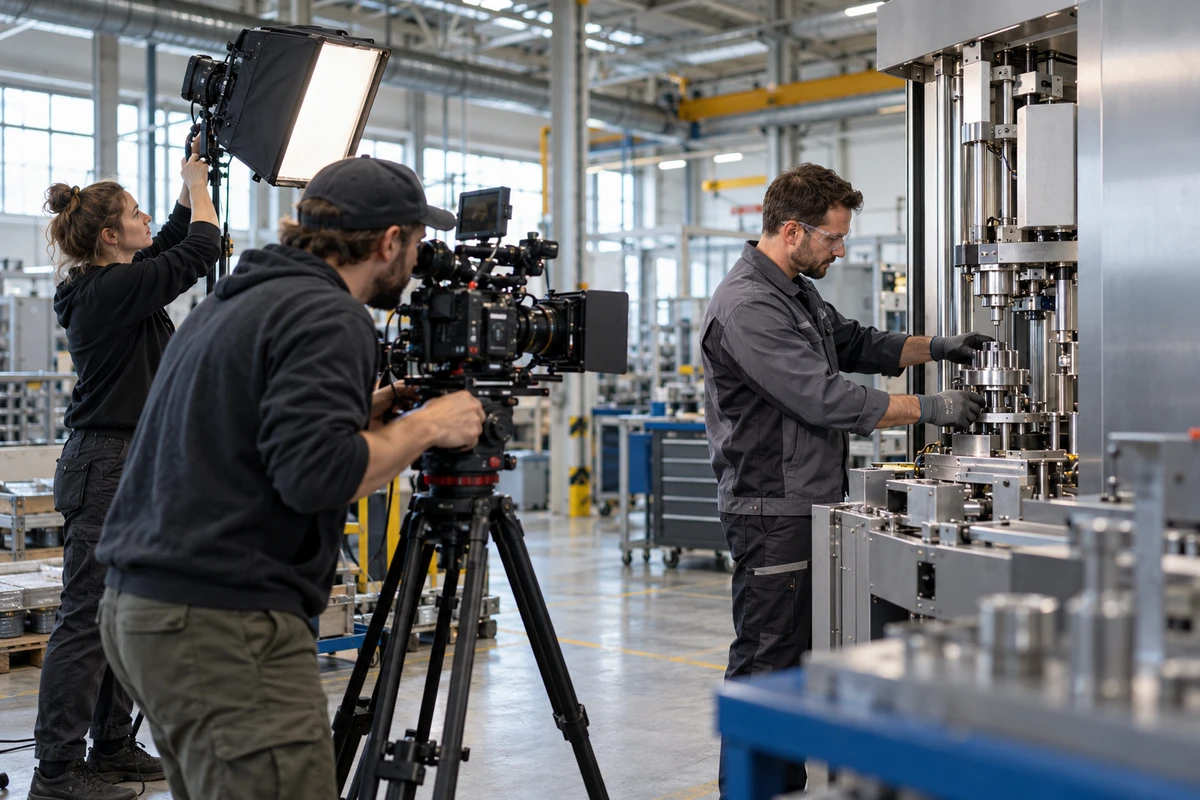
No. A corporate film is usually built to explain the company, team, product, R&D, manufacturing, and vision in one continuous story. A LinkedIn feed edit often assumes a nearby phone or laptop, readable captions, and an immediate click. Connected TV competes for attention on a larger screen, at a greater viewing distance, when the buyer may not be ready to complete a form.
On May 7, 2026, Amazon Ads and LinkedIn announced that U.S. advertisers could activate LinkedIn professional audiences for CTV through Amazon DSP. The deal-based buying option brings LinkedIn first-party signals—including job title, industry, and seniority—to streaming inventory through Microsoft Monetize.
That expands where B2B brands can reach decision-makers. It does not make one video sufficient for awareness, professional evaluation, and sales conversion. The production unit should change from “one master plus cutdowns” to a connected asset ladder from big-screen memory to technical proof and sales follow-through.
What the platforms confirmed—and what they did not
Confirmed: the Amazon DSP collaboration is described for advertisers in the United States. It lets media teams activate LinkedIn and Amazon audiences within an Amazon DSP workflow spanning CTV and other media, rather than fragmenting every buy.
Current delivery guidance: LinkedIn’s recently updated CTV specifications recommend 1920×1080, 16:9 MP4 and define requirements for bitrate, stereo audio, frame rate, codecs, and duration. LinkedIn also warns that meeting recommended requirements does not guarantee delivery across every publisher. Duration compatibility can vary by inventory and buying path.
Not confirmed: a product announcement does not prove that B2B CTV universally improves conversion, nor does it establish worldwide availability. Brands still need to verify account eligibility, market, inventory, duration, measurement, and the downstream path. Platform capability is evidence that a test is possible—not that its result is known.
Why neither a corporate film nor a feed crop is enough
The corporate-film problem: too much information, too late
A comprehensive film may begin with the founding story, campus, headcount, and management before reaching the buyer’s problem. A CTV ad has a narrower attention window. A polished sequence of aerials, reception desks, meetings, and handshakes can leave the professional viewer unsure why the company matters to their work.
The corporate film remains valuable for websites, trade shows, sales sharing, and due diligence. Its job is complete explanation. ONCE’s guide to a B2B brand film that travels without the sales pitch addresses that self-contained structure. CTV sits earlier in the journey: it must earn memory before the buyer requests completeness.
The feed-cutdown problem: small-screen behavior does not scale up
LinkedIn feed viewers can read dense captions, inspect a product UI, open comments, and click while the screen is close. Expanding the same composition to 16:9 does not make it television-ready. Small type, three-column specifications, long URLs, and interface details decay quickly at living-room distance.
Pure cinematic mood is not the answer either. A B2B viewer still needs to identify who the product serves, which operational problem it addresses, and why the claim is credible. CTV creative should not remove professional substance; it should express one piece of substance as an observable conflict, action, or result.
The ONCE BRIDGE framework: commission a cross-touchpoint asset ladder
BRIDGE does not force one edit to serve every channel. It gives each touchpoint a different job while keeping product truth, rights, and production assets connected.
B — Big-screen idea: preserve one memory
Decide what the viewer should remember after 15 or 30 seconds. It might be “this system reduces the disruption of a production-line changeover” or “remote teams can see the real status of every quality check.” Do not ask the audience to retain six features, three segments, and the company history at once.
The image should complete the idea, not merely decorate the voice-over. Industrial equipment can use one uninterrupted action, a before-and-after state, or a structural detail. Software and service brands need a human action and business consequence that can stand in for an invisible workflow.
R — Role relevance: show the job, not the job title
Professional audience signals can help media reach an industry, seniority, or role. Creative still has to make the viewer recognize their work. Do not solve relevance with a super that says “procurement director.” Show what that person must judge: whether delivery is traceable, equipment fits an existing line, or an exception has a clear owner.
The more exact the work situation, the less explanation the image needs. A familiar environment, action, and risk lets the right buyer decide, “This concerns me.”
I — Industrial proof: one legible proof per CTV ad
A large-screen ad should not become a wall of certifications, customer logos, and technical tables. Select one representative proof: motion stability, a product’s connection inside a real environment, an engineer validating a critical component, or one indispensable quality-control step.
Detailed specifications, credentials, cases, and implementation evidence belong in feed follow-ups, landing pages, sales enablement, or longer trade-show content. The evidence is not removed; it is sequenced by depth.
D — Delivery readiness: treat distribution specs as capture conditions
Confirm the buying path, publisher inventory, and live requirements before post-production. Composition, safe areas, viewing distance, television audio, duration, and non-click viewing should shape the shoot—not become an export problem at the end.
Use 15- and 30-second cuts as practical core narratives, then validate any additional duration against the actual inventory. Complete loudness, channel, codec, and frame-rate checks for the chosen platform. Brand and product relationships should also remain intelligible when a viewer misses part of the voice-over.
G — Guided next touch: decide what the next encounter must answer
After CTV creates memory, the next touchpoint should not replay the same argument. LinkedIn’s official CTV page describes options to combine its platform path with feed retargeting and measurement across forms, site visits, and social engagement. A campaign purchased through Amazon DSP must use the data, transaction, and measurement options actually available in that setup; teams should not assume the two buying paths are identical.
Whichever route is chosen, assign the content jobs in advance: CTV makes the problem and brand memorable; feed establishes role relevance; a landing page or case video qualifies the technical and commercial fit; sales material answers implementation, certification, and delivery questions.
E — Evaluation split: separate awareness from lead qualification
The CTV layer can be evaluated with reach, frequency, completion, audience delivery, or brand-lift methods. Downstream touchpoints can then track site behavior, content engagement, forms, and qualified leads. Do not give every conversion to the last click, and do not treat a high completion rate as proof of sales impact.
Production acceptance is more concrete: can the big-screen edit be understood at distance; is the proof real; does the next asset supply missing detail; and does each version retain source, rights, market, and measurement identifiers?
Budget the complete audience path, not the number of files
A B2B CTV package can be scoped in five cost layers:
- Shared truth: audience roles, product facts, approved claims, and market restrictions.
- CTV masters: the big-screen idea, 15/30-second structures, sound design, and broadcast-ready delivery.
- Proof modules: reusable R&D, manufacturing, product-action, customer-context, and interview footage.
- Next-touch variants: the durations and depths needed for feed, landing pages, trade shows, and sales sharing.
- Distribution QA and measurement IDs: specifications, rights, language, markets, versions, and result capture.
Cost per runnable audience path = (shared truth + CTV masters + proof modules + downstream variants + QA) ÷ audience paths that complete attention, proof, handoff, and measurement.
This is not an industry price and does not promise that CTV lowers acquisition cost. It replaces a weak procurement denominator—how many video files were exported—with a useful one: how many target roles have appropriate content from first exposure through technical and commercial qualification.
Who should test first—and who should wait
The strongest candidates generally have high contract value, a long sales cycle, several stakeholders, and a defined U.S. professional audience. Industrial equipment, enterprise software, robotics, energy, medical devices, and supply-chain services may need big-screen credibility and deeper follow-up proof in equal measure.
A brand should wait if its target market is outside the available buying scope, its account or budget cannot access the required route, its role-level problem is still vague, or its landing and sales follow-up are not ready. Adding an expensive touchpoint before fixing the website, product evidence, and sales content usually increases leakage rather than trust.
The final test is straightforward: after this CTV ad, what will the buyer see next, what will they verify, and who will continue the conversation? If the team cannot answer, it does not yet have a complete B2B content path.
For China-linked companies planning English corporate video, industrial product capture, and international sales assets, ONCE can organize CTV, LinkedIn feed, websites, trade shows, and sales sharing around one verified production base. Start with our B2B video production insights and build the capture list around the full buyer journey rather than one isolated master.