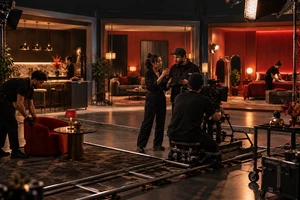
Imagine a product film that never says “carbon neutral.” It uses a forest aerial, a leaf icon, a green grade and the line “designed for a better planet.” That combination can still communicate an environmental claim.
Since 27 September 2026, EU Member States have been applying Directive (EU) 2024/825, commonly described as the Empowering Consumers for the Green Transition Directive. Its significance for video is practical: the review cannot stop at the script. Words, images, colours, sounds, symbols and the overall presentation can all influence what an average consumer understands.
For international brands sourcing or producing in China, the production question is no longer “can we make this feel sustainable?” It is “which exact object, metric and scope can the evidence support in this market?” This article offers a production and procurement method, not case-specific legal advice.
Start with the rule that is actually in force
The Directive was adopted on 28 February 2024. Member States had to transpose it by 27 March 2026 and apply those national measures from 27 September 2026. It amends existing EU consumer law and concerns business-to-consumer commercial practices connected with promoting, selling or supplying a product. Pure B2B communications sit outside that particular scope.
This is not the separate Green Claims Directive proposal. Treating the two as interchangeable creates the wrong status line in a brief. The operative production issue now is the consumer-law framework that addresses generic environmental claims, misleading overall presentation, certain offset-based product claims and future performance claims that lack the required commitments and verification.
The European Commission's September 2026 Q&A is useful implementation guidance, but it also states that it is not binding. The Court of Justice of the European Union has the final authority on interpretation, while national authorities and courts enforce the rules. A production checklist therefore supports—rather than replaces—market-specific legal review.
Pictures can make the claim before the voice-over does
An environmental claim may be textual, pictorial, graphic or symbolic. It can also be implied through a label, brand name or product name. The Commission's Q&A explains that an overall presentation can be misleading even when individual pieces of information are factually correct; layout, wording, colours, images, sounds, symbols and labels may all matter.
Leaves, water drops, wildlife, earth imagery and green badges are not automatically prohibited. Nor are they automatically neutral. Placed next to “cleaner,” “future-ready” or “better for the planet,” they may cause viewers to infer a broad benefit for a product, its packaging or the company behind it.
Before approving a storyboard, run three silent tests:
- With the voice-over removed, what environmental meaning does the sequence still imply?
- With the nature imagery removed, do the remaining product facts support the claim?
- Will viewers apply the claim to a component, the whole product, or the whole company?
The third question is where many otherwise careful films expand their meaning accidentally. A close-up of recycled packaging can be followed by a hero shot of the full appliance; the edit may turn a packaging fact into a product-wide impression.
The ONCE four-cell claim card
Before scripting, assign every environmental message a four-cell claim card. If a cell is empty, the message is not ready for production.
Object
What exactly is making or receiving the claim: the product, packaging, one component, one manufacturing process or corporate operations? “The packaging contains recycled plastic” is not the same message as “this is an environmentally friendly product.”
Metric
What observable change is being described: recycled content, energy source, material reduction, repairability or emissions per unit? “Greener” is not a metric.
Scope
Which facility, batch, SKU, market, period and lifecycle stage does the evidence cover? If evidence covers packaging production only, the film should not imply a full-lifecycle product advantage.
Proof
Who owns the source data, which method was used, when will it be refreshed, and who approved the wording? A certification, supplier declaration and internal calculation carry different evidential weight; the on-screen language should reflect that difference.
Specific wording is easier to govern. The Commission gives “100% of the energy used to produce this packaging comes from renewable sources” as an example that may be specific rather than generic. It still needs substantiation and relevant context. Specificity is not automatic compliance; it makes the proof obligation identifiable.
The same-medium rule changes the edit
For a written or oral generic claim, the relevant specification must be clear and prominent on the same medium. In video procurement, this means a link in the caption or on a landing page should not be treated as the only qualifier for an expansive claim made inside the film.
Use a frame-level acceptance test: when the claim is made, can the viewer see or hear its object, metric and scope? If the hero image shows the whole product while tiny legal copy limits the statement to the box, the image and qualification may still pull in different directions. If a six-second cut cannot carry the necessary qualification clearly, the right intervention may be to remove the claim from that cut—not shrink the type.
Classify sustainability shots by what they can prove
Evidence shots
These directly show the supported object: a replaceable part, refill mechanism, material mark, weighing process or the relevant production step. Even an evidence shot needs boundaries; one verified feature should not be edited into a lifecycle promise.
Context shots
Factories, transport, recycling and R&D footage explain a process, but seldom prove the final environmental outcome by themselves. Use them to answer “how,” not automatically “how much.”
Atmosphere shots
Forests, oceans and green light create emotion. When evidence is limited, keep them separate from environmental claims; when they are necessary, log the implication they could add to the sequence.
This is not a ranking of creative value. It is a hierarchy of responsibility. A film can be emotional, but its evidence shots and qualifications must constrain the meaning amplified by that emotion.
Buy claim units, not just seconds
Runtime is a weak predictor of the review burden. A more useful commercial model is:
Project cost = base production + claim units × evidence-translation complexity + market and language versions + verification and revision + archive and refresh.
A claim unit is one message that requires its own object, metric, scope and proof. Two 15-second films may have radically different governance costs: one contains a single approved packaging fact; the other combines materials, energy, emissions and a corporate ambition.
For procurement, specify these deliverables:
- a claim register covering voice-over, supers, icons and implication-bearing visuals;
- an evidence pack with sources, method, period, applicable SKUs and markets;
- an annotated storyboard classifying evidence, context and atmosphere shots;
- a version matrix for country, language, platform, duration and qualifier placement;
- a change log showing which masters, cut-downs and thumbnails require replacement when evidence changes.
This converts a one-off “green-looking” film into a claim asset that can be reviewed, localized and updated. It also complements a broader performance-claim production workflow: environmental messages need the same discipline, with an added review of visual implication.
Five reasons to pause the claim
Do not proceed with an environmental message when:
- there is only a corporate ambition, without a public, verifiable and time-bound plan;
- the evidence covers one supplier or process, while the creative describes the whole product;
- product, packaging and corporate operations are collapsed into one line;
- a label or certification does not match the SKU shown;
- the necessary qualification cannot be communicated clearly in the film itself.
Future environmental performance claims are not necessarily impossible. They require clear, objective, public and verifiable commitments, a realistic implementation plan, measurable time-bound targets, resource allocation and regular verification by an independent competent expert. If those foundations are absent, film the proven product fact—not the aspiration.
The production decision
The new rules do not ban visual ambition. They make “green feeling” part of the message that must be managed. The practical starting point is not an extra disclaimer added in post; it is a completed four-cell claim card approved by legal, sustainability, marketing and production before creative development.
Once the object, metric, scope and proof are locked, ONCE's cross-border product-video workflow can turn them into footage and versions that are specific, localizable and maintainable. If one cell remains empty, the most valuable production decision may be to leave that claim out.
Sources
- European Commission — Sustainable consumption, including the adoption, transposition and application dates for Directive (EU) 2024/825.
- European Commission — Questions and Answers on the Empowering Consumers for the Green Transition Directive, 22 September 2026.
- Directive (EU) 2024/825, 28 February 2024.