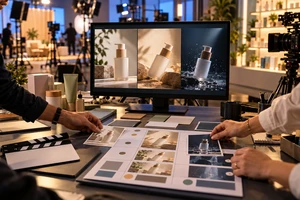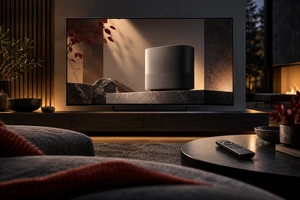
Mute an audio-product commercial. Can viewers still tell what it is selling? If the film is reduced to floating waveforms, glowing particles, and a slowly rotating speaker, the answer may be little more than “an expensive-looking device.” The actual value of sound—where it starts, how it enters a space, and what it enables people to do—has not become visible.
Two official campaign releases from September 2026 point in different directions. Sonos moved from individual-speaker specifications toward the whole-home system in “Love the Sound. Feel the System,” using hand-drawn configuration “dance cards,” rooms, and emotional photography. Two weeks later, Neumann's “Hear the Moment” placed professional-audio value inside the creative process, connecting inspiration, recording, production, monitoring, and playback as a chain of decisions.
One campaign lets sound change a home; the other lets sound support creative judgment. Their shared lesson is not a visual style. Both give sound a visible consequence.
Show Where the Sound Begins
Sound unfolds over time. If the picture has no clear starting point, every lighting change, body movement, and room transition can feel like a generic music video.
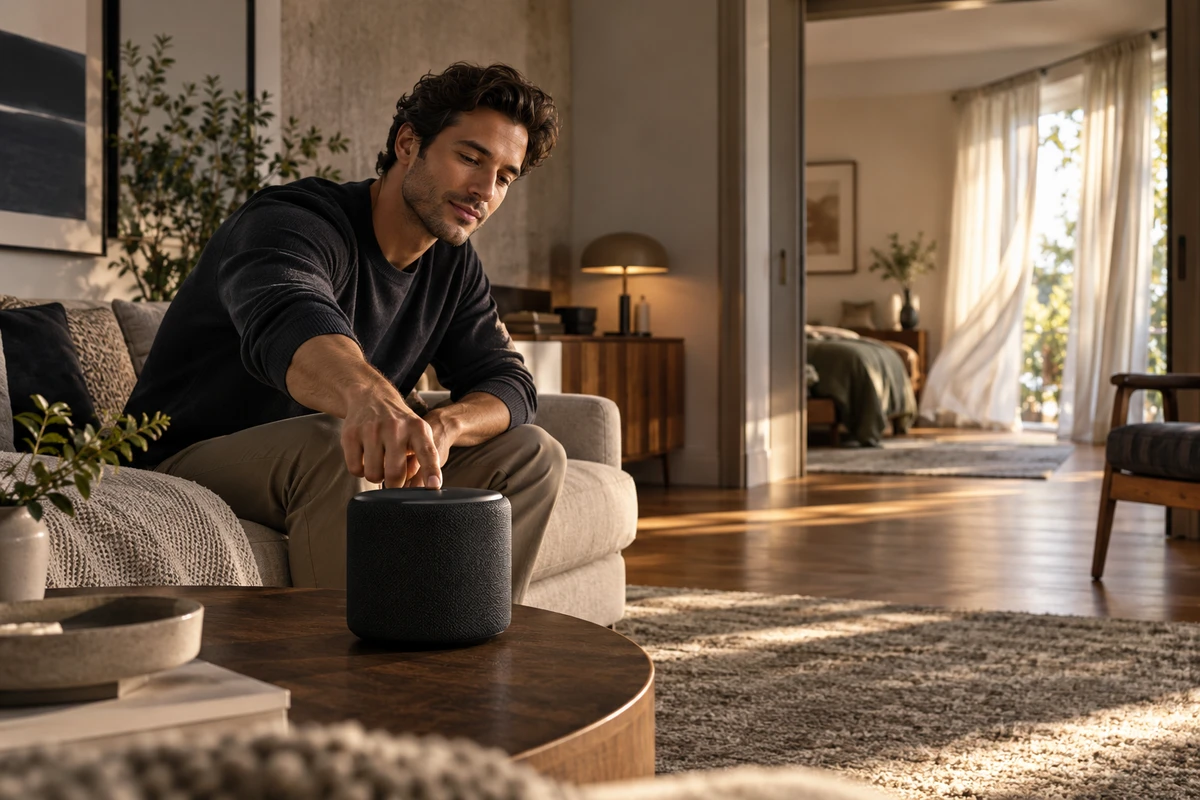
The trigger can be small: a finger taps play, a stylus touches vinyl, a fader moves, headphones go on, or another room joins the system. The point is not merely to show someone operating a product. It is to give viewers a causal anchor: after this action, the world changes.
Break the trigger into three visible moments:
- the state of the room and person before control;
- the instant of physical contact with the device;
- the first product response, such as an indicator, interface state, or a listener's brief pause.
The product facts still matter. Interfaces, light behavior, and linked-device actions should come from a real product or a confirmed demonstration build. The ease of generating a seamless whole-home connection with AI does not make that speed a real product capability.
Let Sound Travel Through Space
Many speaker commercials place a waveform around the product. That can say “sound is here,” but it rarely explains why sound matters to a person's life.
For a whole-home system, the picture needs a route. A rhythm begins in the kitchen, enters the hall, reaches someone in a bedroom, and changes an action in the living room. The camera can carry one direction through doorways, or match similar movements across rooms so each location feels like another phrase in the same sentence.
Professional monitoring needs a different route. It can move through decisions rather than rooms: a performer makes a sound, an engineer adjusts it, monitoring reveals a difference, and the creator keeps or rejects a choice. Neumann's official release positions reference quality across that creative chain instead of presenting microphones and monitors as an isolated product lineup.
This is the question to settle before production begins: does the product create value across a physical environment, or during a decision that needs to be made correctly? As with hand performance that reveals physical product response, the answer changes the locations, art direction, performance, and editing logic.
Direct a Specific Reaction, Not a Performance of Sound Quality
The easiest reaction to “great sound” is a closed-eye smile, spontaneous dancing, or bass that shakes a tabletop. Those gestures can fit almost any music commercial, and they may turn an emotional performance into an implied technical claim.
More credible reactions are usually more specific. Someone keeps cooking without losing the program as they move. A child runs between rooms while the experience remains continuous. An engineer stops at one detail and returns to the previous bar. Two people exchange a look because they heard the same change. The characters are not proving that the sound is “powerful.” They are using sound to complete something in life or creative work.
The environment can react, but restraint matters. Curtains, water, paper, and rhythmic light can suggest mood. If they appear to demonstrate sound pressure, bass extension, coverage, or transmission through walls, the image starts to imply a testable capability.
Use Audiovisual Correspondence as a Prompt, Not a Formula
Audiovisual research shows that people do build relationships between sound and shape, size, and position. A 2023 study found that listeners could reliably express rising or falling pitch and increasing or decreasing loudness as different straight or curved visual gestures. A 2024 study found that pitch-to-size and pitch-to-position correspondences depended more on meaningful, real-world scene cues than on abstract retinal position alone.
That suggests a useful creative principle. Low frequencies do not automatically need a darker picture, and high frequencies do not have to become bright particles. Real objects, distance, and motion can support the same perceptual idea more convincingly than a single color code.
Research does not prove that one visual treatment will make an advertisement more effective. A 2025 review of crossmodal art warns that effects found with simple stimuli do not automatically carry into complex films. Treat the sound-picture relationship as a hypothesis. Make short versions with aligned, opposed, and unrelated motion, then judge which relationship belongs to the brand.
Make the Cause Clear on Mute, Then Reward Sound-On Viewing
Amazon Ads' current video guide says its display video autoplays muted and recommends captions so important information is not lost. Audio-product teams are especially vulnerable to assuming that viewers will turn sound on, then placing the entire proposition inside the mix.
A stronger film works in two layers:
- on mute, the trigger, route, human response, and necessary captions already explain the cause;
- with sound on, source position, space, material detail, and rhythm enrich the experience;
- specifications, connection range, and performance claims remain attached to clear copy, test conditions, or product documentation rather than music and acting.
Run three review passes before locking the edit. Watch completely muted to test the story. Listen without looking to test whether the track has a beginning, structure, and landing. Then intentionally offset picture and sound to discover which synchronizations communicate product value and which are decoration.
Use CG and AI to Draw Hypotheses, Not Measurements
A public production case for Harman Kardon's Onyx Studio 9 used three-dimensional sound waves synchronized to a custom score. It shows how abstract graphics can be part of audiovisual design. The useful question is not whether a waveform can be drawn, but what job it performs.
CG and generative AI are well suited to exploring routes, transitions, colors, shapes, and emotional metaphors. They can compare ideas quickly in preproduction. If particle density, wall vibration, or depicted coverage starts to resemble an engineering diagram, it needs separation from verified product capability. Creative imagery can propose what an experience feels like; a product claim must state what happens and under which conditions.
A mature audio-product commercial therefore uses two honest systems. One makes the experience visible through space, people, and emotion. The other makes performance checkable through specifications, tests, and qualifications. They can support each other, but they cannot substitute for each other.
Start With One Sound-Route Rehearsal
This method does not require every commercial to become a family story or every professional-audio film to show a recording studio. It asks the creative team to answer three questions during scripting: Where does sound begin? What does it travel through? Who or what changes visibly at the end?
Sources reviewed for this article include the Sonos campaign release dated September 14, 2026, Neumann's September 28 release, Amazon Ads' video guidance, and audiovisual-correspondence research published from 2023 to 2025. Brand releases document the brands' stated creative choices, not independent effectiveness. Laboratory findings do not replace audience testing of a finished commercial.
If you are planning a speaker, headphone, or smart-home launch, ask the ONCE visual team to storyboard the trigger, spatial route, and human response as a silent sequence before assigning live action, CG, and AI their roles.